
What to Expect From Texas Instruments’ Q3 2026 Earnings Report
Texas Instruments Incorporated (TXN) has become one of those semiconductor names that touches far more parts of the economy than its name might suggest. Based in Dallas, the company makes analog and embedded processing chips that help power automobiles, industrial machinery, consumer electronics, and a range of other products.
With a market capitalization of nearly $257.3 billion, Texas Instruments combines a broad customer base with significant manufacturing scale, giving it exposure to multiple end markets rather than relying on a single source of demand. Its global reach and extensive chip portfolio have helped make it one of the biggest players in the analog semiconductor space.
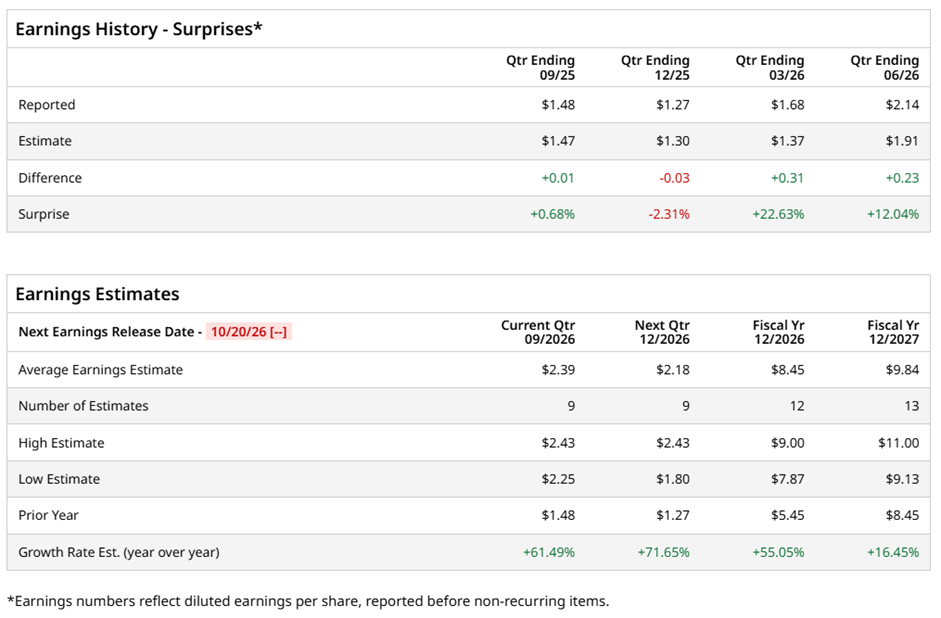
That scale will be put to the test when Texas Instruments reports its fiscal Q3 2026 results soon. Wall Street expects diluted EPS of $2.39, which would represent a hefty 61.5% jump from $1.48 a year earlier. The company has topped consensus estimates in three of its past four quarters, although it did miss expectations once during that period.
Looking at the full year, analysts are forecasting EPS of $8.45 for fiscal 2026, up 55.1% from $5.45 in fiscal 2025. Expectations remain positive beyond that, with fiscal 2027 EPS projected to reach $9.84, representing another 16.5% year-over-year increase.
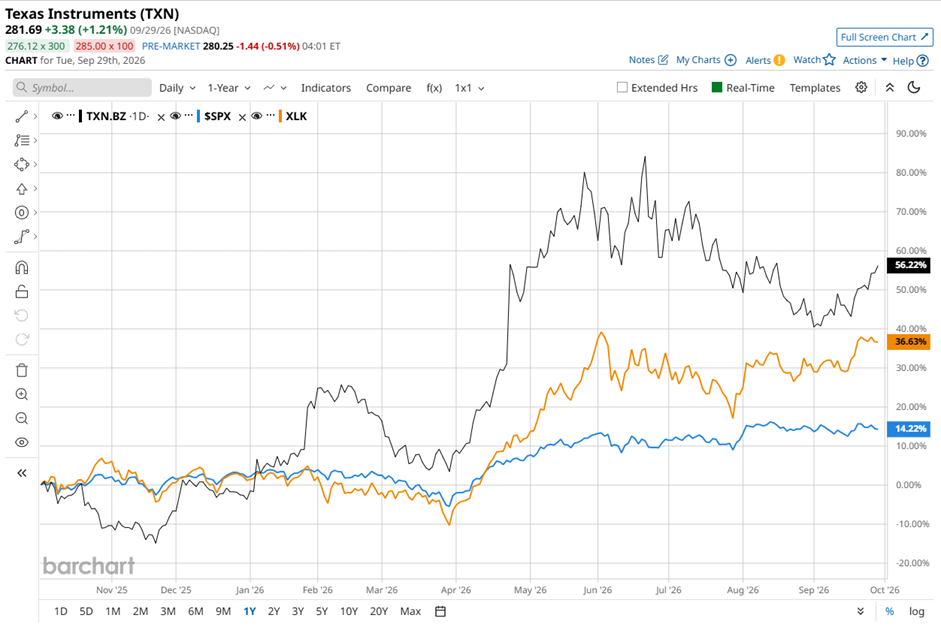
TXN stock rose 53.7% over the past 52 weeks, outperforming the S&P 500 Index’s ($SPX) 15.2% gains. Plus, it has also surged past the State Street Technology Select Sector SPDR ETF’s (XLK) 38.8% gains over the same time frame.
The chipmaker has a strong foothold in analog and embedded processing semiconductors, which are essential across everything from cars and factory automation to consumer electronics and communications. Now, the AI buildout is adding another opportunity. As data centers expand, demand for efficient power management is growing, giving TXN another potential source of long-term growth.
At the same time, the company is getting a lift from a cyclical recovery in analog chip demand, particularly across its industrial and automotive businesses. Several stronger-than-expected financial results have added to investor confidence that the semiconductor downturn is gradually giving way to healthier revenue and earnings growth.
There is also a shareholder-return angle supporting the stock. Texas Instruments has paid dividends for more than 30 years and has raised its payout for 20 consecutive years. Its forward dividend yield of 2.16% is considerably higher than the 1.23% yield on the State Street SPDR S&P 500 ETF Trust (SPY) and the 0.22% yield on the iShares Semiconductor ETF (SOXX). So, TXN is getting support from several directions at once – recovering chip demand, AI-related opportunities, and a dividend that gives income-focused investors another reason to stick around.
Analyst sentiment toward TXN is overall positive, although the Street is far from unanimous. Among 33 analysts covering the stock, the consensus rating is “Moderate Buy.” That’s based on 18 “Strong Buy” ratings, 12 “Holds,” one “Moderate Sell,” and two “Strong Sell” ratings. TXN’s mean price target of $325.03 suggests that the stock has 15.4% upside potential.
On the date of publication, Sristi Suman Jayaswal did not have (either directly or indirectly) positions in any of the securities mentioned in this article. All information and data in this article is solely for informational purposes. For more information please view the Barchart Disclosure Policy here.