
How Investors May Respond To Beam Therapeutics (BEAM) Trade Secrets Lawsuit
- Beam Therapeutics reported that it has filed a lawsuit against former scientist Zi Jun “Emma” Wang, YolTech Therapeutics, and Serapha Bio, alleging theft of trade secrets and misuse of confidential research to develop competing rare disease treatments and file related patents.
- The dispute highlights how Beam Therapeutics’ core know how in gene editing is tied directly to its competitive edge, legal costs, and future partnering leverage, especially as it works to advance programs like BEAM-101 and BEAM-302 in a crowded biotechnology field.
- This development could influence how investors view the role of intellectual property, competitive positioning, and legal risk in Beam Therapeutics’ overall story.
Scan how Beam Therapeutics fits into the broader biotech IP story by comparing it with 32 resilient stocks with low risk scores that may be less exposed to legal and competitive shocks.
Beam Therapeutics Investment Narrative Recap
To own Beam Therapeutics, you need to believe base editing can translate into approved treatments in hematology and liver disease, and that programs like BEAM-101 and BEAM-302 justify heavy, loss-making R&D today. The lawsuit centers on intellectual property rather than core clinical execution, so the near term scientific catalysts around BEACON and liver programs look largely intact in the short run.
The bigger swing factor right now is whether Beam can keep advancing trials safely while funding an expanding pipeline despite ongoing losses and no profitability expected over the next three years. Legal costs and distraction from the IP case could add friction, but the primary operational risk still sits with trial safety, timelines, and future financing.
The lawsuit itself is the key recent development, because it directly touches the IP foundation behind Beam Therapeutics’ future products. If the company protects its trade secrets successfully, the perceived moat around its base editing toolkit and rare disease programs could remain tied tightly to its own pipeline rather than potential rivals.
For catalysts, you are still watching clinical updates from BEAM-101, BEAM-302 and the ESCAPE platform, since those data points influence how much value the disputed gene editing know how might support. The legal dispute simply adds another execution task on top of clinical progress, competition from other gene editing players, and the need to secure ongoing funding while the business remains loss making.
Beam Therapeutics' current earnings are a loss of US$66.0 million, with a consensus view that earnings could reach US$39.3 million by 2029, implying an earnings increase of about US$105 million. Analysts are assuming revenue will grow 8.1% annually, which would support forecast revenue of US$207.3 million and earnings of US$39.3 million by 2029 if those projections play out.
Uncover why Beam Therapeutics' fair value indicates a 108% potential upside to its current price that could close sooner than you expect.
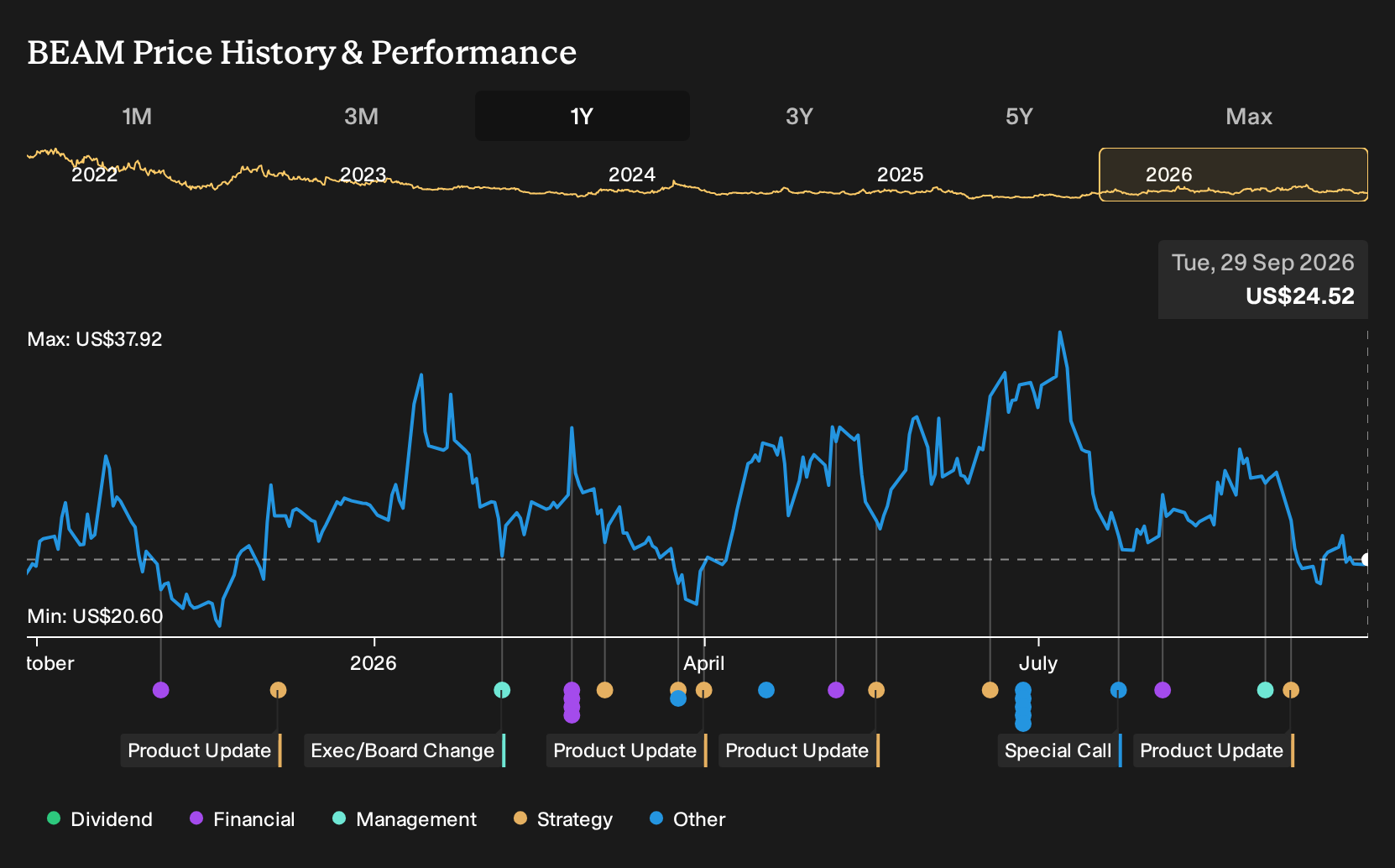
Exploring Other Perspectives
You have another angle to consider. The most optimistic analysts were already leaning hard into Beam Therapeutics’ PKU and liver editing plans, baking in revenue of about US$271.1 million and earnings of US$28.6 million by 2029. Those projections came before this IP lawsuit, so their upbeat story could shift as the legal process unfolds.
Explore 5 other Beam Therapeutics fair value estimates, including one that suggests as much as 512% upside from the current price.
Reach Your Own Conclusion
Don't just follow the ticker; dig into the data and build a conviction that's truly your own.
- A great starting point for your Beam Therapeutics research is our analysis highlighting 2 key rewards and 2 important warning signs that could impact your investment decision.
- See our latest analysis for Beam Therapeutics. The report includes a comprehensive fundamental analysis summarized in a single visual, the Snowflake, making it easy to evaluate Beam Therapeutics' overall financial health at a glance.
Looking For More Investment Ideas Beyond Beam Therapeutics?
If this Beam Therapeutics story has you thinking about risk, reward, and intellectual property, it can help to line it up against other opportunities using the Simply Wall St Screener. That way you can compare different businesses side by side and decide where Beam really fits in your portfolio.
- If capital protection matters most to you, start with a basket of companies that our models flag as relatively resilient by screening for 32 resilient stocks with low risk scores.
- If you prefer to focus on financial strength and balance sheet quality, filter for businesses with robust assets and manageable obligations using the list of solid balance sheet and fundamentals (25 results).
- If you want to cast a wider net across lesser-known opportunities with strong fundamentals, scan through the 17 high quality undiscovered gems and see which stories deserve a closer look.
This article by Simply Wall St is general in nature. We provide commentary based on historical data and analyst forecasts only using an unbiased methodology and our articles are not intended to be financial advice. It does not constitute a recommendation to buy or sell any stock, and does not take account of your objectives, or your financial situation. We aim to bring you long-term focused analysis driven by fundamental data. Note that our analysis may not factor in the latest price-sensitive company announcements or qualitative material. Simply Wall St has no position in any stocks mentioned.
Have feedback on this article? Concerned about the content? Get in touch with us directly. Alternatively, email editorial-team@simplywallst.com