
General elections, inflation, and debt issuance hit the risk premium on French debt and rose above 120 basis points
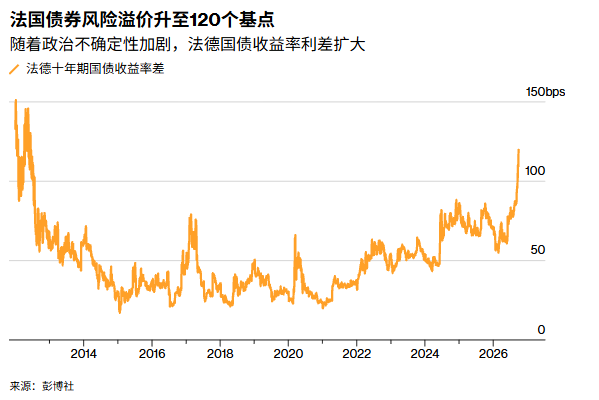
The Zhitong Finance App learned that indicators for measuring the risk of French bonds have reached a new milestone as investors prepare for possible political turmoil next year and the possibility that the populist government may ease fiscal restrictions. The additional yield on French 10-year treasury bonds and the relatively safer German treasury bonds rose above 120 basis points for the first time since 2012. The spread has risen sharply in recent weeks, and the latest round of upward movement occurred after French inflation data exceeded expectations.
French debt shines red: the difference against Deli broke through 120 basis points
Marie Jacott, CEO of Edmond Rohill Asset Management France, said this level was a “wake-up call for the bond market.”
Investors are nervous about next year's French presidential election because there are only seven months left until the vote, and the opposition is still unwilling to compromise with the outgoing Macron administration. According to a voting intent survey released this week, far-right candidate Marina Le Pen and far-left candidate Jean-Luc Mélenchon are expected to advance to the second round.
“As the poll approval ratings for Melanchon and Le Pen rise in the second round of voting in the presidential election, the political risks implicit in interest spreads are further intensifying,” said Théophile Legrand, an interest rate strategist at the French Foreign Trade Bank.
French bonds did not perform well on Wednesday. According to the latest inflation data, prices in France accelerated to the fastest rate in more than two years in September, putting more pressure on ECB policymakers. Traders are betting that the ECB will raise interest rates for the third time before the end of the year, and possibly up to three more next year.
Macro strategist Skyler Montgomery Corning said, “Supply-driven price pressures are squeezing real income and economic growth while driving up interest rates and borrowing costs. This combination makes it more difficult to stabilize an already difficult debt trajectory.”
France's fiscal risks also continue to receive attention. The French debt management agency announced on Tuesday evening that it plans to issue medium- and long-term bonds totaling 340 billion euros (386 billion US dollars) next year (after deducting repurchases), a record high. The French government will announce the 2027 budget on Thursday.
Due to a sharp slowdown in economic growth and a divided parliament resisting austerity measures, it has been difficult for France to reverse the situation where public finances are out of control. The fiscal deficit is expected to soar to around 5.4% of economic output in 2026, rather than narrow slightly from 5.1% in 2025, as the government initially targeted.
Political and financial concerns are heating up, and France may become Europe's “weakest link”
Political and financial turmoil has led to poor performance of French bonds in the recent wave of global sell-offs. The spread between French and German bonds has almost doubled in the past four months, and 120 basis points are viewed as a key psychological threshold. Long-term borrowing costs in France also rose to their highest level since 2002.
The transaction price of French treasury bonds is also 22 basis points higher than Italian 10-year treasury bonds, the highest level since the establishment of the Eurozone. This marks a sharp reversal of the situation in the Italian treasury bond market. In 2018, the populist coalition government clashed with the European Commission over spending rules, and Italy was violently sold off by investors.
“We are still choosing to sell French treasury bonds and buy German treasury bonds because the situation will worsen before it improves.” Kevin Tozet, a member of the Carmignac Investment Committee, said, “France is being identified as the weakest link in Europe.”