
The UK's GDP improved in the second quarter, and the G7 had the highest growth rate in the first half of the year: a “before interest rate hike” report card was delivered just in time for the budget
The Zhitong Finance App learned that revised data released by the UK Office for National Statistics (ONS) on Wednesday showed that the UK's GDP grew 0.5% month-on-month in the second quarter, higher than the initial 0.4%; when combined with the 0.6% growth rate in the first quarter, the overall performance of the UK economy in the first half of the year was significantly better than previously estimated — according to ONS's caliber, the UK is the fastest-growing Group of Seven (G7) economy in the first half of 2026. Liz McKeown (Liz McKeown), director of economic statistics at ONS, said: “The service sector grew more strongly in the latest quarter, which means that the size of the UK economy is slightly higher than previously estimated.”
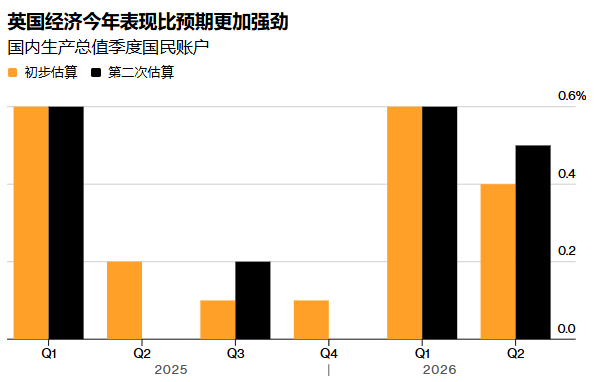
A lot of improvements, few downgrades
This revision was almost entirely beneficial: the month-on-month growth rate of the service sector was revised from 0.5% to 0.6%, with professional, scientific and technological activities surging 2.3% and information and communication growing 2.5%; the GDP for the second quarter was 2.0% higher than the fourth quarter of 2024, slightly higher than the initial estimate. There are only two downgrades — the production sector, which was dragged down by the June heatwave suspension, was downgraded to -0.1% month-on-month, and the full-year growth rate of 2025 was slightly lowered from 1.3% to 1.2%.
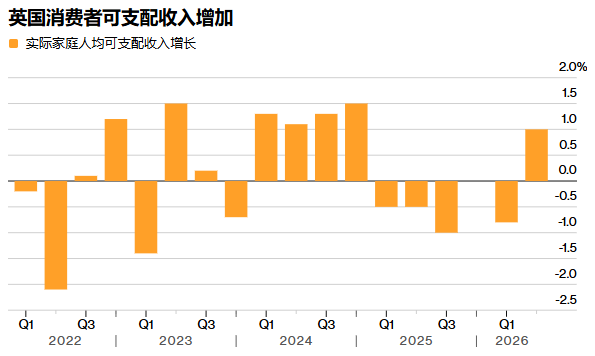
The signal from the residents' side is more important than the total amount: real household disposable income per capita rebounded 1.0% month-on-month, a rebound after a 0.8% decline in the first quarter, and the biggest increase since the end of 2024; the household savings rate rose to 8.8%. Consumption hasn't stalled; it's just becoming cautious. External accounts also improved: the current account deficit of £19.9 billion, better than the forecast of $24.7 billion, narrowed to 1.4% of output after excluding precious metals trade, the smallest in five years. The British pound continued to rise after the data was released, and it once rose to 1.3277 during the European session.
But this is a report card “before the rate hike”
The problem is the chronology. The corresponding increase in this revised data occurred before energy prices and borrowing costs rose sharply — the UK CPI had risen to 3.1% in August, mainly driven by gasoline and diesel prices; the Bank of England remained on hold for the sixth consecutive meeting at 6:3 on September 17 (maintaining 3.75%), but its stance clearly changed: the central bank expected inflation to reach 3.75% by the end of 2026, slightly above 4% in the first quarter of 2027, equivalent to double the target level; the minutes of the meeting emphasized that the indirect impact of the energy shock was more likely to be “delayed rather than” Weakened”. Governor Bailey's original statement was: the longer energy fluctuations continue, “the more likely we are to need to raise central bank interest rates.” Most institutions expect interest rate hikes in November or December.
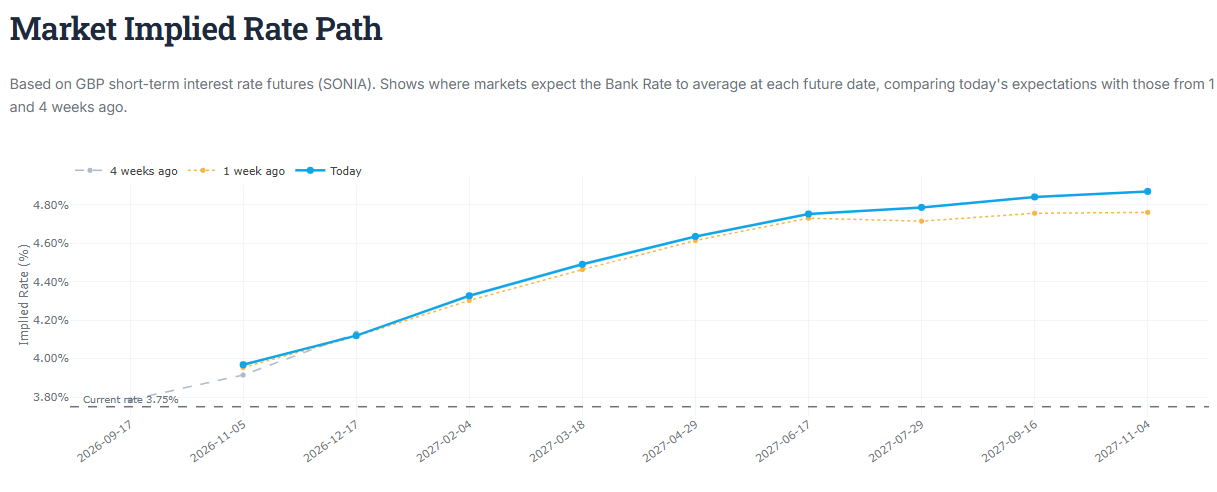
In other words, the UK is in a delicate mix: growth data provides arguments for “affordability of interest rate hikes,” and inflation data provides reasons for “having to raise interest rates.” XTB analyst Kathleen Brooks warned of the other side — since inflation is being driven up by global oil prices that central banks cannot control, the interest rate hike itself “may be meaningless.”
The real exam is on October 28th
For the market, the report card's greater effect was to raise the baseline before the October 28 budget. Prime Minister Andy Burnham (Andy Burnham) announced adjustments to the “triple lock” of pensions and promised to lower household energy bills at the Labor Party's annual meeting this week. Finance Minister John Healey (John Healey) reiterated that he would stick to fiscal rules — temporary purchases in the Phnom Penh bond market, and the 10-year yield fell 6 basis points to 5.35% on September 30; however, just last week it pushed the 30-year yield to a new high of 5.95% since 1998, and the Bank of England also had to adjust the downsizing plan and abandon the sale of long-term treasury bonds. David Rees, head of global economics at Schroder, made a clear judgment: the current economy does not urgently need to raise interest rates; the greater risk lies in fiscal policy — if the budget increases spending drastically, it may reignite inflation and raise interest rates early.
The “base” of the UK economy is thicker than expected, but this has reduced the necessary space for fiscal expansion — the better the data, the less room for maneuver in the October 28 budget, and the lower the November interest rate threshold.