
Xuyang Group (01907) restarted the buyback, strengthened shareholder returns at an inflection point, and sent a positive signal
The industry adjustment period is the stage that tests the shareholders' willingness and ability of listed companies to return. Zhitong Finance notes that despite being disrupted by irrational market sentiment, the stock price performance of China's Xuyang Group (01907) is still under pressure at this stage, but the world's leading energy and chemical company insists on using the “repurchase+dividend” combination to strengthen shareholder returns and use real money to give back to investors.
Recently, Xuyang Group has restarted large-scale share repurchase operations. On September 24, Xuyang Group spent HK$3.208,500 to repurchase 2 million shares, with an average repurchase price of HK$1.604; on the 25th, the company repurchased 1 million shares at a cost of HK$1,589 million; on the 28th and 29th, Xuyang continued to buy back 31.9 and 500,000 shares, respectively. Looking at the long-term axis, this is another repurchase by Xuyang Group after a lapse of nearly two months after late July, and the single-day repurchase intensity increased significantly compared to the July period.
Judging from the rules of repurchase, Xuyang Group's share repurchase activities have distinct characteristics of continuity and phased nature. From June 18 to July 27 this year, the company used a total of over HK$55 million to repurchase 26.438 million shares; since then, the company has taken the initiative to slow down the pace until September 24, when it began increasing again. Judging from past rules, once the repurchase window is opened, Xuyang Group will usually operate continuously and at a high frequency for the next period of time, so it is expected that in the upcoming fourth quarter, the company is expected to continue this repurchase rhythm.
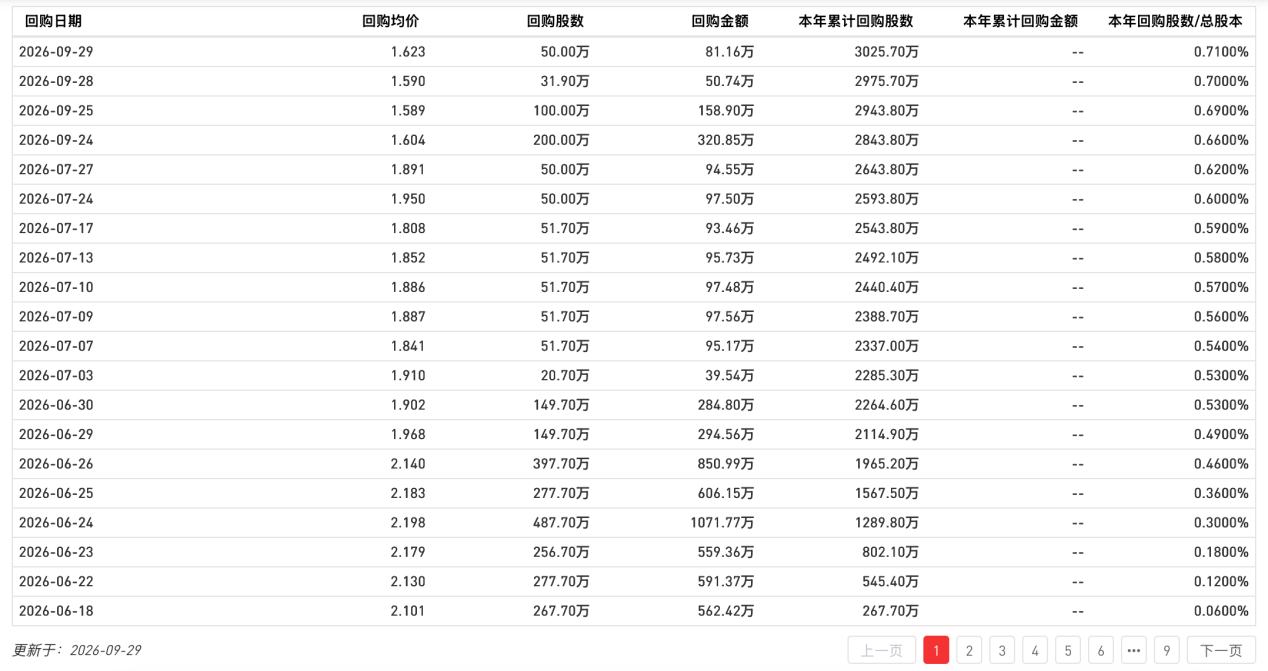
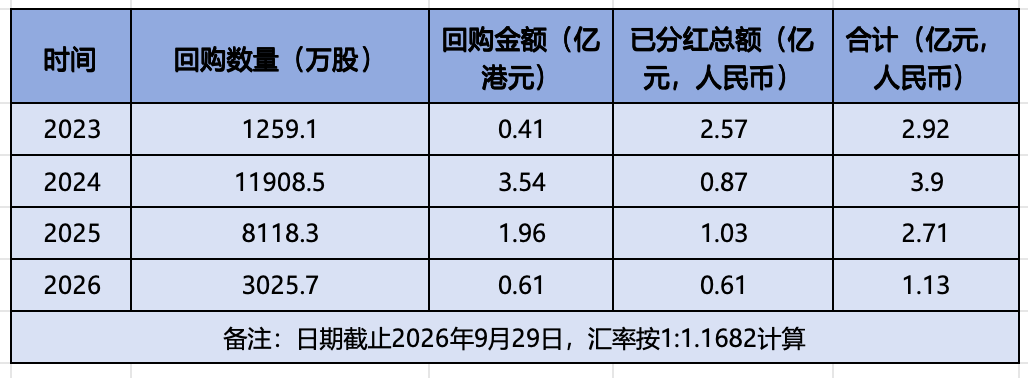
Looking back at historical data, in fact, Xuyang Group has always attached importance to shareholder returns, and repurchases are one of its normalized mechanisms. According to the data, the company's repurchase amount was about HK$41 million in 2023, increased sharply to HK$354 million in 2024, and continued to maintain a repurchase strength of HK$196 million in 2025. Entering 2026, as of the close of trading on September 29, the company had repurchased a total of 30.257 million shares during the year, accounting for about 0.71% of the issued share capital, and a cost of about HK$61 million. If the repurchase amount is added on subsequent trading days, the repurchase scale for the full year of 2026 is expected to move closer to the historical high level.
However, if we look at repurchases and dividends together, Xuyang Group places more importance on shareholder returns. Xuyang Group declared a dividend of 1.44 points per share in mid-2026, with a total dividend payout of 61.231,000 yuan. The dividend payout strength was significantly higher than 0.20 points in the same period last year. At the bottom of the industry cycle, Xuyang Group did not choose to keep cash, but instead insisted on continuing to give back to shareholders with real money. This decision itself conveyed the management's full confidence in the company's cash flow situation and future profitability.
Looking back at the fundamentals of the Xuyang Group, the 2026 interim results previously disclosed by the company show that its industrial layout has initially formed a situation where the three pillar industries of chemicals, coke and new energy go hand in hand. At this stage, Xuyang's financial indicators are undergoing comprehensive restoration, and at the same time, growth potential is being unleashed at an accelerated pace. Looking ahead to the future market, the anti-cyclical development capabilities built by the collaborative development of the three major industries of chemicals, coke and new energy will inevitably continue to expand the visibility and sustainability of Xuyang Group's growth. A number of financial indicators were repaired month-on-month, and signs of inflection points in performance increased. At the same time, shareholder returns continued to increase. Also, considering that Xuyang Group's current valuation is still at a historically low level, the company's investment value urgently needs to be re-examined by the market.