
The SEC issued a “no-objection framework letter”: retail investors were authorized once and followed the board vote by default, and Tesla (TSLA.US) was the first to get the template
The Zhitong Finance App learned that the US Securities and Exchange Commission (SEC) Finance Department said on Tuesday that if Tesla (TSLA.US) runs a voluntary program as described and allows retail shareholders to give “standing instructions” — voting as recommended by Tesla's board of directors unless otherwise specified by themselves — the department will not recommend enforcement action. This unobjection letter isn't just about Tesla: it's written in the form of a “framework,” and the SEC clearly stated in the letter that “this position applies to any issuer that operates the program in the same way.” In other words, Tesla got the template, and other companies could copy it.
The letter was submitted by Tesla General Counsel Brandon Ehrhart (Brandon Ehrhart) and Sullivan & Cromwell (Sullivan & Cromwell) on September 29, and the SEC M&A Office approved it on the same day; a footnote to the letter explains the speed of “ask the same day, approve the same day” — the two parties had previously been communicating about this for several months. The letter was issued by Tiffany Posil (Tiffany Posil), director of the Mergers and Acquisitions Office of the Company's Finance Department.
SEC officials stated in their letter that if the plan operates strictly as such, it will not recommend enforcement of rules 14a-3 (a), 14a-4 (d) (2), 14a-4 (d) (3), 14a-4 (f), 14a-6 (o), 14a-10, and 14a-12 (a) under the Securities Exchange Act — these are the core provisions limiting “early solicitation of votes.” Tesla previously asked exactly two questions: whether a permanent, reusable voting option would break these rules; and how long a voting authorization can last. The answers are not against the law, and can be effective for a long time.
According to the statement quoted in the letter: retail investors who join the program will still receive all power of attorney materials; they can reverse the standing order for any individual bill free of charge; they can withdraw at any time for free; they will be reminded at least once a year to inform them that they have joined, selected the order, and how to withdraw; the issuer must fully disclose the plan on the official website and power of attorney statement. Registration will take effect from the next shareholders' meeting where the power of attorney materials have not been submitted. Shareholders can follow the board of directors on every bill, and can also exclude disputed director elections, as well as any acquisition, merger, or divestiture requiring shareholder voting under state law or exchange rules. Tesla also collaborated with a shareholder communication service provider to design a “hub” (hub) entrance operated by a brokerage firm. Investors can sign up for all participating companies' similar programs at once — as Tnev's statement on X confirms, Robinhood (HOOD.US) is one of the partners.
Why Tesla?
The reason given by Tesla in the application letter is straightforward: most minority shareholders never vote. The letter quoted Broadridge's data, showing that retail investors only voted for 28% of their shareholding in the 2025 voting season, compared to 76.6%; according to Broadridge's “2025 ProxyPulse Report” quoted by conservative research firm 1792 Exchange, this retail participation rate is still the lowest point in 9 years. Tesla also revealed that the proxy collection fee for the past two annual shareholders' meetings alone was over $2 million.
At Tesla, retail tickets have indeed decided the outcome time and time again. At the annual shareholders' meeting on November 6, 2025, ISS and Glass Lewis both recommended that institutional shareholders oppose Musk's new compensation plan, which was still approved with the support of retail investors. A more subtle example at the same meeting was the xAI proposal: According to voting data compiled by electric vehicle industry media Electrek, the board of directors made no suggestions. In the end, about 1.06 billion shares were in favor, 916 million shares opposed, and more than 473 million shares abstained — Tesla counted the abstentions as a negative vote, and the proposal was not passed; Tesla then invested 2 billion dollars in xAI in January of this year, and a few weeks later SpaceX ( SPCX.US) acquired xAI, and the investment became SpaceX stock. It is worth pointing out that the new no-objection letter does not explain how the standing order will be handled when the board chooses not to take a stand, as is the case with the xAI proposal.
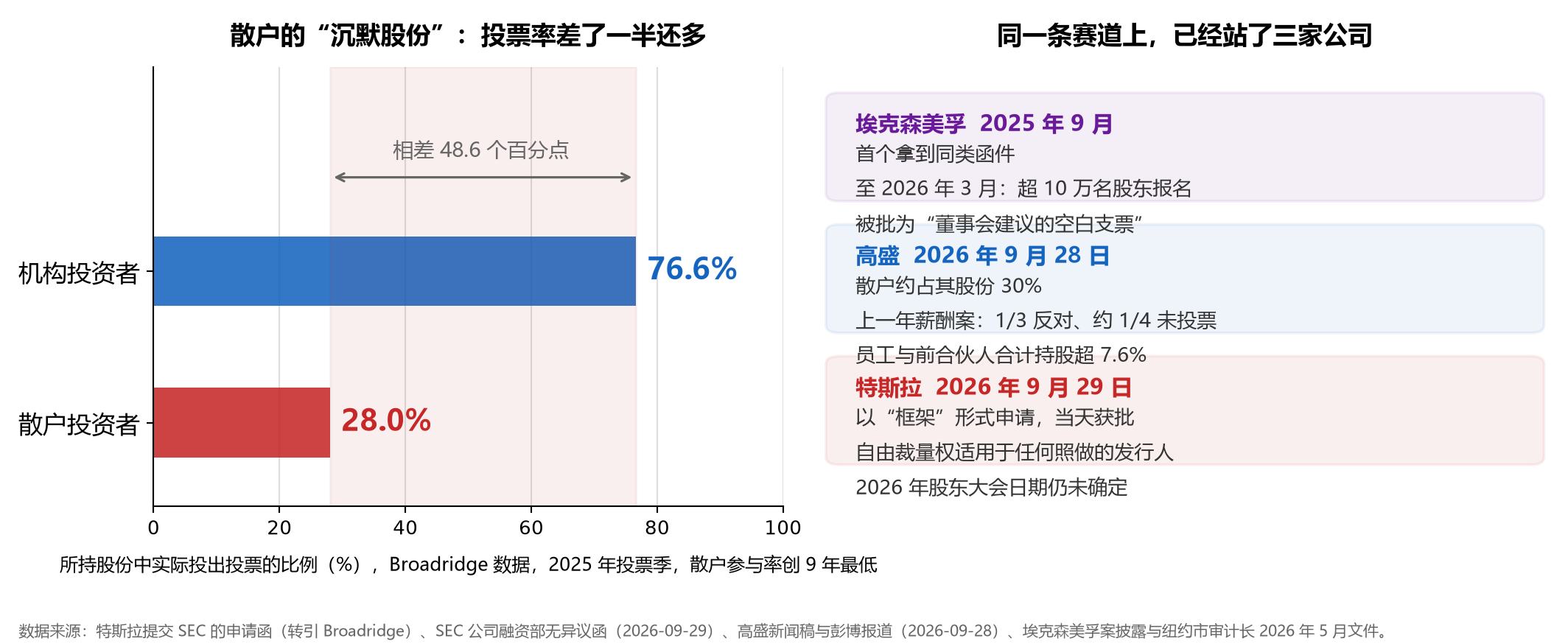
The timing is also hard to ignore. There is no fixed date for Tesla's 2026 annual shareholders' meeting — Tesla's 10-K amendment submitted on April 30 states that the board of directors “has not yet determined the date of the 2026 Annual General Meeting”. More than five months have passed, and there is still no proxy material on EDGAR. Tesla was re-registered in Texas in 2024. According to Texas law, shareholders can appeal to the court to force a shareholders' meeting for more than 13 months — in the case of Tesla, this point was in early December.
Meanwhile, Musk has continued to hint at a merger between Tesla and SpaceX for several months: during the July second-quarter earnings call, he said the two companies “overlap more and more”; according to reports, Tesla is also considering selling the Chinese business to pave the way for the deal. If the merger requires a shareholder vote, and quite a few retail investors already follow the board of directors by default, the voting structure of this deal is easy to imagine. Of course, retail investors can also choose the second range, excluding M&A matters from automatic voting — leaving this exit on the menu.
Symbolism: Tesla is not the first, nor will it be the last
The real beginning of this system was a year ago. In September 2025, ExxonMobil received the first similar letter from the SEC, becoming the first US listed company to introduce a “permanent voting order” for retail investors; according to Tesla's application, by March 2026, more than 100,000 shareholders of Exxon had signed up. But opposition ensued: New York City Auditor Mark Levine (Mark Levine) called Exxon's plan “a 'blank check' recommended to the board of directors” in a May 2026 document, arguing that shareholders should have the option of not implying support for management.
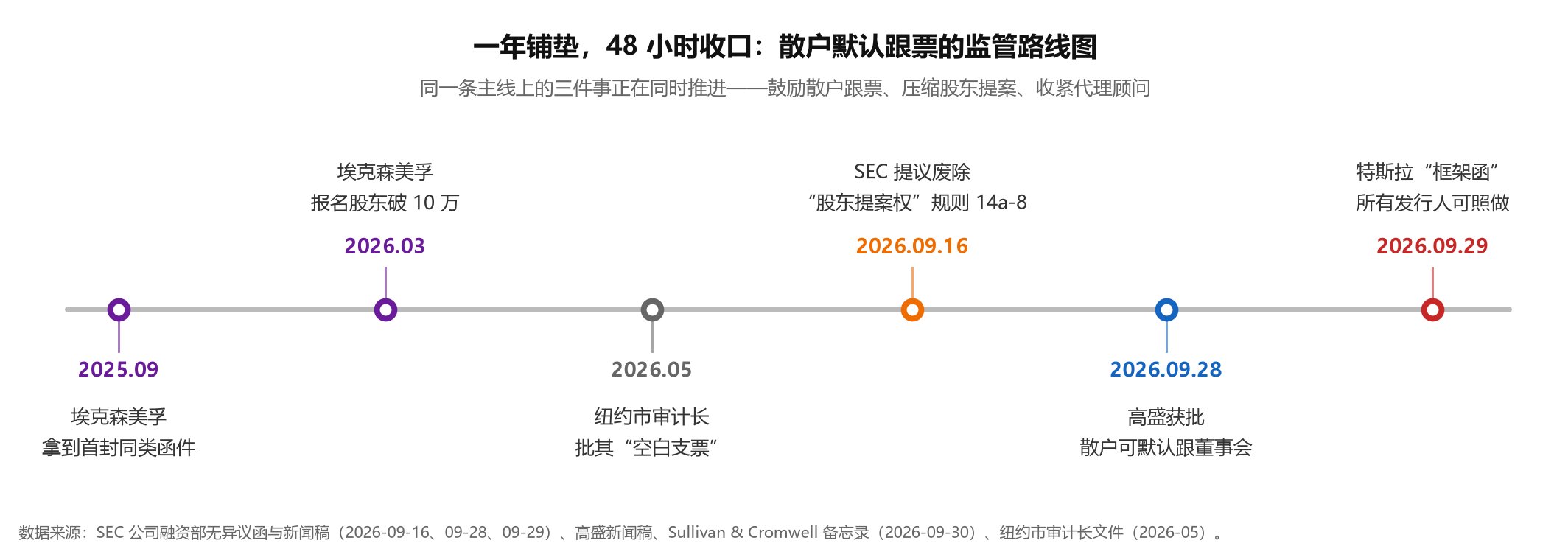
On September 28, Goldman Sachs became the latest company to be approved. According to reports, Goldman Sachs will launch a “Voting Order Program”, operated by Broadridge; retail investors account for about 30% of Goldman Sachs shares (according to people familiar with the matter), and its employees and former partners hold more than 7.6% of the total shares. Goldman Sachs specifically sought internal system registration channels for them in the application, and promised that registration would not be linked to employment or promotion. Goldman Sachs's motivations are also in numbers: Last year, one-third of voting shareholders opposed retaining bonuses of $80 million each for CEO David Solomon (David Solomon) and President John Waldron (John Waldron) — the biggest compensation opposition in the company's history — and about a quarter of the shares did not vote at all on the compensation proposal. “We are delighted to provide individual investors with this free and flexible way to ensure that their shares are voted on important matters,” Solomon said in a statement.
The significance of this letter from Tesla is to turn each case into a framework. According to a customer memo issued by Sullivan Cromwell on September 30, compared to the Exxon letter, which only covered the 14a-4 (d) (2) and (d) (3) rules, the scope of Tesla letter relief was extended to seven; registration communication can be carried out before the final power of attorney for a specific meeting is issued; plans can be open to all or some retail investors, or to investment advisors registered under the Investment Advisors Act and exercise voting rights on behalf of clients; it supports joint registration (householding) across accounts, and even allows registration status to be retained after shareholders have temporarily cleared their positions. The regulatory model has been upgraded from “one-company special approval” to “infrastructure that any company can reuse.”
Another boot from the same week
Take the camera further away; this is not an isolated incident. On September 16, the SEC proposed to completely abolish Rule 14a-8 of the Securities and Exchange Act — a rule that has been in operation for more than 80 years and allows eligible shareholders to write proposals into the company's power of attorney. On the same day, the SEC also proposed amending 14a-4 (c) and modernizing the agency collection process (abolishing annual report delivery requirements, lifting exemption notices, and shortening the brokerage search period from 20 working days to 5), the public The comment period is 60 days.
SEC Chairman Paul Atkins (Paul Atkins) said repealing the rule reflected its “highest regulatory priority”; Commissioner Hester Peirce (Hester Peirce) said in an accompanying speech that the move would “disrupt the mechanism by which minority shareholders gain disproportionate influence over the company through small holdings.” Opposition is just as fierce: Freshfields partner Melissa Hodgman (Melissa Hodgman) warned that “the federal ruling will disappear” as the company's finance department stops accepting 14a-8 no-objection applications in August; Ele Klein (Ele Klein), head of active shareholder business at McDermott Will & Schulte, expects the total number of shareholder proposals to drop significantly if the rules are repealed.
The agency consulting industry was also rescheduled during the same period. Trump signed an executive order in December 2025, naming ISS and Glass Lewis, the two largest proxy advisors, requiring the SEC to review the regulatory rules for proxy advisors and the FTC to investigate whether they violate competition law; Glass Lewis has announced that it will stop issuing standard benchmark voting recommendations from 2027; J.P. Morgan Asset Management abandoned the two external proxy advisors in January this year and used the internal AI tool Proxy IQ to handle US market votes. The department manages more than 7 trillion dollars of customer assets dollars.
Three things are in the same direction: encouraging retail investors to hand over their votes to the board of directors, reducing federal channels for shareholder proposals, and weakening the influence of proxy advisors. The “shareholder expression” of US corporate governance is being rewired — retail investors are changing from “silent shares” to “shares that default to voting”, and the two checks and balances of proxy advisors and shareholder proposals are being removed at the same time.
What does the market think?
The share of retail investors in Tesla is worth mentioning separately. According to Investing.com's shareholding data as of June 30, 2026, mutual funds and ETFs hold about 24.1% of Tesla's shares, while other institutions hold about 19.2% of shares, and “listed companies and retail investors” total about 56.7% — this is thick, and the actual share of retail investors needs to deduct shares held by listed companies; ARK Invest founder Cathie Wood (Cathie Wood) quoted about 40% of retail voting power last year. This is why Norway's sovereign wealth fund has voted against Musk's salary plan twice, but it has not been able to change the results.
Proponents viewed this review as “empowering retail investors.” Tanev posted that the letter “cleared the way for a voting program that empowers retail investors” and that Robinhood “is honored to work with Tesla's excellent team” and wrote in another post: “This is what holding shares should look like — when millions of people hold shares in a listed company, voting should be easier.
“Musk himself only returned one word on X: “Cool!” Opponents continued Levine's “blank check” logic: there was only one direction on the menu—following the board of directors, with no options to “follow objections” or follow other voting policies; moreover, votes were cast when Tesla submitted a final proxy to the SEC, long before most shareholders read the full proxy statement.
Tesla's stock price fell 21% cumulatively during the year. Retail sentiment surrounding Tesla on Stocktwits fell from “bullish” to “neutral” over the past 24 hours, and the number of posts remained low. The rearrangement of the governance structure is never a matter of a day — but it will determine who will write the script for every key vote in the future, such as the shareholders' meeting with no fixed date until now, and the SpaceX merger that Musk is talking about.