
China Power International Development (SEHK:2380) Expands Environmental Services, Is The Valuation Too Rich?
China Power International Development (SEHK:2380) has just signed a wide ranging Framework Agreement to provide environmental protection engineering and related services to State Power Investment Corporation Limited Group through to the end of 2028.
For context, China Power International Development’s short term price action has been relatively firm, with a 1-day share price return of 0.56% and a 7-day gain of 2.66%, although the 30-day share price return is down 6.90% and the move year to date is a decline of 17.68% from HK$2.7. That sits against a 1-year total shareholder return that is down 11.70%, while the 3-year total shareholder return shows a gain of 11.15% and the 5-year total shareholder return is down 13.07%. Together, these figures suggest recent momentum has softened compared with the medium term, even as the new environmental services Framework Agreement and the upcoming H1 2026 earnings call keep the investment story in focus.
Scan a curated field of utilities and infrastructure stocks that are already aligned with cleaner power and grid upgrades by starting with our 39 power grid technology and infrastructure stocks in the same theme as China Power International Development.
Bulls see China Power International Development’s cleaner power mix and new environmental services pact as underappreciated. Bears point to the share price decline and revenue contraction. Which side does the valuation support next?
Price-to-Earnings of 17.9x: Is it justified for China Power International Development?
On the face of it, China Power International Development looks expensive on earnings, with a P/E of 17.9x against a last close of HK$2.7 and both the renewable energy peer group and wider Asian sector trading on lower multiples.
The P/E ratio compares what investors are paying today for each unit of profit the business is generating. For a power producer like China Power International Development, this metric often reflects what the market expects from future earnings, regulatory conditions, and capital intensity in new projects.
Here, the premium is clear. The stock trades on a P/E of 17.9x while the Asian Renewable Energy industry sits at 14.8x and direct peers at 6.8x. The estimated fair P/E of 13.2x is also well below the current level, which points to the market attaching a much richer earnings multiple than both sector averages and the level the SWS model suggests could be more balanced.
Explore the SWS fair ratio for China Power International Development.
Result: Price-to-Earnings of 17.9x (OVERVALUED)
Still, the recent share price decline and annual revenue contraction for China Power International Development leave the cleaner power and services story vulnerable to disappointment.
Find out about the key risks to this China Power International Development narrative.
Another View on China Power International Development’s Valuation
The earnings multiple paints China Power International Development as expensive, yet the SWS DCF model points the other way. With the share price at HK$2.7 and the DCF fair value at HK$9.56, the stock screens as significantly undervalued on future cash flows. Which signal do you trust more?
Look into how the SWS DCF model arrives at its fair value.
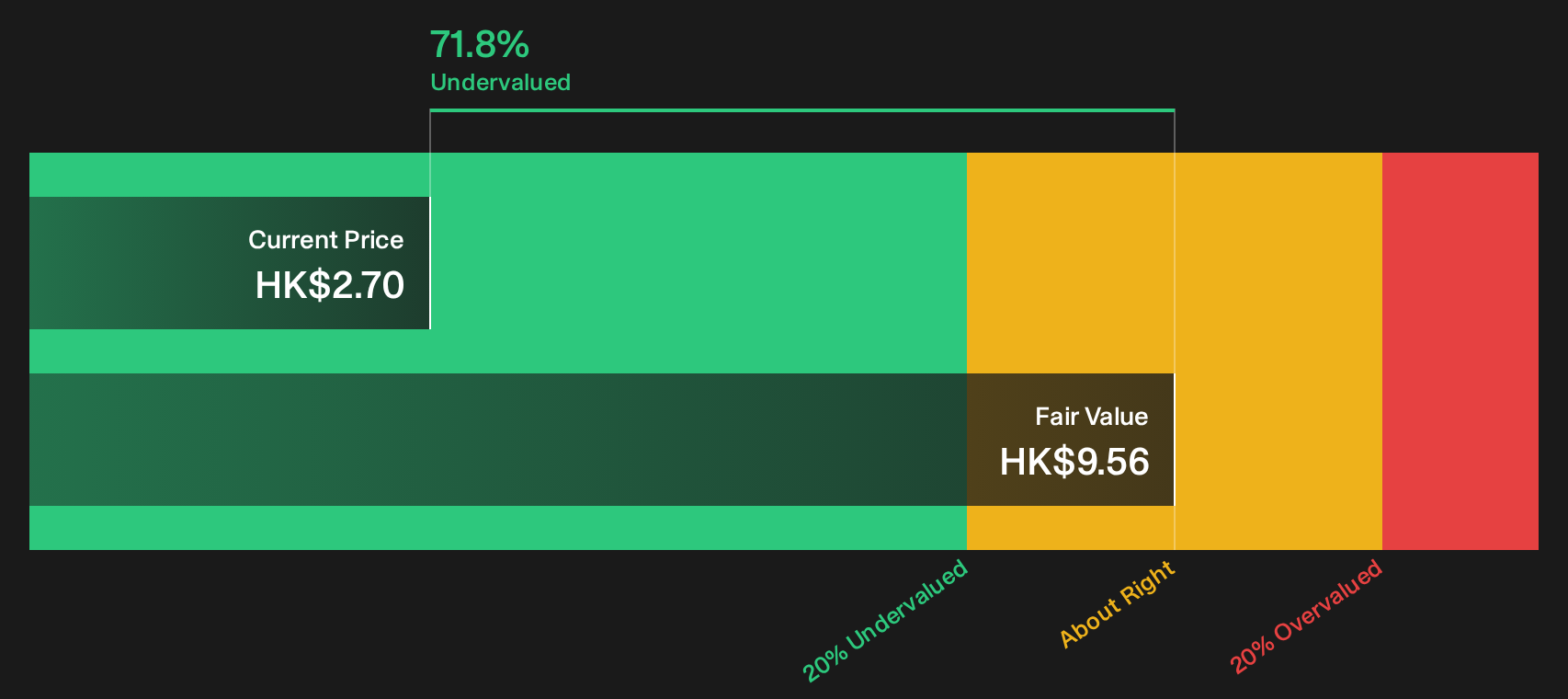
Simply Wall St performs a discounted cash flow (DCF) on every stock in the world every day (check out China Power International Development for example). We show the entire calculation in full. You can track the result in your watchlist or portfolio and be alerted when this changes, or use our stock screener to discover 198 high quality undervalued stocks. If you save a screener we even alert you when new companies match - so you never miss a potential opportunity.
Next Steps
Mixed signals around China Power International Development’s valuation and outlook can feel confusing, so consider reviewing the underlying data promptly to form your own stance. To weigh both sides of the story in one place, start with our 2 key rewards and 3 important warning signs
Looking for more investment ideas beyond China Power International Development?
If China Power International Development is on the watchlist, round out your research with a few fresh angles that could sharpen how you think about opportunities.
- Target long term compounding potential by scanning a curated 198 high quality undervalued stocks that combines quality fundamentals with prices that may sit below what the numbers suggest.
- Strengthen your income playbook by reviewing a focused set of 161 dividend fortresses that can help anchor total returns with regular cash payouts.
- Dial back risk without switching off return potential by checking a hand picked group of 226 resilient stocks with low risk scores built on sturdier financial profiles.
This article by Simply Wall St is general in nature. We provide commentary based on historical data and analyst forecasts only using an unbiased methodology and our articles are not intended to be financial advice. It does not constitute a recommendation to buy or sell any stock, and does not take account of your objectives, or your financial situation. We aim to bring you long-term focused analysis driven by fundamental data. Note that our analysis may not factor in the latest price-sensitive company announcements or qualitative material. Simply Wall St has no position in any stocks mentioned.
Have feedback on this article? Concerned about the content? Get in touch with us directly. Alternatively, email editorial-team@simplywallst.com