
Bain's latest research: The AI infrastructure frenzy needs to be backed up by $6 trillion in annual revenue, and the $4.2 trillion gap calls for a new “wave of innovation”
The Zhitong Finance App learned that the 7th “Global Technology Report” recently released by consulting firm Bain & Company (Bain & Company) issued a calm warning to the artificial intelligence (AI) infrastructure carnival: by 2031, AI-related computing needs must reach an annual revenue scale of about 6 trillion US dollars to provide economic rationality for the current unprecedented construction of data centers, chips, networks, and power systems. Otherwise, this capital expenditure feast will face the risk of financing that the demand curve cannot handle in a timely manner.
The report points out that the “arms race” among hyperscale tech giants is accelerating. The capital expenditure of the five companies Microsoft (MSFT.US), Google (GOOGL.US), Amazon (AMZN.US), Meta (META.US), and Oracle (ORCL.US) may reach 780 billion US dollars in 2026, almost five times the level of three years ago. At the same time, the individual size of AI data centers is also rapidly expanding. Leading AI data centers are currently approaching 1 gigawatt (GW) of power capacity, such as Meta's Prometheus project in Ohio. Bain predicts that by 2027, many data centers will approach 2 GW, and by the end of 2030, the world's largest data center campus may reach 9 GW.
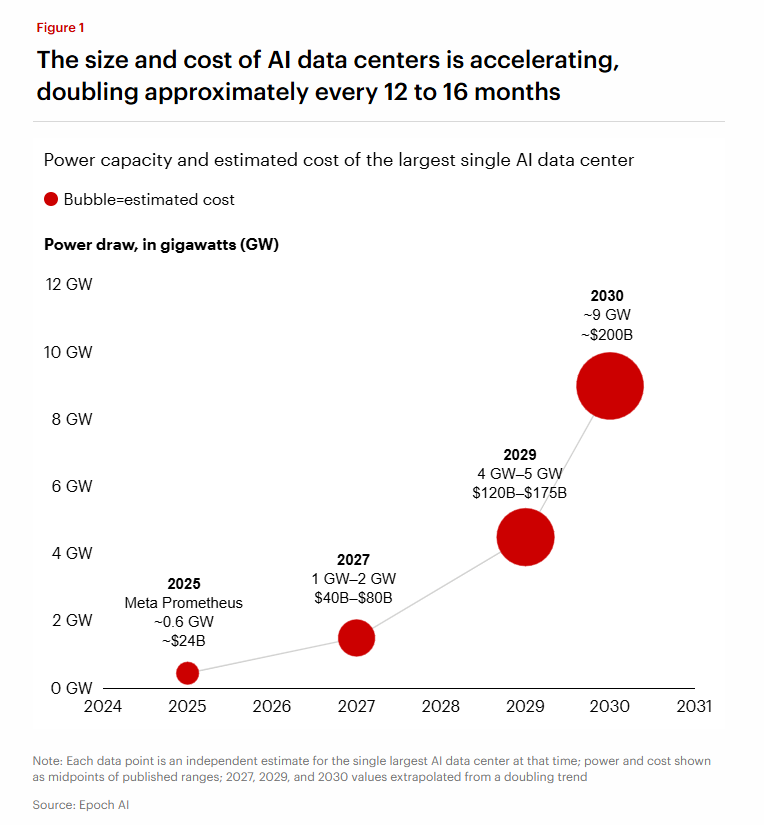
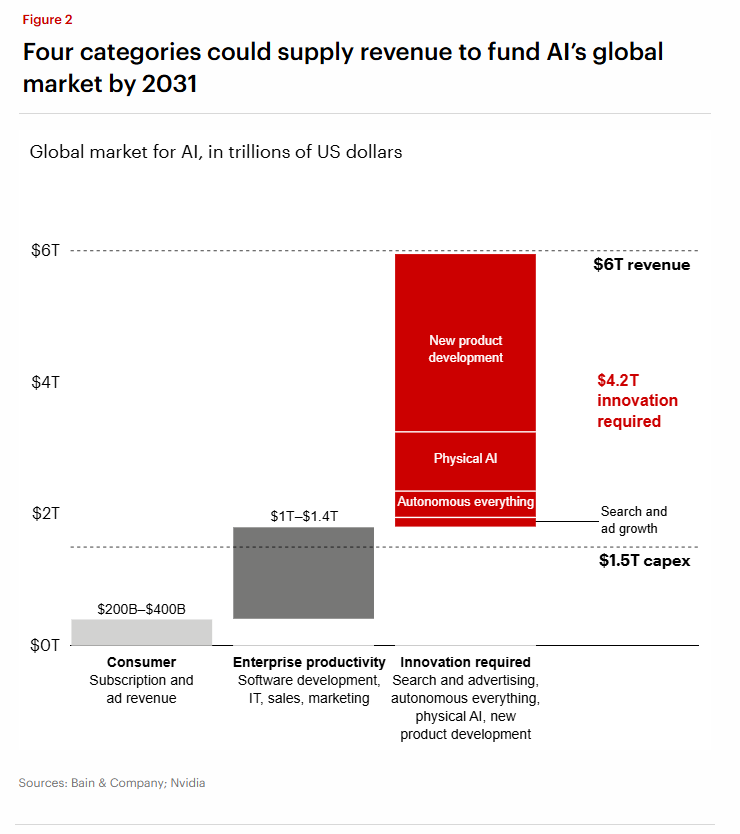
Annual AI infrastructure spending could rise to $1.5 trillion by 2031, covering new data center infrastructure, additional computing capacity, and ongoing upgrades to installed GPUs, memory, and networking equipment. Bain hypothesizes that if capital expenditure accounts for about 25% of the industry's revenue — although this ratio is ambitious, the established trend based on cloud service providers is still reasonable — then maintaining this investment intensity would require an AI market with annual revenue of close to $6 trillion.
However, current predictable revenue sources are far from sufficient to fill this huge gap. Bain estimates that by 2031, consumer-grade AI products can generate about 200 billion to 400 billion US dollars in revenue through subscriptions and advertisements; enterprise adoption of AI may bring additional revenue growth of 1 trillion to 1.4 trillion US dollars to providers, mainly from significant productivity increases in software development, sales, marketing, customer service and IT operations.
Together, the total size of the consumer and enterprise AI market is about 1.2 trillion to 1.8 trillion US dollars, and there is still an additional revenue gap of about 4.2 trillion US dollars to support the 6 trillion US dollar market.
Bain emphasized that part of the gap must come from new sources of economic value, not just efficiency improvements to existing workflows. The report points to four types of innovative directions that may help bridge the gap.
First, search and advertising, on a scale of about 100 billion to 200 billion US dollars. Frontier model developers can unlock $100 billion to $200 billion or more by integrating ads into chatbot products and driving AI to replace most traditional internet searches.
Second, autonomous everything (autonomous everything) has a scale of about 400 billion US dollars. Using AI to autonomously operate cars, trucks, and drones, and promote other industrial automation initiatives, it is expected to form a market of about 400 billion US dollars by improving equipment uptime and reducing training and operating costs. Autonomous vehicles can not only be used as new cars and trucks for consumers, but can also create significant value through Robotaxi services and logistics automation.
Third, physical AI, with a scale of about 900 billion US dollars. Advanced AI models can achieve highly realistic physical process simulation and digital twins to help enterprises improve productivity, test transformation solutions, and accelerate autonomous system deployment. Meanwhile, AI-driven robots, including humanoid robots, can operate in unstructured environments, unlocking new applications in a wide range of scenarios from manufacturing to surgery. Bain hypothesizes that if R&D and manufacturing costs are reduced by 10% due to higher yields and faster factory climbing, the physical economy could represent an opportunity of about 900 billion dollars in key areas such as automobiles, electronics, semiconductors, aerospace, and defense.
Fourth, new product development needs to fill a gap of about 3 trillion US dollars. This includes AI-driven drug discovery to make rare disease treatments economically viable; always-available mental health support to meet billions of dollars of unmet demand; breakthroughs in materials science to unlock next-generation batteries and semiconductors; and autonomous scientific research to accelerate progress in fields from neuroscience to fusion energy. These are all seen as new opportunities brought about by “rich intelligence.”
David Crawford (David Crawford), Chairman of Bain's Global Technology Business, put it bluntly: “The focus of today's debate is on employee productivity. But the economics of AI infrastructure require trillions of dollars in additional revenue, not just productivity gains. What the industry needs is a wave of innovation that far exceeds that unleashed by mobile internet and cloud computing. AI infrastructure is being built far before the demand curve. To finance it in a sustainable manner, the global annual GDP growth rate will need to increase by an additional 1 percentage point.”
So far, the main beneficiary of AI construction is still the hardware industry. From 2020 to 2026, hardware and semiconductor companies' market capitalization grew at an average annual rate of 24%, compared to just 6% for software companies. This differentiation highlights that if the AI application layer does not explode in a timely manner, the return on infrastructure investment will face a severe test. The increase in enterprise productivity is only the “tip of the gun”. It is the earliest benefit seen in AI deployment, but it is far from enough. The real key is whether application innovation can arrive in time before financial pressure is realized to provide sufficient economic support for this trillion-dollar AI infrastructure frenzy.