
I'm afraid the US PCE will throw cold water again in August! Core inflation is expected to remain stubborn, and evidence that the Federal Reserve “no longer needs to raise interest rates” may be difficult to find
The Zhitong Finance App learned that the August Personal Consumption Expenditure (PCE) price index to be announced on Wednesday will probably not bring comfort to US Federal Reserve officials who want to find evidence of “no more interest rate hikes” from the data.
As the Federal Reserve's most important indicator of inflation, PCE is expected to show that price pressure is still stubborn, while consumer spending has not significantly cooled down. This means that after the September rate hike, the debate over whether to act again in October or December will only become more intense.
According to market forecasts, overall PCE and core PCE excluding food and energy costs in August are both expected to rise 0.3% month-on-month. On a year-on-year basis, the overall PCE is expected to rise by 3.7%, and the core PCE is expected to rise by 3.3%, all the same as in July, and still far above the Federal Reserve's 2% target. In other words, there is little sign that inflation will subside anytime soon.
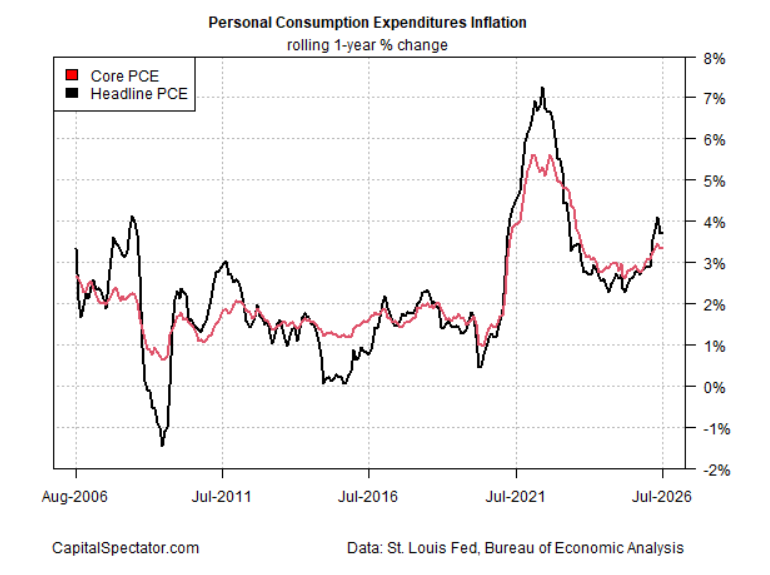
The market sees core PCE 0.3% month-on-month as a key watershed. If the core reaches 0.4% month-on-month, it will be difficult for the Federal Reserve to downplay this after raising interest rates in September, which may reinforce expectations of another rate hike at the October 27-28 meeting. Conversely, if the core ratio is only 0.2% or less, it will give policymakers more reason to wait and evaluate subsequent data. If the data is generally in line with expectations, the October and December actions will remain as options.
What's more complicated is that the US Bureau of Economic Analysis (BEA) will conduct an annual update of the national accounts at the same time as the August report, which means that recent inflation history may be revised. BEA will adjust the price measurement method for legal services, software and computer accessories, and portfolio management services, going back to 2021.
Bank of America economists estimate that these changes could make the relevant index 0.2 percentage points lower than the old method. Some Wall Street agencies expect that PCE may be revised 0.2 to 0.3 percentage points year-on-year in July as a result, and the overall annual rate may drop to about 3%. Therefore, traders should not only focus on August's year-on-year data, but should also pay close attention to the revised three-month and six-month annualized inflation rates.
Goldman Sachs expects the inflation data for the next few months to be “slightly unfavorable” before a more moderate trend reappears. Scott Anderson, chief economist at BMO Capital Markets, said bluntly that in many ways, the August data is “out of date” because the resurgence of the Middle East conflict in September has driven fuel prices to soar.
Consumers are still spending money, and the bond market is already betting on interest rate hikes
Consumer spending is another factor that makes it difficult for the Federal Reserve to feel at ease. Market consensus expects consumer spending to rise 0.8% in August, compared to a 0.2% increase in July, partly due to another surge in gasoline prices. Personal income is expected to grow by around 0.5%.
Bank of America reports that in the week ending September 19, debit and credit card spending increased 6.9% year over year, with gasoline spending surging 26.5%; even excluding gasoline, spending increased 5.7%. Although consumer sentiment is weakening amid continued price increases, they are still willing and able to support the economy.
The bond market is sending similar signals. The policy-sensitive 2-year US Treasury yield closed at 4.93% on Monday, continuing to test a two-year high; since the interest rate hike on September 16, the 2-year yield has matched an increase of 25 basis points, indicating that the market's expectations for further tightening have not changed. The 10-year Treasury yield broke through a recent high and closed at 5.24%, the highest level in nearly 20 years. Economists are debating the extent to which rising yields are being driven by inflationary anxiety, federal debt expansion, increased economic activity, and huge financing needs brought about by the artificial intelligence (AI) boom. In any case, these factors are driving up borrowing costs.
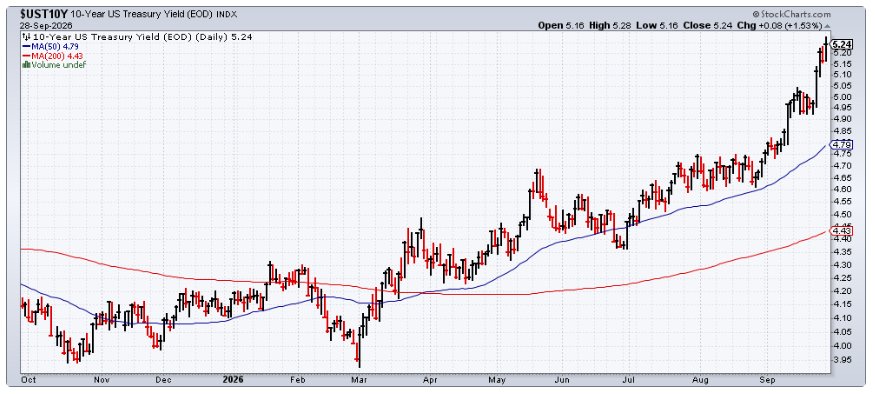
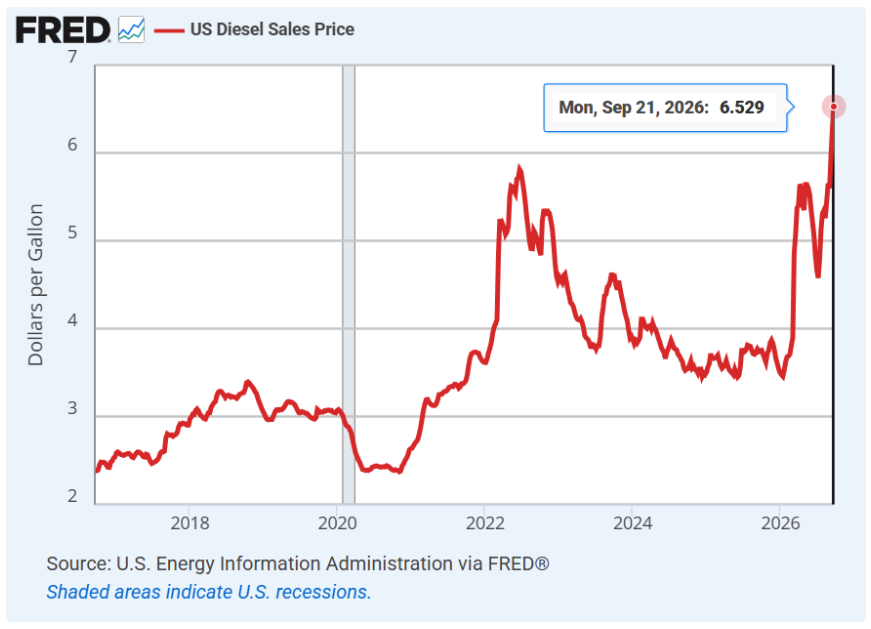
Meanwhile, diesel prices are becoming a new inflationary concern. As a key input to freight and industrial activity, rising diesel prices tend to spread to a wider range of consumer prices. Washington's discussions on restricting US diesel exports have highlighted concerns, but the ban could be counterproductive: disrupting the refining economy and global fuel markets, weakening production incentives, causing supply shortages, and ultimately driving up prices even further.
Gevenga Aguilore, chief economist at the Center for Budget and Policy Priorities, said: “The rise in diesel prices is worrying, but the main driver is the war in Iran. End the war with Iran and open the Strait of Hormuz, and diesel prices will drop.”
Within the Federal Reserve: Hawks' concerns remain, dovish emphasizes patience
The Federal Reserve raised the federal funds rate target range by 25 basis points to 3.75% to 4.00% at the September meeting. This is the first rate hike since 2023, aimed at curbing borrowing and spending and rebalancing supply and demand. The bitmap shows that most officials expect at least another 25 basis point rate hike before the end of the year; of the 18 FOMC officials who provided the forecast, all but 2 expected at least one further action.
Federal Reserve Chairman Kevin Walsh said at a press conference earlier this month that recruitment data, business investment, and private sector profits showed that the economy was doing well. “It's hard for me to describe the broad range of financial conditions as restrictive,” he said. Financial conditions are an important input for the Federal Reserve to calibrate interest rate policies.
Federal Reserve Governor Michael Barr is even more concerned. He said that the combination of tariffs and Iran's long war meant “we have been knocked off track in the process of moving towards the 2% target.” “I haven't seen a clear trend of a timely return to 2%,” he added.
Barr reiterated that the Federal Reserve may still need to continue to raise interest rates, but did not specify the level of interest rates. “In my benchmark scenario, further policy adjustments may be needed to ensure that inflation falls to target in a timely manner. We want to support sustainable and lasting growth to support maximum employment, and price stability is critical to this,” he said.
New York Federal Reserve Chairman John Williams pointed out the third driver of continued inflation: AI construction and demand for related commodities. However, he also said that other indicators are more encouraging: housing service prices have decelerated, the labor market has not increased inflationary pressure, and tariff pressure on commodity prices has largely subsided.
In terms of policy, Williams is more dovish than Barr, saying “there is no need to be urgent; we have time to gather more information,” but he still anticipates that a “further increase” may be needed this year.
Dan North, senior economist at Allianz Trade, concluded that the Federal Reserve will see core inflation unmoved, and there is no reason to believe it will fall in a convincing manner. “It's still far above target... I think it's embedded in it, and the Fed can't ignore or explain it.”
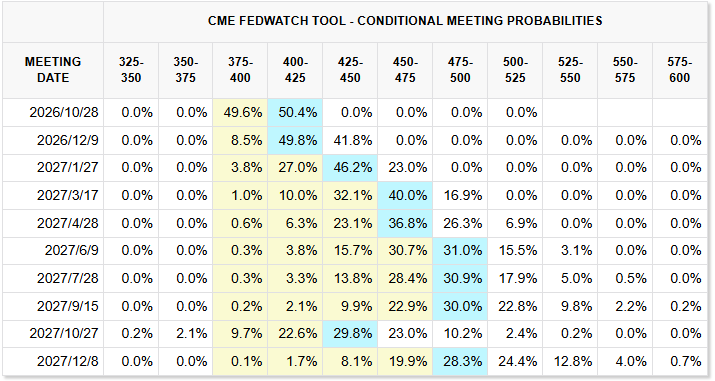
As of now, although the market's expectations for the Fed's interest rate hike in October have cooled down after Williams delivered his speech, according to the latest data from the CME “Federal Reserve Watch” tool, the market still expects the probability that the Fed will raise interest rates by 25 basis points at the end of October meeting to reach 50.4%.
Wednesday's PCE report is the last PCE data before the October meeting, which will undoubtedly directly affect US Treasury yields, the US dollar, and broader risk sentiment. After months of hoping that inflation would gradually fade out of sight, investors are once again confronted with the possibility that price pressure may persist. The PCE report may not be able to quell this debate, but it is bound to affect the next chapter where the market continues to struggle between inflation and interest rates.