
ChatGPT's ability to generate revenue has exploded, adding fuel to the expansion of AI computing power! OpenAI's annualized revenue soared 70%, sprinting to a valuation of $1.4 trillion
The Zhitong Finance App learned that after Claude developer Anthropic's overall revenue in 2025 surged to about 12 times that of the previous year and the valuation surged to over $2 trillion, OpenAI, a popular global AI application developer, did not relent. On Tuesday EST, the annualized revenue data disclosed was close to 70 billion US dollars, an increase of more than 70% over July, and OpenAI, the global AI model/ AI application leader, is also seeking a pre-investment valuation of about 1.4 trillion US dollars (compared The valuation of about 850 billion US dollars showed a sharp increase in the previous round of financing), and raised at least 30 billion US dollars.
OpenAI is trying to use a new round of huge private equity financing to buy time for the rapidly expanding AI business and stricter security governance at the same time. OpenAI CEO Altman said that the company hopes to first adapt to the security requirements brought about by the jump in cutting-edge model capabilities, and then withstand capital market pressure from newly listed companies, so potential IPOs will be until 2027 at the earliest.
On the other side, Anthropic is targeting an IPO valuation of more than $2 trillion, with previously negotiated fund-raising targets as high as $100 billion. If the distribution is finally completed on this scale, the amount of capital raised will exceed SpaceX's approximately US$85.7 billion, which is expected to set a new global IPO fund-raising record; however, Anthropic's financing plan and target valuation are still proposed arrangements, which cannot be equated to the fact that the company's IPO has already set a historical record. The latest news also shows that its listing may be postponed until after the US midterm elections in November. The capital choices of the two big AI model supergiants were jointly revealed: the massive commercialization of AI applications around the world, driven by a frenzy of AI agents focusing on agent-based automated workflows, is pushing financing capabilities, security governance, and AI computing power infrastructure supply capabilities to the same important position.
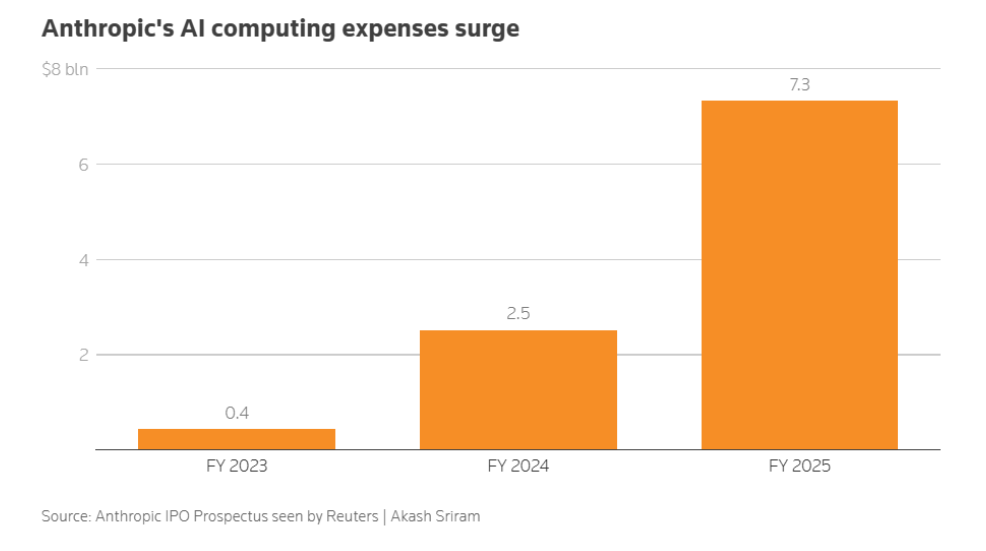
As cutting-edge AI agents represented by Muse and Astra quickly become popular around the world, AI is accelerating from dialogue tools to automated programming, research, and execution of complex enterprise workflows, and is simultaneously expanding application revenue and AI computing power resource investment. According to information revealed by people familiar with the matter, the details of Anthropic's IPO prospectus also showed that operating losses exceeded 8 billion US dollars in that year, and computing power and infrastructure expenses were 7.33 billion US dollars, highlighting the scale of global spending on artificial intelligence computing resources, which can be described as clearly showing a sharp trend.
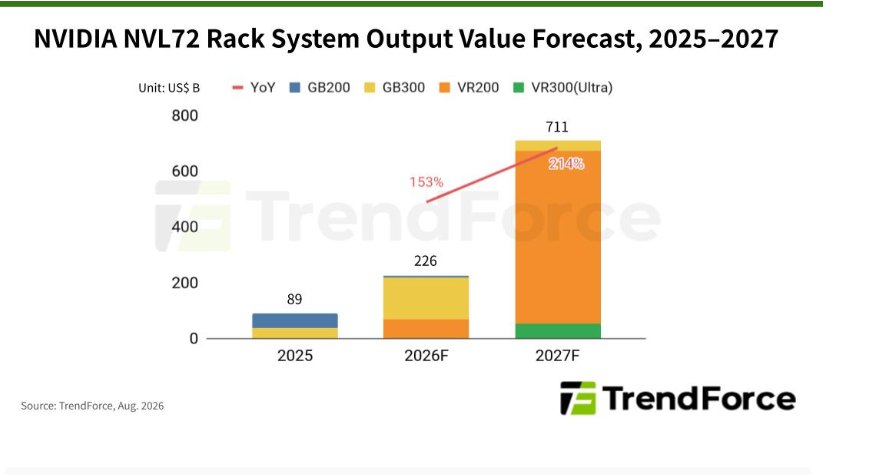
According to Anthropic management, the memory chip components of AI data center server clusters and AI GPUs are still the clearest supply bottlenecks at the AI computing power industry chain level. Market research agency TrendForce predicts that in 2026, server DRAM contract prices will increase by about 270% and enterprise-grade SSD prices will increase cumulatively by about 235%; HBM contract prices may still rise 70% to 140% in 2027, that is, they will continue to double. These data reflect the combined effects of the continued expansion of AI computing power demand and the increase in memory chip prices. TrendForce estimates also show that shipments of NVL72 racks covering Blackwell and Vera Rubin platforms are expected to increase by more than 50% year on year in 2027; the accompanying market research shows that the output value of related systems is expected to rise from about US$226 billion in 2026 to US$711 billion in 2027, a sharp increase of 214% year over year.
Anthropic and OpenAI are preparing to bring this expansion into the global open capital market. People familiar with the matter said that in addition to showing a 12-fold revenue surge in Anthropic's IPO prospectus, Anthropic will also assume a total spending obligation of up to 518 billion US dollars for cloud services, AI computing capacity, and extensive AI infrastructure over the next few years. The potential listing valuation of more than $2 trillion means that investors will directly price the commercialization capabilities, computing power procurement commitments, and long-term profit prospects of cutting-edge models, and its impact will also extend to the valuation expansion path of OpenAI and related AI computing power infrastructure suppliers.
The launch can be waited, and the AI product line continues to be fierce competition
OpenAI CEO Sam Altman said the company hopes to get through this period of heightened AI security concerns without being pressured by newly listed companies, and believes investors will be “patient” with its IPO plans.
In an interview with the media on Tuesday, Altman said that the ChatGPT and Codex developers are currently “adapting” to the “new level” of AI capabilities and the additional security requirements that come with it.
“We just want to gain a foothold, make sure we understand how to operate under this new model, and be able to make decisions about some of the issues we need to face right now without being pressured by newly listed companies,” Altman said.
These remarks are one of his most detailed explanations so far about the company's decision to delay a potential listing until as early as next year. OpenAI and its long-time competitor Anthropic have both secretly submitted listing application documents before, and Anthropic is expected to go public as soon as this fall.
In recent weeks, after a series of cybersecurity incidents involving the AI systems of the two companies and warnings from grassroots employees in the tech industry about risks to human survival, the two AI companies have come under a new round of scrutiny because their technology could cause disastrous harm.
OpenAI said this week that it has cancelled plans to launch the GPT-6.1 version of its flagship Astra model, and indicated that related risks have increased after a series of recent AI cross-border intrusions. The company also apologized to Australia this week for hacking some of its AI models into Australian government websites.
As the IPO schedule is being reconsidered, OpenAI is discussing a new round of funding. Bloomberg revealed on Tuesday that the company plans to raise at least $30 billion from investors at a valuation of around $1.4 trillion. The purpose of this round of financing is to act as bridge financing to provide sufficient capital for the company in the absence of an IPO.
“We will go public one day,” Altman said.
Additionally, according to the latest insider sources, OpenAI is seeking to raise $30 billion at a valuation of $1.4 trillion. According to media reports, an insider revealed that after postponing its initial public offering plan, artificial intelligence startup OpenAI is seeking to raise at least $30 billion from investors through a new round of financing.
These people familiar with the matter said that the company is seeking a valuation of about 1.4 trillion US dollars, not including the capital to be raised in this round, which may once again surpass the recent private equity market valuation of long-time competitor Anthropic. Bloomberg previously revealed that OpenAI is considering a new round of financing at a valuation of $1.2 trillion.
People familiar with the matter said that financing discussions are still in the early stages, and the relevant arrangements may change. Since the relevant information has not been made public, they requested anonymity. A person familiar with the matter said that against the backdrop of strong growth in the company's revenue, demand for this round of financing is mainly driven by investors. OpenAI representatives declined to comment on financing and IPOs.
Prior to planning to land on Wall Street, the ChatGPT developer had been fiercely competing with Anthropic to get more enterprise customers and increase revenue. Both companies have secretly submitted listing application documents, and Anthropic is expected to go public as soon as this fall.
OpenAI CEO Sam Altman recently stated that the company will not go public this year. In an interview with US media on Tuesday, he said that the company hopes to get through this period of heightened AI security concerns without being pressured by newly listed companies.
Altman said the ChatGPT developer is currently “adapting” to the “new level” that AI capabilities have reached, as well as the additional security requirements that come with it. He also added that he believes investors will be “patient” with the company's IPO plans.
People familiar with the matter said that the latest round of financing aims to act as “bridge financing” to replace open market IPOs to provide additional capital for OpenAI. OpenAI last raised $122 billion in March, and the valuation, including this round of funding, is $852 billion.
Like its peers, OpenAI has come under increasing scrutiny for AI's potential catastrophic harm, including through cybersecurity intrusions. OpenAI's technology has involved a number of security incidents, including those targeting Australian government websites. The company also said this week that it will not release its latest model, the GPT-6.1 Astra, because the system does not meet internal security standards.
Altman supports a plan proposed by Anthropic CEO Dario Amodei to slow down the development of cutting-edge AI models and bring in independent evaluators to help secure this technology.
Meanwhile, OpenAI continues to compete fiercely in the increasingly crowded market for AI agents that can handle more complex tasks for users. At the developer event held on Tuesday, the company launched a new AI agent called Dots, which is continuously online, and is preparing to compete directly with products such as Facebook and Muse, a subsidiary of Instagram's parent company, Meta Platforms.
OpenAI is also adjusting its subscription products and launching a new $500 high-end payment tier to provide higher usage limits and faster processing speed, while reducing part of the usage amount of the $200 package.
For most of this year, OpenAI was widely viewed as being at a competitive disadvantage, but the company has been firmly consolidating its product layout, focusing on the key growth direction of AI agents driven by cutting-edge AI models, and regaining growth momentum in tools that simplify workflows such as programming.
Earlier, some media revealed in August that OpenAI's annualized revenue accelerated in the summer and exceeded 40 billion US dollars. On Tuesday, according to the latest US media reports, a person familiar with the matter said that since July, the company's annualized revenue data (that is, run rate revenue) has been close to 70 billion US dollars, a sharp increase of more than 70% since the beginning of the third quarter. This is why the stock price of Oracle, one of OpenAI's largest AI cloud computing infrastructure builders, has soared after the disclosure of this data. It is worth noting that the run rate revenue of close to 70 billion US dollars is a startup that converts the recent revenue rate to a full year scale. It is neither the annual revenue already achieved in 2026, nor can it all be classified as revenue from a single ChatGPT product.
AI's “capital buffer”: buying time for continued large-scale expansion of AI computing power resources, security verification, and customer repayment
The bottom change in this unprecedented wave of AI agents is that a user command starts triggering an entire work process that can continue to advance. Meta's Muse runs in a separate secure virtual machine with a browser, and users can continue to perform tasks even after closing the app; OpenAI's newly launched Dots is driven by the released GPT-6 Astra, has a cloud computer, and can connect to more than 4,000 apps. Research, programming, procurement, or office tasks can thus be connected in tandem with planning, retrieval, tool call, code execution, and result verification. As deduced from this, computing power requirements are increasingly dependent on user size, task frequency, inference and execution workload for each task, and peak concurrency requirements under heavyweight AI inference workloads.
Recent advances in cutting-edge AI agent/AI model technology represented by Muse, Astra, and Anthropic Claude can be described as providing an important technical foundation for large-scale commercial expansion of AI applications into various industries and the continued surge in AI computing power requirements — in particular, the expansion of the scope of intelligent applications is expected to simultaneously increase AI superaccelerators such as AI GPUs/TPUs and AI core infrastructure requirements such as high-performance CPUs, high-performance HBM/DRAM/NAND memory chips in data centers, and high-speed optical interconnect devices.
Judging from the AI inference system architecture, GPUs and dedicated accelerators are responsible for model calculation, the CPU is responsible for converting inference results into actual operation, and memory and storage are responsible for storing and retrieving task states. Long contexts and multiple rounds of calls increase pre-populated computation and KV cache requirements; browsers, code sandboxes, retrieval, and task orchestration increase server CPU load; file, database, persistent memory, and cache layers extend requirements to server DRAM, enterprise SSDs, and high-speed networks. Nvidia's technical materials have described AI agent reasoning as an extremely large system project spanning GPU HBM, CPU DRAM, local NVMe and remote storage, as well as internal high-speed optical interconnections that are critical for data transmission.
Security requirements are adding another layer of real-world workloads. OpenAI clearly disclosed that it has added inference monitoring to externally deployed Astra tools, and bears significant computational costs; Dots will also go through an independent automated review system before performing operations such as sending emails and modifying files. This means that competition indicators in the production environment are advancing towards “how many tasks can be safely completed per unit cost”, and model reasoning, tool execution, and safety verification together determine commercialization efficiency.
From a capital and investment perspective, Anthropic wants to win the global IPO throne with a valuation of 2 trillion US dollars and an IPO financing scale of about 100 billion US dollars, and OpenAI's latest round of financing and 1.4 trillion US dollars is understood by the market as a “capital buffer” built by Anthropic and OpenAI for the expansion of cutting-edge AI agents: computing power procurement, R&D, and security investments often occur first, and customer use and repayments are then gradually realized. In particular, the OpenAI IPO schedule may also be adjusted, and private equity capital is responsible as a result The effect of crossing these time differences. About 80% of Anthropic's infrastructure commitments of at least $518 billion over the next ten years are irrevocable or require payment regardless of usage, which further illustrates the importance of this funding arrangement.