
The Credit Rout Is No Longer a Distant Threat: 4 ETFs Show How a Looming Debt Collapse Could Hit Stocks
Equity investors like to believe that credit market stress is a distant problem confined to distressed balance sheets. But if you want to know where stock market liquidity is actually headed, stop looking at headline equity indexes and start watching the credit “chain.”
Let’s take a quick roll call. Long-term Treasury yields remain anchored near multi-year highs. AI hyperscalers are flooding the bond market with hundreds of billions of dollars in fresh debt. The cost of capital just reset across the entire financial system.
There are four key credit-sensitive ETFs that I track constantly using Barchart.com watchlists and charts. They tell me the credit rout isn’t in the rearview mirror. On the contrary, it is more likely just getting started.
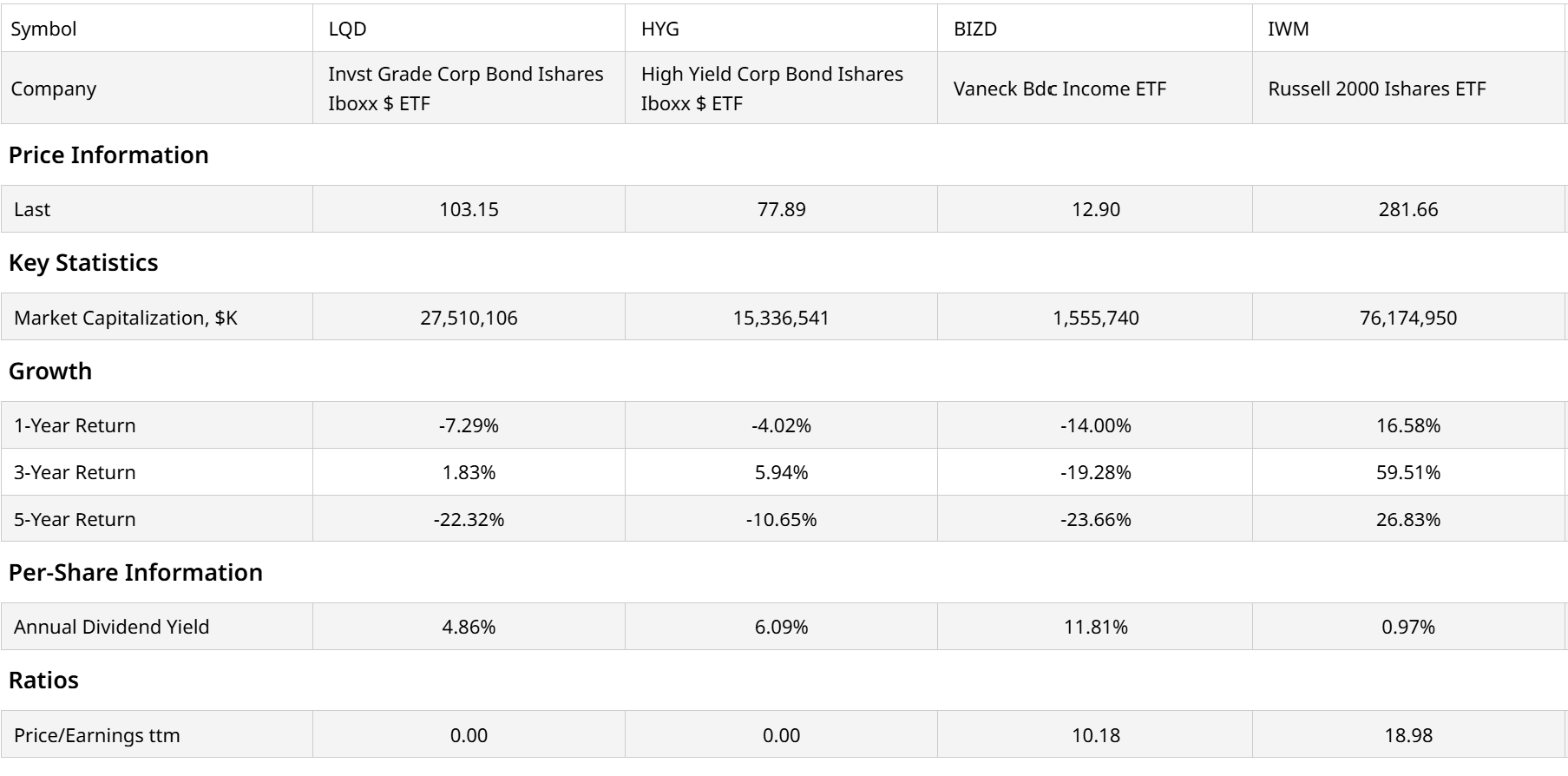
Let’s explore this foursome, one at a time. Because while credit spreads over Treasuries may look tight on a relative basis, the absolute cost of debt is what hurts corporate balance sheets.
LQD (Investment Grade Corporate Debt)
Not long ago, 4.8% was like a magical yield. Untouchable by the Treasury market. Now, spreads continue to be tight, but the government segment has caught up. Game, set, and maybe match, for the iShares iBoxx $ Inv Grade Corporate Bond ETF (LQD).
High-grade companies that easily serviced 2%-3% debt during the zero-interest-rate era are now forced to refinance maturing paper at nearly double the interest expense. Every extra dollar spent servicing investment-grade debt is a dollar taken directly away from share buybacks, capital expenditures, and dividend growth. When high-grade corporate borrowing costs stay elevated, profit margin compression across broad market equities is a near mathematical certainty.
HYG (High Yield Corporate Debt)
If LQD reflects the pressure on high-grade issuers, the iShares iBoxx $ High Yield Corporate Bond ETF (HYG) represents the front lines of speculative corporate credit. HYG holds non-investment-grade corporate debt across telecommunications, energy, and healthcare providers. With HYG’s yield in the 6% range, junk issuers are running out of runway.
That’s because big-money institutional bond buyers no longer need to buy lower-quality corporate debt to generate income when they can lock in 5%-plus yields on risk-free Treasuries or target-maturity bond ladders. An escalating wave of debt restructurings is likely part of the 2027 narrative.
BIZD (Middle-Market Private Credit)
When small and mid-sized businesses get priced out of traditional public bond markets, they turn to direct lenders and business development companies (BDCs). The VanEck BDC Income ETF (BIZD) tracks publicly traded BDCs that provide floating-rate loans to private, middle-market companies. As occurs in every cycle, there’s a period where retail investors clamor for that 11%-plus yield. Then they realize it is akin to a teaser rate. Because the price trend goes like this:
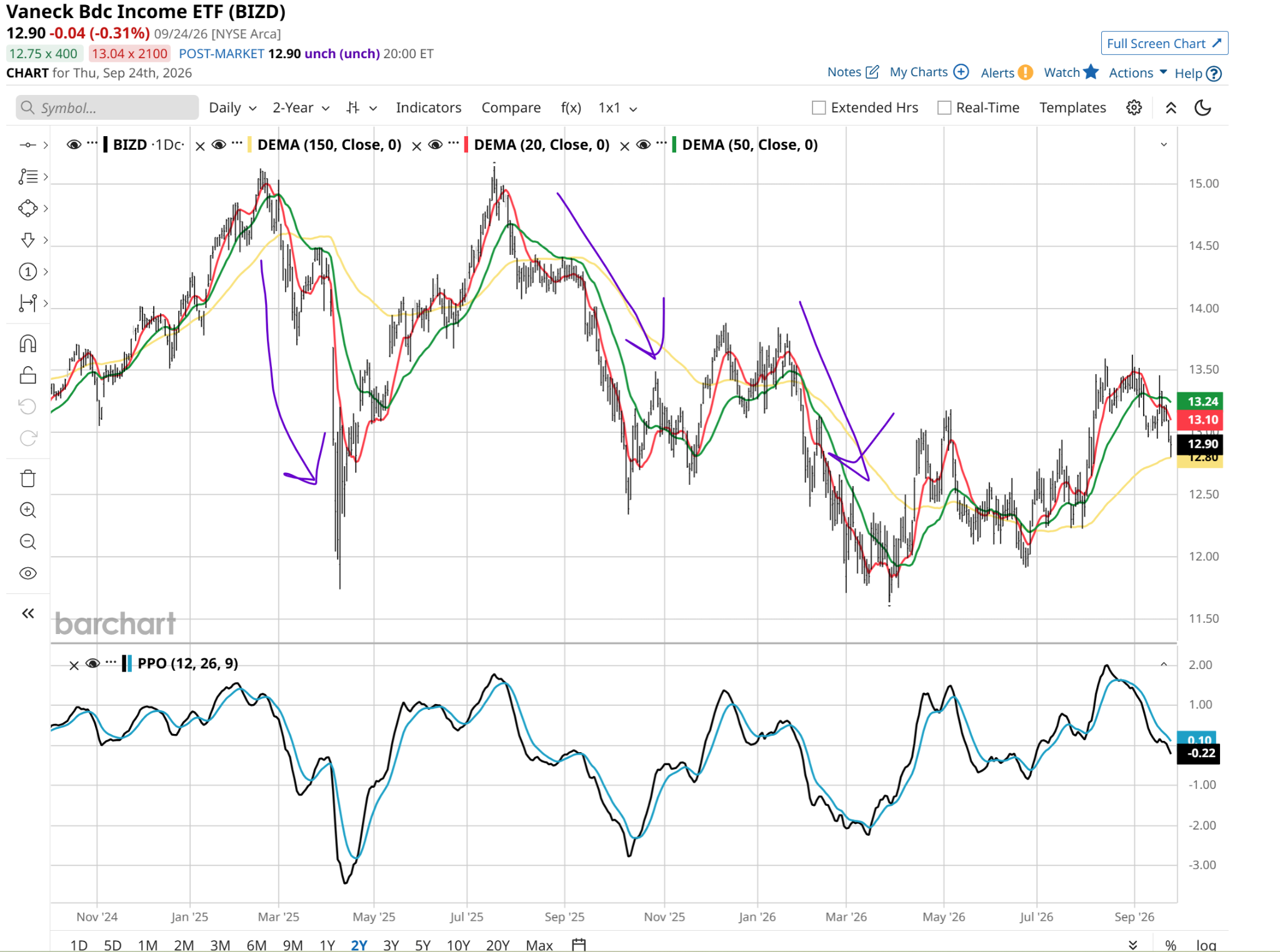
It sure looks like another 20%-plus price decline is underway. And with it goes that big dividend return. And then some.
Plus, that yield level signals severe underlying stress. BDCs make floating-rate loans to private companies that are heavily leveraged. As reference rates stay high, those middle-market borrowers face soaring debt-service costs. Rising non-accruals, payment-in-kind (PIK) loan modifications, and NAV erosion across BDC portfolios are early warnings that the private credit boom is entering a long-overdue and painful default cycle.
IWM (Small-Cap U.S. Stocks)
The credit squeeze directly feeds into equity market performance through the iShares Russell 2000 ETF (IWM). As I’ve noted here several times, nearly 40% of the small-cap companies inside the Russell 2000 are currently unprofitable. 800 public companies!
The “debt cliff” is arriving, as scheduled. All of that cheap, pandemic-era 5-year debt is coming due for refinancing. When small-caps cannot access low-cost debt, they are forced to borrow at exorbitant rates from BDCs, issue highly dilutive equity offerings, or cut operating costs severely. That is why small-cap equities continue to lag behind mega-cap tech heavyweights. And why I am regularly looking to profit from that, via ETFs like the ProShares Short Russell 2000 (RWM) and the Direxion Daily Small Cap Bear 3X ETF (TZA).
Credit markets always lead equity markets. This time is not different. Watching LQD, HYG, BIZD, and IWM tells me loud and clear that the cost of capital is tightening across every tier of the economy.
My plan: Rather than chasing equity relief rallies on the assumption that credit woes won’t touch stock prices, active risk managers should be raising the bar, similar to a lender. A bank won’t just lend to anyone, especially in a budding recession. So I won’t invest in high yield, low quality parts of the market. Unless you consider inverse ETFs to be “investing.” To me they are for trading. To hang in there during periods like this, and emerge with tons of “dry powder” when the next bull cycle inevitably arrives. Even if that’s a long time from now.
Rob Isbitts is a semi-retired CIO, former fiduciary investment advisor, and Barchart columnist. Check out his other work at ETFYourself.com (featuring the Fresh Charts weekly trading post), and ROAR.PiTrade.com, helping investors to better-manage their own portfolios.
On the date of publication, Rob Isbitts did not have (either directly or indirectly) positions in any of the securities mentioned in this article. All information and data in this article is solely for informational purposes. For more information please view the Barchart Disclosure Policy here.