
Nvidia vs. AMD: Which AI Chip Stock Has More Room to Run After AMD's Surge Past $1 Trillion?
Key Points
AMD recently joined Nvidia, Broadcom, Taiwan Semi, Samsung, and Micron as the latest AI chip stock to reach a $1 trillion market cap.
AMD's revenue and profit growth relative to its valuation show that the stock is priced to perfection.
Nvidia's valuation multiples look positioned for meaningful expansion as the company ramps its Vera Rubin CPU push.
As of the closing bell on Sept. 25, Advanced Micro Devices (NASDAQ: AMD) finished the week reaching a historic milestone: the semiconductor company punched its ticket to the $1 trillion club. AMD stock has rallied 195% this year while its rival, Nvidia (NASDAQ: NVDA), has gained closer to 20%.
The disparity between these share price gains feels backwards. Nvidia is bigger than AMD, and it is growing faster. This gap presents an interesting argument right now: is the market overpaying for AMD because it suddenly has a cleaner story, or has AMD's stock price gotten ahead of the company's earnings? Let's dig in and find out.
Missed Nvidia in 2009? This Rare Signal Is Flashing Again. In 2009, a "Double Down" signal flashed for a little-known chipmaker called Nvidia. For the first time in years, that same "Total Conviction" signal is flashing for a company 1/100th the size of Nvidia. Continue »
Image source: The Motley Fool.
Why AMD stock is beating Nvidia in 2026
After an uninspiring 2025, AMD spent the last year landing hyperscaler deals and convincing investors that its Instinct accelerators are no longer an afterthought next to Nvidia. Revenue in the most recent quarter reached $11.5 billion, up about 50% year over year. That is real growth, but it's nowhere near Nvidia.
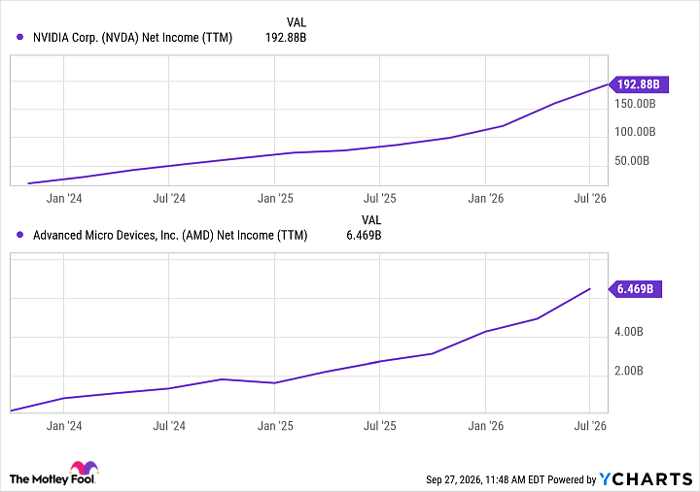
Nvidia's last quarter featured $96 billion in sales, with the data center segment alone contributing $89 billion and growing 117% year over year. Over the last year, profitability is in a different universe: AMD has made about $6.5 billion in net income over the past 12 months, while Nvidia has generated closer to $193 billion.
NVDA Net Income (TTM) data by YCharts
These figures prove that AMD is not winning meaningful business over Nvidia. Rather, it is simply winning the narrative right now. Investors tend to migrate toward smaller names that can still compound, and they like the idea that cloud buyers are diversifying vendors away from Jensen Huang.
AMD's edge in CPUs is going to erode
AMD's premium also comes from its product mix. The company is not just a GPU designer. EPYC processors give AMD a serious CPU franchise in AI server racks, something Nvidia did not really have until recently. The market has been treating AMD's dual-stack approach like a scarcity asset, and it is one of the biggest reasons the company can trade like an unstoppable growth stock even while it trails Nvidia in a distant second place in AI training.
I think that premium is at risk of cracking because Nvidia is quietly expanding outside of its legacy GPU lane. Over the last year, Nvidia's Grace CPUs, which were only launched in 2021, generated over $5 billion in revenue. Meanwhile, the next-generation Vera Rubin CPU architecture is forecast to reach $20 billion in sales next quarter. Nvidia's management says that demand for Vera Rubin currently implies CPU revenue to more than double in fiscal 2028, which would position the company "as one of the world's leading server CPU suppliers."
The valuation gap shows which stock is positioned for a breakout
AMD trades at a price-to-earnings (P/E) ratio of 162. Even on a forward P/E basis, the stock still trades in the ballpark of 51x. To me, AMD is priced to perfection at the moment. While its market cap has nearly tripled this year, earnings have not. At this rate, AMD has almost no room for an earnings miss or it will be at risk of a harsh valuation reset.
Nvidia looks like the opposite setup. The stock trades at 28 times trailing earnings and has a forward P/E around 14 -- its lowest level in a decade. While that might not appear cheap on first glance, consider Nvidia is still growing its data center revenue more than 100% and guiding to about 70% sales growth in fiscal 2028 as the Vera Rubin cycle ramps.
In reality, Nvidia's valuation multiples have compressed while the underlying business kept compounding. This is how breakouts are born: not because the story is new, but because smart investors start to see how the stock price meaningfully lags earnings power.
None of this means AMD is a bad company. It just means the easy money has already been made. After a sprint into the $1 trillion club, AMD now needs to prove its earnings can catch the valuation. By contrast, Nvidia already has the earnings, and it now has a CPU lever that can help its multiple expand once again. That is why Nvidia is the AI semiconductor stock that has more room to run from here, making it a compelling opportunity to buy and hold as AI infrastructure buildouts push on.
Adam Spatacco has positions in Nvidia. The Motley Fool has positions in and recommends Advanced Micro Devices and Nvidia. The Motley Fool has a disclosure policy.