
Tokenized Fund Collateral Might Change The Case For Investing In Franklin Templeton (BEN)
- Bybit announced a collaboration with Franklin Templeton that lets eligible clients use Benji-issued tokenized money market fund shares as off-exchange collateral for USDT and USDC trading, with assets held in custody through ByCustody.
- The arrangement ties Franklin Templeton’s blockchain-based Benji Technology Platform directly into a crypto trading venue, linking regulated, yield-bearing collateral with on-exchange liquidity and education for wallet-based investors.
- This development highlights how Franklin Templeton’s investment narrative intersects with tokenized money market collateral, now embedded in Bybit’s trading ecosystem.
Scan other fund managers using tokenization in a similar way by reviewing our hand-picked 16 high quality undiscovered gems that are starting to plug regulated yield into on-chain trading rails.
Franklin Templeton Investment Narrative Recap
Owning Franklin Templeton means believing a traditional active manager can keep reshaping itself around alternatives, retirement solutions and digital infrastructure like Benji. The short term focus is still on stabilising flows, especially where Western Asset outflows and fee pressure meet. The Bybit tie up helps the story, but does not yet change that core tension.
The largest near term risk remains muted revenue growth, with fee compression, one off items and integration costs all tugging on margins. Earnings forecasts point to improvement, yet return on equity is still low and dividend coverage is tight. Execution on acquisitions and cost control matters more than this single crypto partnership.
The Bybit collaboration plugs Franklin Templeton’s tokenized money market funds directly into a trading venue, turning Benji into live infrastructure rather than a side project. For the business, that is an operational proof point that its blockchain work can support real collateral use, custody and client education rather than just pilots.
From a catalyst angle, this sits alongside expansion in alternatives and global mandates as another distribution rail. The key question is scale. If tokenized vehicles stay niche, fee pressure and Western Asset outflows still dominate the investment story. If adoption grows, the groundwork in digital distribution could support margins and keep Franklin Templeton relevant to on chain investors.
Franklin Templeton Forecasts Behind the Tokenization Story
Franklin Templeton's current analyst narrative leans on stable revenue assumptions and a bigger earnings base by 2029. Consensus views in the Simply Wall St excerpt point to revenue staying broadly flat over the next 3 years while profit margins step up from 8.1% today to 14.9% in that period. On those numbers, earnings move from US$759.2m today to US$1.4b by 2029, with analysts also assuming the share count gradually shrinks by about 2.47% a year over the next few years.
That forecast earnings path implies an increase of roughly US$640m in profit from today to the 2029 estimate. The equity story in that scenario relies less on strong top line expansion and more on margin improvement, operating leverage and buybacks doing the heavy lifting. For a reader tracking the Benji and Bybit collaboration, this matters because it shows analysts are not baking in aggressive tokenization revenue, but they are comfortable that higher efficiency and better mix could support higher profitability.
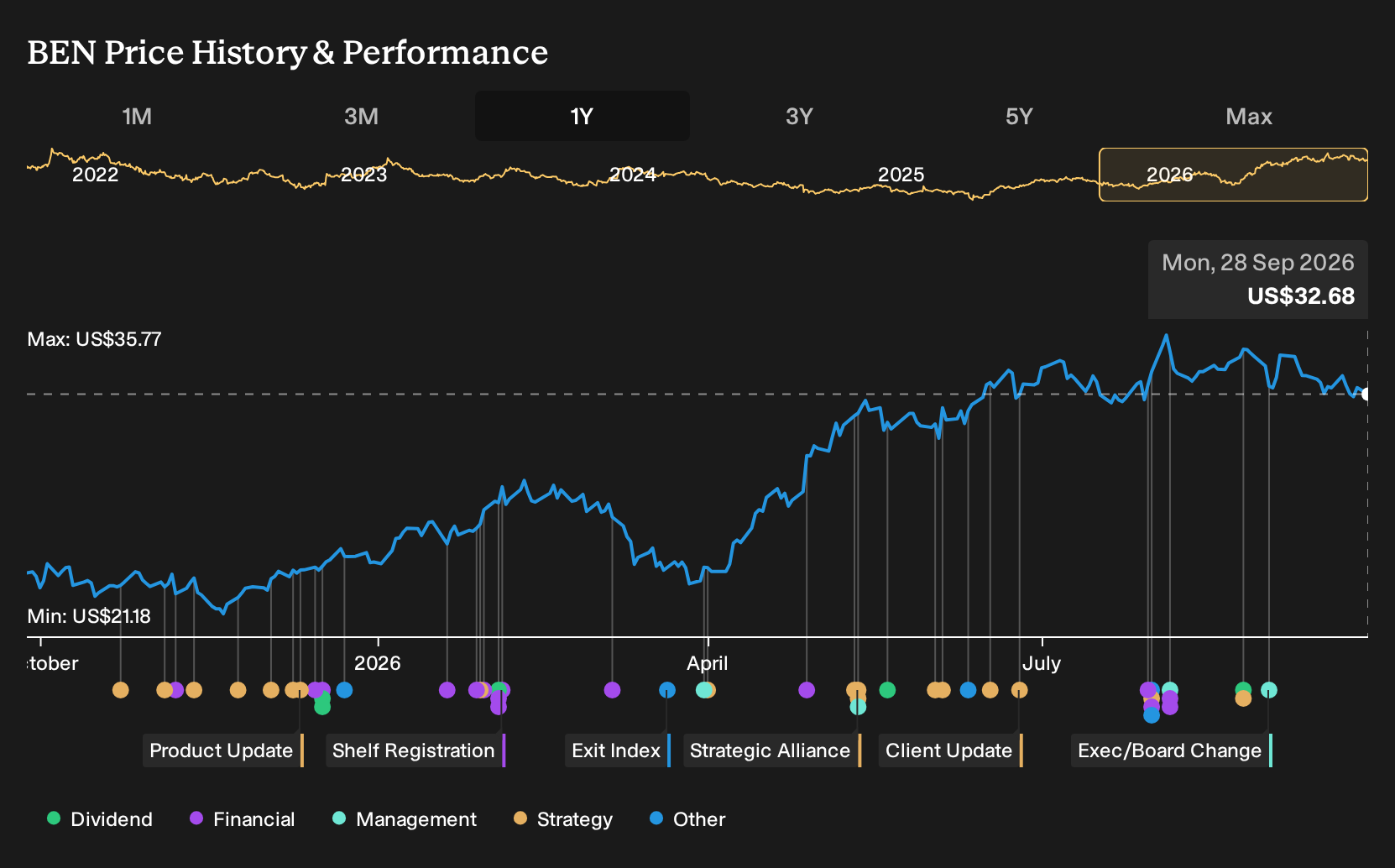
On valuation, the consensus price target of US$35.18 sits modestly above the current share price of US$33.01. This is a gap of about 6.2%. That target is anchored to 2029 expectations of US$9.4b in revenue and US$1.4b in earnings, on a 15.1x P/E multiple that is below the current US Capital Markets industry P/E of 39.7x. The implied rerating is actually a derating, with investors being asked to accept a lower future multiple in exchange for higher earnings power.
Franklin Templeton's narrative projects US$9.4b revenue and US$1.4b earnings by 2029. This assumes broadly flat yearly revenue growth and an earnings increase of about US$640m from current earnings of US$759.2m.
For anyone weighing this against the tokenization push, the key takeaway is that the Benji platform and Bybit link are currently treated as supporting acts inside a much larger playbook. Analysts are still framing Franklin Templeton around traditional levers such as margin expansion, acquisition integration and retirement flows. If on-chain collateral and tokenized funds eventually matter more, that would layer on top of these existing assumptions rather than replace them in the model.
Uncover why Franklin Templeton's fair value indicates an 8% potential upside to its current price that may not last much longer.
Exploring Other Perspectives
One contrasting angle is tokenization risk. The lowest Franklin Templeton analysts already assumed earnings of about US$1.8b on roughly US$9.8b of revenue by 2029, yet still only saw fair value near US$27.36. That more cautious group viewed digital bets as expensive and unproven. You can now ask whether this new Bybit link shifts that story at all.
Explore 5 other Franklin Templeton fair value estimates, including one that suggests as much as 17% downside from the current price.
Reach Your Own Conclusion
Don't just follow the ticker; dig into the data and build a conviction that's truly your own.
- A great starting point for your Franklin Templeton research is our analysis highlighting 3 key rewards and 2 important warning signs that could impact your investment decision.
- See our latest analysis for Franklin Templeton. The report includes a comprehensive fundamental analysis summarized in a single visual, the Snowflake, making it easy to evaluate Franklin Templeton's overall financial health at a glance.
Looking For More Investment Ideas Beyond Franklin Templeton?
Once you have a handle on Franklin Templeton, it can help to compare its setup with other opportunities that share some of the same qualities, whether that is valuation support, balance sheet strength or lower perceived risk. The Simply Wall St Screener lets you do that quickly by focusing on the traits that matter most to your approach.
- If you want potential mispricing as a starting point rather than a finish line, scan through our 32 high quality undervalued stocks that already combine strong fundamentals with attractive pricing signals.
- For readers who care more about resilience than excitement, filter by our 30 resilient stocks with low risk scores and focus on companies with steadier risk scores and fewer financial red flags.
- Income focused investors can concentrate on stability and payout strength by checking the 6 dividend fortresses that pair higher yields with more robust underlying businesses.
This article by Simply Wall St is general in nature. We provide commentary based on historical data and analyst forecasts only using an unbiased methodology and our articles are not intended to be financial advice. It does not constitute a recommendation to buy or sell any stock, and does not take account of your objectives, or your financial situation. We aim to bring you long-term focused analysis driven by fundamental data. Note that our analysis may not factor in the latest price-sensitive company announcements or qualitative material. Simply Wall St has no position in any stocks mentioned.
Have feedback on this article? Concerned about the content? Get in touch with us directly. Alternatively, email editorial-team@simplywallst.com