
The Muse AI Threat to Progressive Stock Is Currently Overstated
Just days after Meta Platforms (META) launched Muse AI, its personal artificial intelligence (AI) agent designed to handle multi-step tasks like shopping for insurance, comparing quotes, switching policies, and canceling old coverage, Wall Street delivered a clear message. Shares of banks, insurers, and travel companies sold off sharply on Sept. 22, with the S&P 500 Financials Index ($SRFI) falling nearly 2% to its lowest level since July.
The narrative was simple. If an AI can secure a cheaper auto policy in minutes, traditional retention advantages and pricing power face a genuine threat.
The selloff reversed almost as quickly. On Sept. 23, online insurance marketplace Insurify blocked Muse from its comparison platforms, warning that automated agents can strip carrier quotes of essential context and create extra data-check costs for insurers.
Still, Muse AI raises a question that investors cannot simply dismiss. Is the threat overstated, and how should investors actually play Progressive (PGR) stock from here? Let’s take a closer look.
Progressive’s Earnings Strength
Based in Mayfield Village, Ohio, Progressive sells personal auto, commercial auto, homeowners, renters, motorcycle, boat, and other property-casualty insurance. Valued at $119 billion by market capitalization, the insurer distributes policies through independent agents, its direct online and phone channels, and partner platforms, while generating most revenue from premiums.
Shares of PGR stock closed at $209.47 on Sept. 28. Currently, shares are down by 8% year-to-date (YTD) and down 14% over the past 52 weeks.
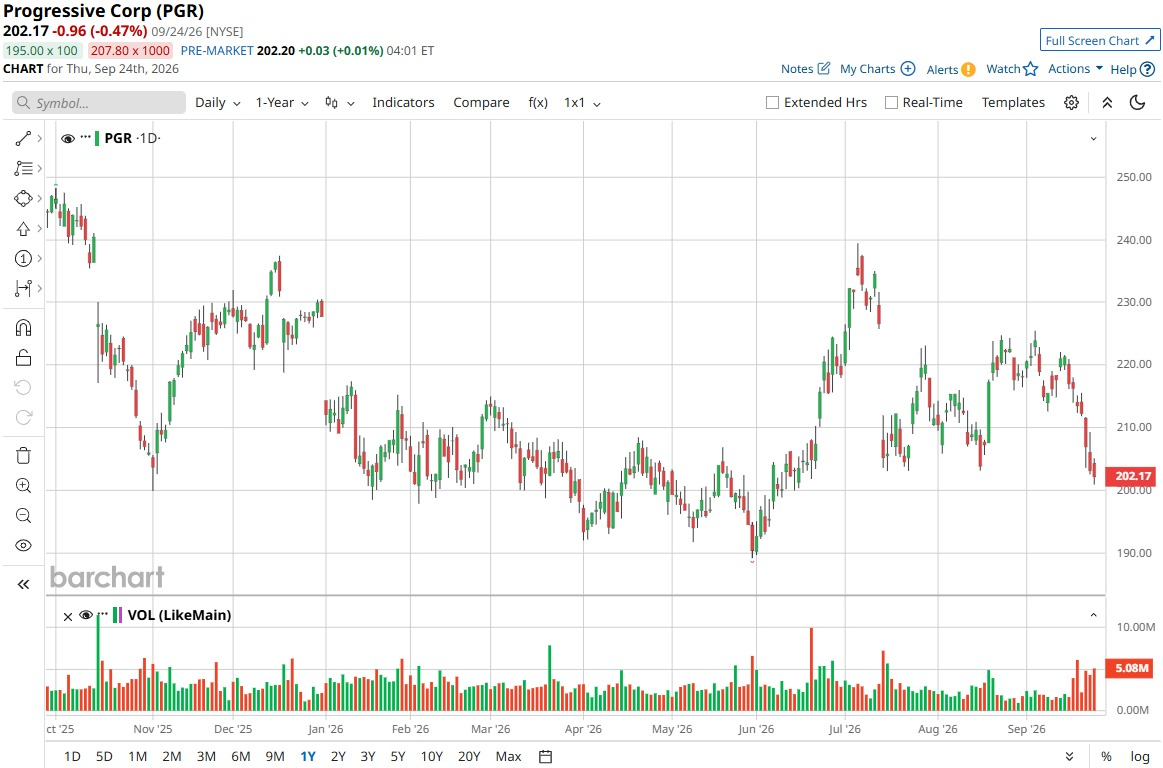
PGR stock trades at a price-to-sales (P/S) ratio of 1.3 times, which is a notable discount to the sector median of 3 times. Meanwhile its price-to-book (P/B) multiple of 3.4 times stands well above the sector median 1.3 times. Progressive also carries a forward annual dividend of $0.40 per share, equating to a modest 0.20% yield.
Progressive released its second-quarter fiscal 2026 results on July 15, reporting $21.57 billion in net premiums earned for the quarter. The premium total increased 6% year-over-year (YOY) but came in slightly below Wall Street’s $21.7 billion estimate.
This result matters because net premiums earned accounted for 94.5% of Progressive’s revenue during the past five years. This leaves the insurer heavily dependent on underwriting performance, rather than fee-based or other non-insurance income streams.
The company generated $23.61 billion in revenue, up 7% from a year earlier and broadly matching the consensus forecast. Progressive also posted GAAP EPS of $5.67, surpassing the $5.30 analyst estimate.
Book value per share reached $59.05, rising 6% YOY and landing close to the $59.31 consensus forecast. This measure has compounded at 13.7% annually during the past five years, and accelerated to 21.7% annual growth over the last two years, rising from $39.85 to $59.05.
All told, the figures show a company still generating profits and expanding shareholder capital, even if margins require close monitoring.
How to Play PGR Stock Now
Progressive shareholders should not sell simply because Muse AI could make insurance shopping easier. The risk is that an agent helps customers find competing quotes more often, increasing switching and pressuring retention. That matters for an auto insurer, but it is not evidence that Progressive’s underwriting business has weakened.
Meta is developing technology that can handle more complex tasks. Its Muse Spark 1.3 model can use tools and revise its approach while working through a request. Those capabilities make automated policy shopping more plausible. They do not show that the consumer agent can consistently obtain accurate quotes or compare equivalent coverage.
Insurify's decision to block Muse from its marketplace illustrates the access problem. Even where quotes are available, the lowest premium may come with a higher deductible or lower coverage limits. An agent that misses those differences could produce a misleading comparison.
Progressive faces a genuine distribution risk if AI agents become a common starting point for insurance shoppers. More frequent comparisons could raise acquisition costs or push insurers to compete harder on price.
Yet Progressive still sets its rates, selects the risks it accepts, and handles the claims it pays. Its direct channels and Snapshot program give it ways to compete for digitally active customers without relying solely on an outside shopping platform.
The distinction for investors is between a possible change in how customers find policies and a demonstrated change in Progressive’s profitability. Existing shareholders have a case to hold while policy growth and underwriting margins remain healthy.
Prospective buyers should not assume PGR stock is attractive merely because it has fallen. Instead, they should look for continued policy growth and a sound combined ratio before treating the decline as an opportunity.
Muse could eventually make customer retention harder. But until Progressive’s results show sustained damage to growth or underwriting profitability, the threat looks overstated rather than decisive for PGR stock.
Wall Street Expects Modest Earnings
Progressive is scheduled to release Q3 results on Oct. 21. Analysts expect earnings of $4.26 per share, up 5% from $4.05 a year earlier.
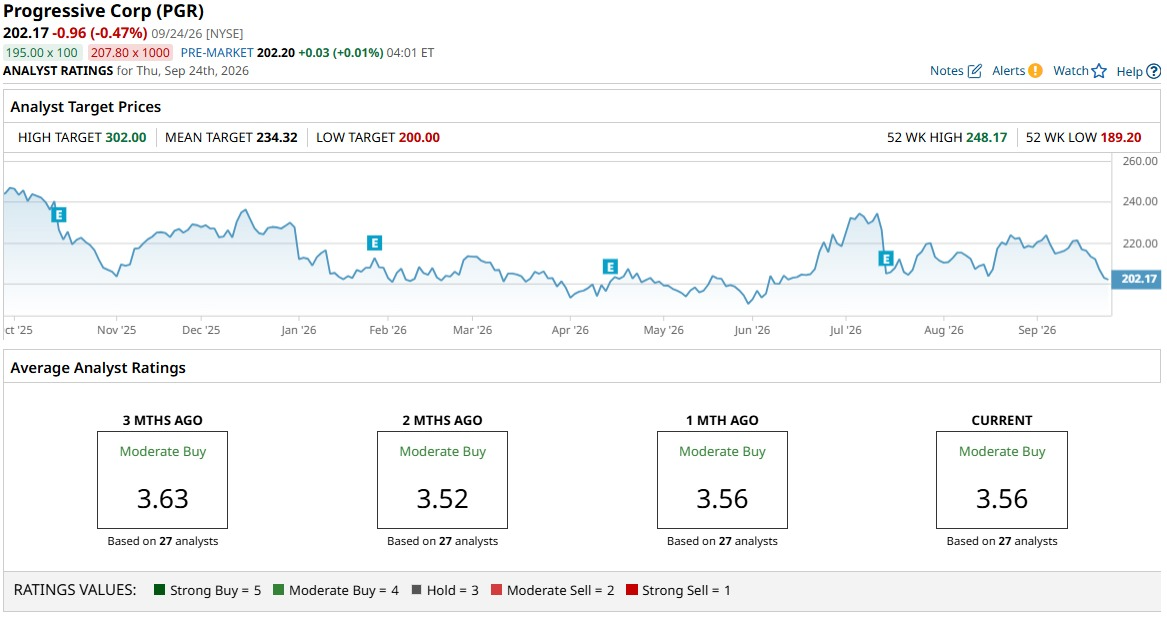
That expected growth helps explain Morgan Stanley’s more constructive stance. In July, the firm upgraded Progressive stock from “Underweight” to “Equal-Weight” and raised its price target from $190 to $210. The new target is roughly in-line with current levels.
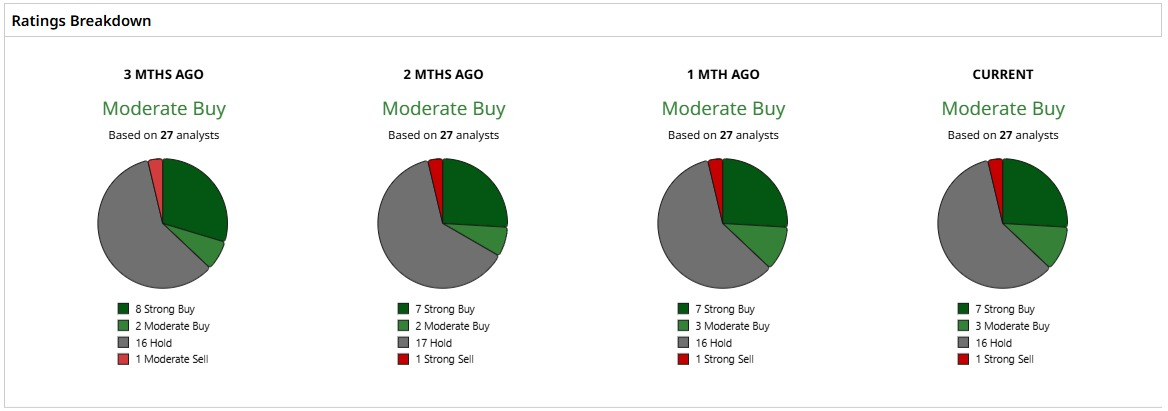
Overall, Wall Street remains optimistic. Based on 27 analysts with coverage, PGR stock has a consensus “Moderate Buy” rating. The average price target of $233.54 implies potential upside of about 12% from current levels.
Conclusion
Muse AI could make it easier for customers to compare policies, and that may eventually put pressure on Progressive’s retention and margins. For now, the threat looks overstated, although it is too early to dismiss. Existing shareholders can watch how policy growth and underwriting profitability hold up before making a move. Potential buyers should be patient rather than treat the recent decline as an automatic bargain. The likelier outcome is more competition for customers, not an immediate change to Progressive’s core business.
On the date of publication, Ebube Jones did not have (either directly or indirectly) positions in any of the securities mentioned in this article. All information and data in this article is solely for informational purposes. For more information please view the Barchart Disclosure Policy here.