
Will Edge Compute Rollout Change Charter Communications Stock Narrative
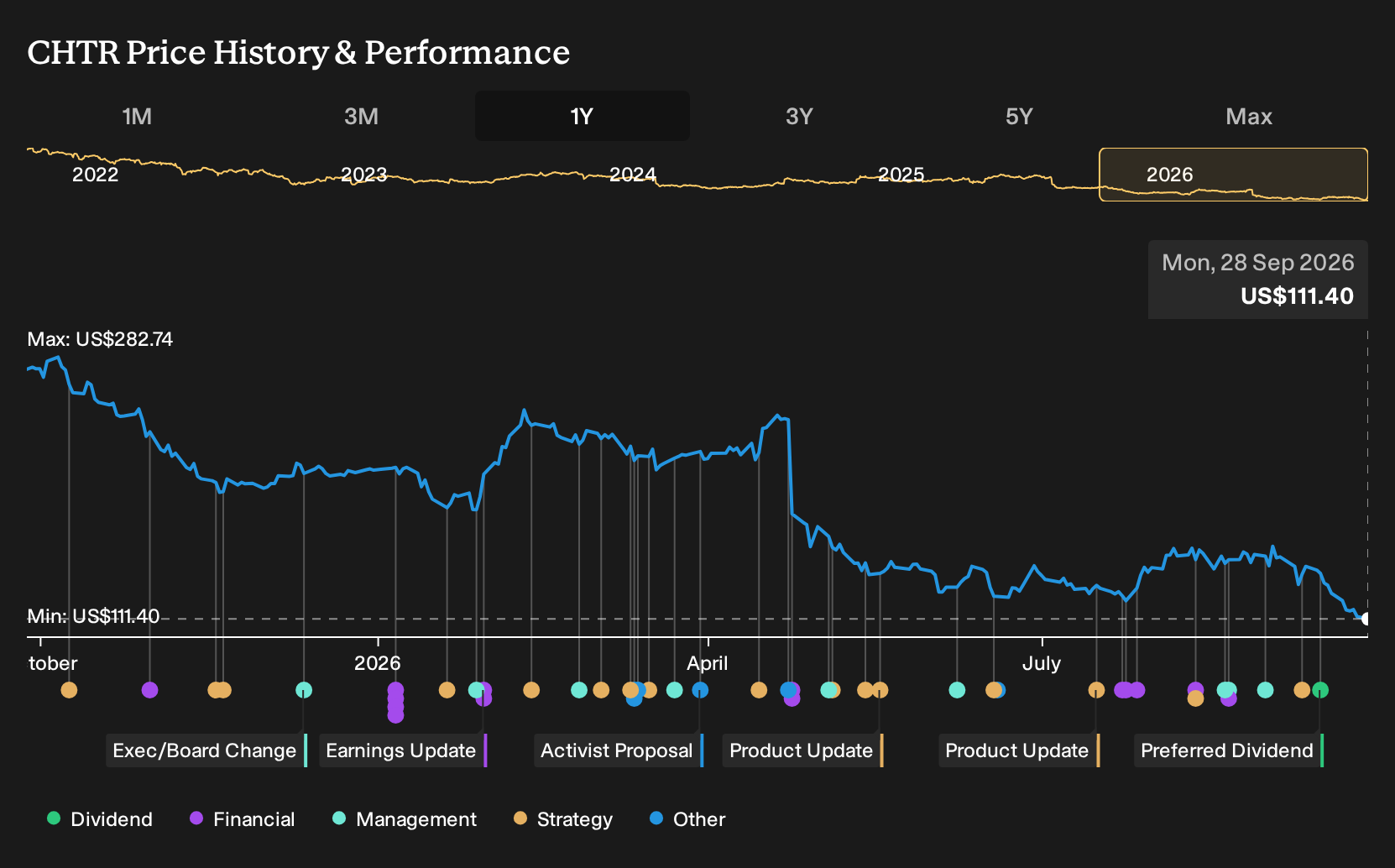
- Charter Communications hosted presentations at SCTE Tech Expo 26 in Atlanta and recently confirmed a regular quarterly cash dividend of $0.43750001 per share on its Series A Cumulative Redeemable Preferred Stock, payable on October 15, 2026 to holders of record on September 30, 2026.
- Spectrum, Charter Communications' brand, has rolled out more than 1,000 edge data centers and is using NVIDIA powered infrastructure with partners such as Cast AI, HP, WWT, and Hydra Host to support low latency AI workloads for robotics and industrial automation.
- The focus now turns to how Charter Communications' new AI driven edge compute rollout might reshape the existing investment narrative around broadband pressure.
Charter Communications Investment Narrative Recap
Being a shareholder in Charter Communications means believing the core connectivity business can absorb pressure on broadband subscribers while Spectrum Mobile, network upgrades and cost efficiencies help keep cash generation resilient. The short term hinge remains how steep broadband losses actually are, given expectations for further pressure and rising fiber and wireless competition.
The biggest risk is that weaker broadband trends combine with high leverage and less support from programs like ACP, which could tighten financial flexibility just as capital needs for network and AI investments stay high. The recent dividend decision on preferred stock appears operationally routine and does not materially change that near term equation.
The most relevant update for this story is Spectrum’s Edge Compute Infrastructure rollout, with more than 1,000 edge data centers and NVIDIA powered hardware showcased at SCTE Tech Expo 26. That buildout sits directly on top of Charter Communications’ existing network, so execution here still relies on keeping broadband churn manageable and capital discipline intact.
For you, the key question is whether edge compute and AI workloads can turn into a meaningful usage and revenue driver before competition and funding costs increase further. If UBS is correct that Q3 broadband losses will be steeper, then the AI infrastructure push becomes more of a test. It needs to support higher value services without stretching the balance sheet further.
Charter Communications' current narrative points to revenue of US$70.8b and earnings of US$4.9b by 2029. This implies analysts are factoring in 9.2% yearly revenue growth while keeping earnings flat at US$4.9b, so the expected earnings change is described as no change from earnings today of US$4.9b.
Uncover why Charter Communications' fair value indicates a 61% potential upside to its current price that may be short-lived.
Exploring Other Perspectives
Some of the most optimistic analysts see the real story in margin expansion rather than broadband pressure. Before this SCTE Tech Expo news, the bullish camp was sketching a path for Charter Communications to lift earnings from US$4.9b to US$6.2b by 2029, with revenue around US$55.5b. That is a very different narrative. It assumes rising profitability, a higher 7.8x P/E on those future earnings, and faster free cash flow growth than the consensus view. Your takeaway is simple: opinions around Charter Communications can be wide apart, so it can help to compare these upbeat pre news forecasts with your own expectations and decide which story feels closer to how you see the edge compute and AI push playing out.
Explore 6 other Charter Communications fair value estimates, including one that suggests as much as 527% upside from the current price!
Decide For Yourself
Don't just follow the ticker. Dig into the data and build a conviction that's truly your own.
- A great starting point for your Charter Communications research is our analysis highlighting 2 key rewards and 2 important warning signs that could impact your investment decision.
- See our latest analysis for Charter Communications. The report includes a comprehensive fundamental analysis summarized in a single visual, the Snowflake, making it easy to evaluate Charter Communications' overall financial health at a glance.
Looking For More Investment Ideas Beyond Charter Communications?
If the Charter Communications story has sharpened your thinking about risk, cash generation and new technology themes, it can be helpful to line it up against other opportunities that fit different profiles on quality, value and volatility.
- If you prefer resilient businesses with steadier risk profiles and want a curated starting point rather than a blank search field, then scan our 30 resilient stocks with low risk scores that fit a more defensive brief.
- If balance sheet strength is a top priority and you want to focus on companies with healthier financial foundations, start with this list of solid balance sheet and fundamentals (25 results) built to spotlight sturdier capital structures.
- If you are looking for companies with strong fundamentals that the market may have overlooked and want ideas that feel earlier in the story, take a look at our 16 high quality undiscovered gems that might deserve a spot on your watchlist.
This article by Simply Wall St is general in nature. We provide commentary based on historical data and analyst forecasts only using an unbiased methodology and our articles are not intended to be financial advice. It does not constitute a recommendation to buy or sell any stock, and does not take account of your objectives, or your financial situation. We aim to bring you long-term focused analysis driven by fundamental data. Note that our analysis may not factor in the latest price-sensitive company announcements or qualitative material. Simply Wall St has no position in any stocks mentioned.
Have feedback on this article? Concerned about the content? Get in touch with us directly. Alternatively, email editorial-team@simplywallst.com