
The $1.45 Billion Question Facing Vertiv Investors
The next bottleneck in artificial intelligence (AI) may not be about making more chips. The problem is getting enough power to run all those chips in the first place. And this is where Vertiv Holdings (VRT) is making a $1.45 billion bet. The data center infrastructure company is acquiring UtilityInnovation Group (UIG), a company specializing in microgrids, onsite generation, and power controls, bringing Vertiv closer to the point where an AI data center gets its electricity. But the $1.45 billion is not the complete picture. Vertiv could ultimately end up paying another $1.15 billion if UIG hits its EBITDA targets.
The question now is whether this $2.6 billion potential bet can turn AI’s power bottleneck into a bigger growth opportunity for Vertiv or an expensive bet.
Vertiv Is Moving Closer to the Power Source
Vertiv makes the infrastructure, such as power systems, cooling equipment, thermal management, and other technologies needed to keep the data centers running. By acquiring UIG, Vertiv is trying to get involved even before the data centers are built. UIG works on microgrid controls, specialized switchgear, on-site generation orchestration, energy storage coordination, and behind-the-meter power architecture — all the things that are needed to obtain and manage electricity before the site is built.
The International Energy Agency expects global electricity demand to increase 3.6% in 2026 and another 3.8% in 2027, driven by the expanding data center capacity. Until now, Vertiv’s opportunity has been largely about supplying the infrastructure needed to keep the data centers running. With this acquisition, the company will now be able to solve the problems that come even before that.
The $1.45 Billion Is Only the Starting Point
The purchase price for the deal is $1.45 billion, payable in cash when the transaction closes, subject to customary adjustments. The agreement also contains another potential payment of $1.15 billion in cash. However, that payment comes with a condition that UIG reaches an undisclosed EBITDA target over 12- and 24-month measurement periods. So a significant portion of the purchase price is effectively tied to UIG’s future performance. This makes UIG’s future earnings growth especially important for Vertiv’s investors.
While the acquisition is sizeable, Vertiv is entering it from a stronger financial position. Its balance sheet strength gives investors an idea of the company’s willingness to pursue a deal of this size. Its debt-to-equity ratio is around 0.62, which is not quite high. This suggests that the acquisition is being undertaken from a balance sheet that is overwhelmingly dependent on debt. The company ended the June quarter with $5.6 billion of liquidity.
Furthermore, Vertiv also generated $925 million in adjusted free cash flow during the quarter and expects to generate $2.4 billion to $2.6 billion for the full year. This makes the $1.45 billion upfront payment large but not beyond its financial capacity. The company’s revenue and adjusted earnings increased 24% and 60% year over year in the second quarter.
Vertiv also has a five-year revenue CAGR target of 20% to 22% and aims to reach a 27% adjusted operating margin by 2030. There is also the matter of opportunity cost investors might consider. The money spent on the acquisition cannot be used at the same time for product expansion, debt reduction, or shareholder returns.
But Vertiv sees a long-term opportunity in this deal, as it could expand its addressable market beyond its traditional role inside the data center. The strategy carries some risk too. If UIG’s technology helps data-center customers solve power constraints earlier, Vertiv’s infrastructure relationship with its clients will strengthen. Investors need to wait and see whether UIG can generate enough incremental earnings to justify the price Vertiv has agreed to pay.
What Does Wall Street Say About Vertiv Stock Now?
Wells Fargo analyst Stephen Tusa has started coverage of Vertiv with an “Overweight” rating and a $340 price target. He sees Vertiv as one of the strongest sales-growth stories among diversified industrial companies, led by its data-center business, expanding market share, and growing services revenue. Tusa also believes these factors could support higher profits and help justify Vertiv’s premium valuation.
Currently, Vertiv stock is trading at 26x forward earnings. Analysts expect adjusted EPS of $6.73 in 2026, implying roughly 60% growth, followed by another 36% to $9.16 per share in 2027.
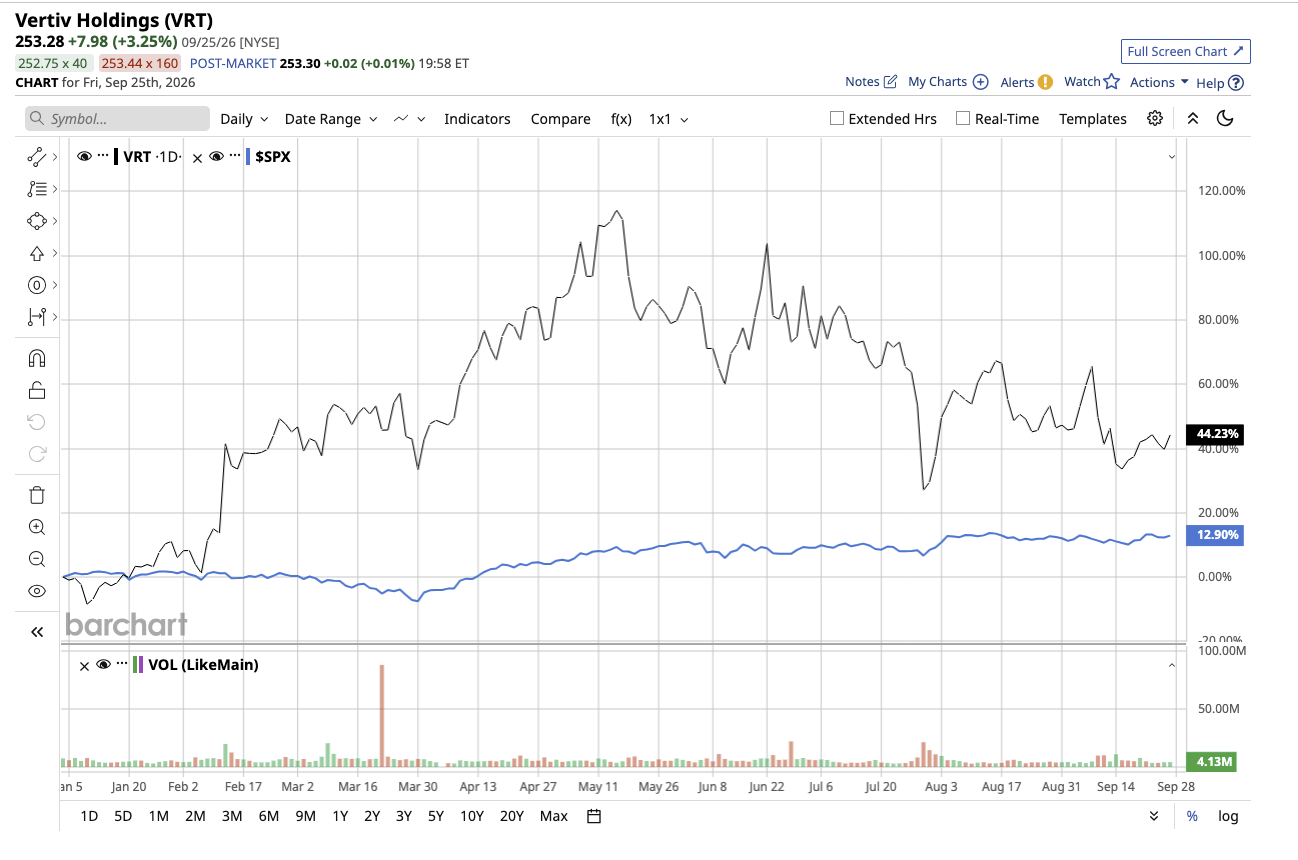
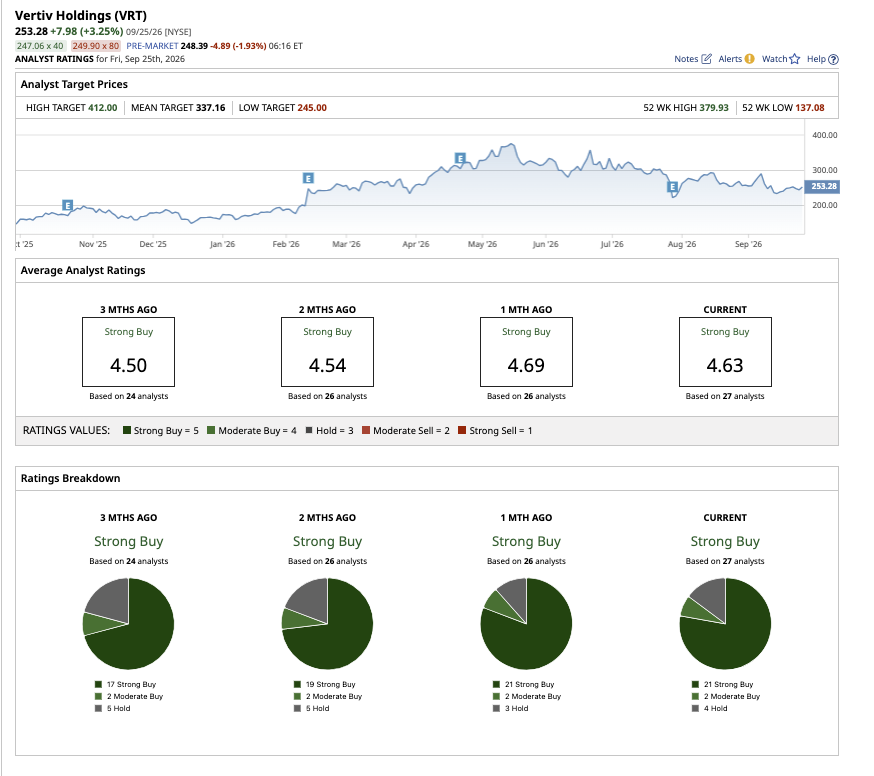
On Wall Street, VRT stock is an overall “Moderate Buy.” Of the 26 analysts covering the stock, 20 rate it as a "Strong Buy," two call it a "Moderate Buy," and four recommend a “Hold.” Vertiv stock has climbed 44.2% year to date. Yet, analysts expect the stock to climb by another 33.1% from current levels, based on its average target price of $337.16. Plus, its high price estimate of $412 suggests potential upside of 62.6%.
On the date of publication, Sushree Mohanty did not have (either directly or indirectly) positions in any of the securities mentioned in this article. All information and data in this article is solely for informational purposes. For more information please view the Barchart Disclosure Policy here.