
The persistent problem of inflation has led investors to plan “higher for longer”! The global bond market has been hit
The Zhitong Finance App learned that while soaring energy costs are driving up inflation, the artificial intelligence (AI) boom is boosting economic growth. This has prompted investors to begin planning for an era where interest rates remain high (higher for longer) for a longer period of time, and the global bond market is also being impacted as a result.
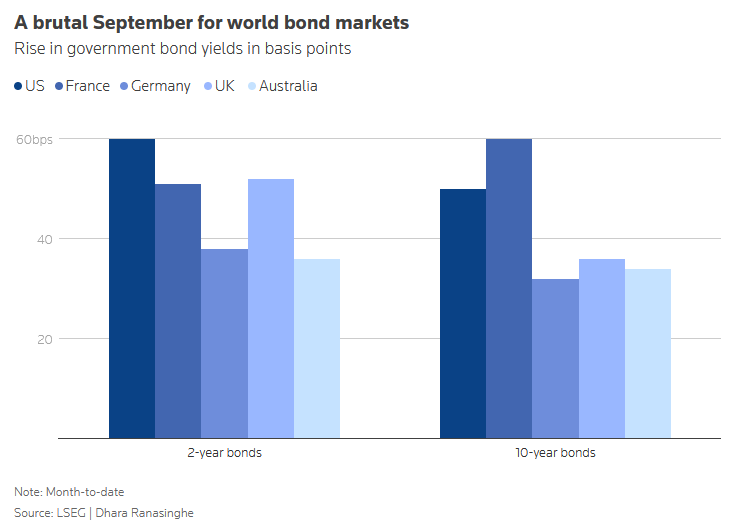
Among them, the world's largest sovereign bond market is entering its worst month in years — two-year US bond yields, which are sensitive to monetary policy, soared nearly 60 basis points in September, and are expected to record the biggest monthly increase since early 2023; 10-year US bond yields rose by a cumulative total of about 50 basis points in September — which is also expected to be the biggest monthly increase since 2022 — has now broken through 5% and hit a new high since 2007.
Meanwhile, two-year government bond yields in France, Germany, the United Kingdom, and Australia are also expected to record their biggest monthly increase since March, while Japanese government bond yields are hovering near decades-long highs.
Kenneth Broux, head of foreign exchange and interest rate corporate research at Société Générale, said: “The market has realized that the entire energy problem and the inflation problem will not go away in the very short term. The bond market is making adjustments to this.”
For some investors, rising yields have once again made government bonds attractive. However, given concerns about the government's high debt, other investors remain wary of long-term bonds.
The global bond market will also face a series of new tests in October, including the latest US employment and inflation data, French budget negotiations, UK budget proposals, and the possibility that technology companies may further increase bond issuance.
High interest rates last longer
Sovereign bond markets are important because they affect the cost of loans to businesses and consumers, such as mortgages. If borrowing costs rise too fast, it may threaten financial and economic stability, so the government and central bank are paying close attention to this.
Compared to 2022 — 2022 was the worst year on record for bond returns — what unsettles the market today is not only the speed with which interest rates are changing, but also the absolute level at which global interest rates are already high and continue to rise. The ICE BofA MOVE Index, which measures the volatility of the bond market, surged nearly 30% in September, the biggest increase since March. This fluctuation, which is expected to continue, caught some investors by surprise.
However, there are also investors who are sniffing out the opportunity. Florian Ielpo, head of macro and multi-asset portfolio management at Lombard Odier Investment Managers, said that given the high yield, his attitude towards government bonds has changed to be more positive. He expects that government borrowing costs will also remain high for some time, as the market will also compete with large technology companies' bond issuances to raise capital for AI investments. According to data from the London Stock Exchange Group (LSEG), the bond issuance scale of hyperscalers (hyperscalers) has more than doubled this year to more than 200 billion US dollars.
Deal makers also said they can accept financing costs, which are currently at the highest level since the global financial crisis. Warburg Pincus CEO Jeffrey Perlman said at a conference in Singapore on Tuesday: “By historical standards, the 5% 10-year US Treasury yield is not particularly high. With a yield of 5%, the transaction still works.”
There are many challenges ahead
However, in Europe, the French budget negotiations and the first budget submitted by the new British Chancellor of the Exchequer John Healey may continue to focus the market's attention on the financial difficulties of large economies.
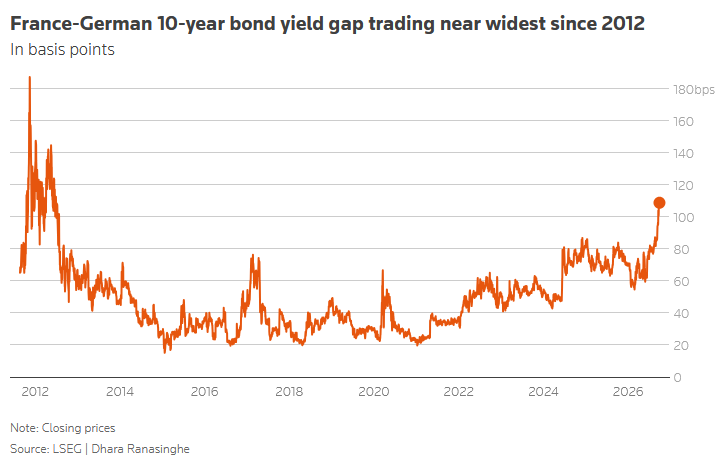
Political tension in France has further fueled notable bond market volatility. The country's 10-year treasury yield has soared more than 50 basis points this month, the biggest monthly increase since 2022, and pushed the spread between it and German treasury yields to the highest level since 2012.
Andrzej Szczepaniak, senior European economist at Nomura Securities, said, “Now that France is facing additional unique risks, people are starting to think, where is the budget? Will there be no budget at all? What's going to happen next? Furthermore, now (the far-left presidential candidate) Melanchon's approval rating in the polls is also rising.”
In the US, although the interest rate hike in September increased the Fed's credibility in fighting inflation, the market's focus remains on the uncertainty of the economic outlook and what next steps the Treasury will take to contain rising borrowing costs. Arun Sai, senior multi-asset strategist at Pictet Asset Management, said, “Policy uncertainty is hitting us from two places — the Federal Reserve and the Treasury, and I'm very uneasy about the US policy mix.”