
Cui Dongshu: Domestic passenger car demand is far from peaking, and the short-term downturn is a phased disturbance, and the long-term market still has huge room for growth
The Zhitong Finance App learned that Cui Dongshu, Secretary General of the Passenger Transport Association, published an article stating that the domestic passenger car market has continued to cool recently. Domestic passenger car retail sales have fallen by about 20% since the 2nd quarter of '26, and industry pessimism continues to ferment. Some opinions believe that the domestic automobile market has hit the ceiling of demand, and the era of total volume growth has completely come to an end. Through comprehensive benchmarking between Guangdong, China's core consumer province, and the Japanese market, I have thoroughly investigated and judged from multiple dimensions such as population size, residents' income structure, car ownership penetration rate, new car sales cycle, urban and rural consumption differences, and institutional policy systems. I have systematically demonstrated that the current downturn in the car market is a phased disturbance caused by a combination of multiple short-term factors; it is not a peak of the fundamentals of automobile popularity. China's passenger car market is still in the middle of popularization. The blue ocean of first-time purchase demand in sinking counties is vast. Combined with the cost revolution brought about by the new energy industry chain, there is huge room for medium- to long-term growth. In particular, it can be clearly seen from the comparison of China and Japan's mini scooter systems: China does not lack demand for automobile consumption, but rather lacks Japan's K-Car-style inclusive consumption incentive regulation system. Regulations and tax system restrictions have suppressed the release of huge demand for entry-level first-time purchases. Auto owners should abandon short-term pessimism and strengthen their confidence in the long-term growth of China's auto market.

1. Core judgment: The short-term downturn in the car market is a cyclical disturbance; it is by no means that demand has peaked
To evaluate the automobile market, a strict distinction must be made between short-term cyclical fluctuations and long-term popularity trends. The popularity of automobiles is a slow variable over a decades-long period based on urbanization, rising residents' incomes, increased driver's license population, and improved infrastructure; however, the rise and fall in annual sales is more dominated by short-term factors such as declining policies, consumer expectations, price wars, and changes in residents' assets and liabilities, which does not mean a reversal of industry fundamentals.
Domestic passenger car retail sales have continued to be under pressure since 2025. The core is the phased weakening caused by the resonance of multiple disposable and incidental factors; it is not a complete exhaustion of residents' demand for car purchases. First, policies such as early purchase tax relief and national trade-in subsidies overdrew large amounts of consumer demand in advance, and naturally entered a phased empty demand window after the policy was withdrawn; second, the industry continued to have a deep price war, strong consumer sentiment, and the “buy rise or not buy down” mentality delayed car purchase decisions; third, real estate market adjustments continued to affect residents' bulk consumer confidence, and household balance sheet repair was slow, suppressing car replacement and initial purchase intentions; fourth, adjustments in technical specifications for entry-level new energy models and contracted supply of low-end compliant products directly dragged down the market Sales performance. The above factors are all short-term external disturbances, and have not changed the underlying logic of automobile popularity in China.
In line with the rules of mature global markets, the peak and contraction of the Japanese car market have clear fundamental irreversible characteristics. New car sales in Japan reached an all-time peak of 7.78 million units in 1990. After the popularization of the country's national cars, the combined population continued to grow negatively, deep aging, and urbanization was completely completed. The market entered a long-term contraction channel. In 2024, sales of new cars were only 4.42 million units (including K-Car light vehicles). The market has completely entered the stock replacement stage, and there is basically no demand for new initial purchases. The decline in the Japanese car market is a two-way long-term result of the completion of popularization and the deterioration of the population structure, and is completely uncomparable to China's current stage of development.
Using Guangdong, the most representative mature consumer province in China, as a target sample, we can also intuitively verify the huge growth potential of China's auto market. The resident population of Guangdong is 129 million, and the total population of Japan is 123 million. The population size of the two is basically the same. However, there is a huge gap between car ownership data: Guangdong has 32.34 million cars and 1,000 people have 262 cars; Japan has a total of 82 million cars, and 1,000 people own up to 660 vehicles. The population of Guangdong slightly exceeds that of Japan, but the total number of cars owned is only 41% of Japan, and the penetration rate of 1,000 people is less than 40% in Japan. The gap in popularity is extremely significant.
Clarifying misconceptions about production and sales is critical. As the largest automobile industry base in the country, Guangdong produced 5.707 million vehicles in 2024. The vast majority of products are exported to foreign countries. This is an industrial manufacturing capacity, not local consumption sales. The actual retail sales volume of new cars in Guangdong has stabilized between 200 and 2.9 million units over the years, 1.93 million units in 2020, 2.25 million units in 2021, 2.45 million units in 2022, 2.91 million units in 2023, and 2.44 million units in 2024, ranking first in provincial new car retail for many years in a row. Against the backdrop of a comparable population and continued economic growth, the sales volume of new cars in Guangdong is significantly lower than in Japan, but the penetration rate gap is huge, which fully proves that Guangdong and the whole country are still in a cycle of rising automobile popularity, far from reaching the ceiling of demand.
Conclusion: The most developed automobile consumer provinces in China still have a huge penetration gap. The national third- and fourth-tier and county markets have more room for growth, and the short-term decline in sales will not change the long-term growth trend.
2. Core city benchmarking: Purchase restrictions in first-tier cities are supply constraints, not demand saturation
There are major misunderstandings in the market, equating the purchase restriction policies of the first tier cities in Guangzhou and Shenzhen with peaking market demand. Through accurate three-dimensional benchmarking of the population, ownership, and new car sales of Guangzhou, Shenzhen, and Tokyo and Osaka in Japan, it is possible to clearly confirm the objective rules of automobile popularity in major international cities and break the theory of first-tier city saturation.
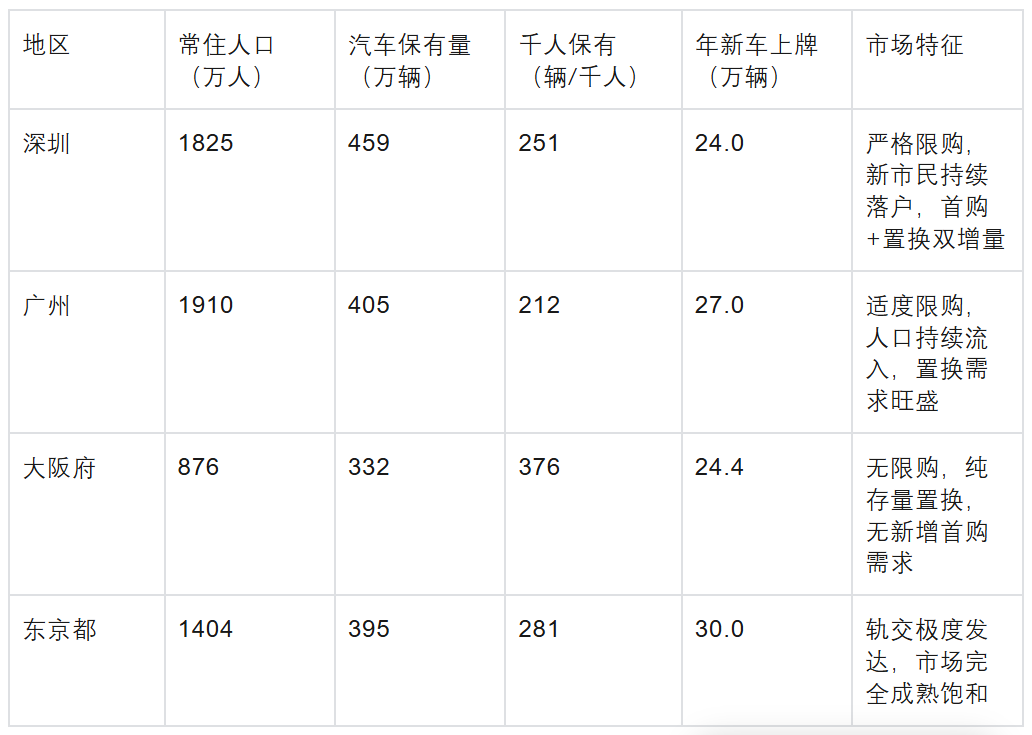
2.1 Core data benchmarking of core cities in China and Japan (2024-2025 unified caliber)
Caliber description: Japan uses prefectural administrative units to benchmark domestic prefecture-level cities. The statistical caliber includes all civilian motor vehicles (including K-Cars). The sales volume of new vehicles is officially registered and licensed locally, and the caliber is completely uniform and comparable.
2.2 Shenzhen vs. Osaka Prefecture: Structural differences between high-density industrial cities
The resident population of Shenzhen is 18.25 million, 2.1 times that of Osaka Prefecture's 8.76 million, yet the number of cars owned by 1,000 people is only 251, far lower than Osaka Prefecture's 376. The annual number of new car licenses between the two places is basically the same, with 240,000 in Shenzhen and 244,000 in Osaka Prefecture. Seemingly on a similar scale, there is an essential difference in the market demand structure. The population of Osaka Prefecture continues to shrink and the household structure solidifies. 100% of new car transactions replace old models. There is no new demand for first purchases, and the market has completely stagnated. Meanwhile, Shenzhen continues to absorb young talents from all over the country, and new families continue to be formed. Under strict license quota restrictions, the market still retains stable demand for initial purchases, compounded by the dividends of electrification of fuel vehicles, and has the momentum for continuous endogenous growth.
2.3 Guangzhou vs. Tokyo: The popularity gap of superhub cities
Guangzhou has a resident population of 19.1 million, which is significantly higher than Tokyo's 14.04 million, but the number of cars owned by 1,000 people is only 212, which is far lower than Tokyo's 281. In terms of new car sales, Guangzhou's 270,000 units and Tokyo's 300,000 units are in the same level. Tokyo is a supercity with the most developed public transportation in the world. Private cars are only used as leisure aids, and the market is already fully mature. However, Guangzhou is still in the deepening stage of urbanization. The urbanization of the foreign population continues to advance, demand for smaller households and upgrading travel quality is strong, and there is huge room for fuel vehicles to be replaced with new energy sources.
2.4 Core conclusions of this dimension
Ownership of fewer than 1,000 people is a common characteristic of global megacities. High-density cities naturally rely on public transportation, weakening the commuting attributes of private cars. Purchase restrictions in Guangzhou and Shenzhen are supply-side policy restrictions on urban traffic management; they are by no means that the demand side of residents' demand for car purchases is saturated. The population of Guangshen far exceeds that of Japan's core cities, the penetration rate is lower, and the double increase of first purchases+replacements has been preserved. The structural growth space for first-tier cities has existed for a long time and has not peaked.
3. The new energy industry is restructured and popularized, and the theoretical ceiling of the domestic market far exceeds the Japanese fuel era
The popularity of Japanese automobiles relies on traditional fuel vehicles and the K-Car system. The overall cost of purchasing and using cars is high, and there are natural bottlenecks at the border of popularity. Car purchases in Japan must provide a parking space certificate, and the hidden entry threshold is high; K-Car mini car pricing is rigid, and the supply of entry-level models is insufficient; compounded by long-term high fuel prices, high insurance, high maintenance, and high annual inspection costs, the cost of popularization in the sinking market remains high.
Relying on the world's only complete NEV industry chain, China has completely restructured the cost curve for automobile popularization, and has drastically reduced both the car purchase threshold and vehicle usage costs throughout the life cycle. First, the car purchase threshold has been drastically lowered, and the domestic market has a large number of cost-effective entry-level NEV models, which accurately match the purchasing power of low-tier households; second, the cost advantage of vehicles is absolutely remarkable. NEVs have low electricity prices, minimal maintenance, and exempt from purchase tax. The cost of vehicles used throughout the life cycle is only 1/3 to 1/2 of Japanese fuel vehicles; third, infrastructure facilities continue to be improved, and the transformation of county and township charging piles and rural power grids has completely solved the pain points of vehicle use in the sinking market.
There is a rigid cost limit for the popularity of automobiles in the Japanese fuel vehicle era, and China's new energy industry has broken this limit, sinking automobile consumption to lower-income households. The theoretical ceiling for automobile popularity in China is significantly higher than in the Japanese fuel popularization era.
4. The reversal of the urban and rural structure: the sinking of the blue ocean from east, west, and north of Guangdong is the core growth of the future
The biggest structural gap between the Chinese and Japanese car markets is not in first-tier cities, and the popularity logic of sinking urban and rural markets is completely reversed. Japan presents a mature pattern of “high income and low ownership in big cities; low income and high popularity in prefectures”; Guangdong and the whole country have a growth pattern of “big cities with high income and relative saturation; low income and extremely low popularity in counties”. This is the largest incremental reservoir in China's car market.
4.1 Characteristics of income differentiation among residents in Guangdong
According to the 2024 Guangdong residents' income data, the income gap between the Pearl River Delta and the eastern, western, and northern Guangdong is nearly double. With Shenzhen's 74,100 yuan, Guangzhou's 71,500 yuan, Foshan's 62,400 yuan, and Dongguan's 61,200 yuan, the per capita disposable income of core cities generally exceeded 60,000 yuan; while the average in eastern Guangdong was 31,070 yuan, the average in western Guangdong was 31,094 yuan, and the average in northern Guangdong was 30,600 yuan. The income in eastern and western Guangdong counties was only about half of the Pearl River Delta.
The road network is scattered and public transportation is weak in the eastern, western, and northern towns of Guangdong. Objectively, there is a strong demand for private cars. However, currently less than 1/3 of Japan's prefectures own a thousand people, and a large number of households still don't own their first car. As the quality of the county economy improves, projects in thousands of towns and villages in 100 counties advance, and residents' incomes rise steadily, the sinking demand for first purchases will continue to be released.
4.2 Core characteristics of popularization in Japanese prefectures
Regional income in Japan is also divided. The income of Tokyo residents is as high as 5.2 million yen, the remote prefectures are only 2.2 million yen, and the income in the prefecture area is only 40% of that of large cities. However, public transportation is scarce in Japan's prefectures, and automobiles are the infrastructure people just need for livelihood. Relying on the dividends of the K-Car system, even low-income households can easily buy and maintain cars. The number of people in the prefecture has generally surpassed 600 vehicles. The sinking market has long been completely popularized, leaving only replacement needs.
4.3 Core Comparative Conclusions
Japan's prefectures are “low in income, high in popularity, and no increase,” while China's prefectures in eastern, western, northern Guangdong and the whole country are “low income, strong immediate demand, low popularity, and large space.” The core growth of the domestic car market in the future will definitely not come from first-tier city replacement, but from the first car purchase demand in the vast county market. The first purchase dividend is far from being exhausted.
5. The shortcomings in the mechanism are the core crux: domestic K-Car cars are popular overseas, and the country is cold, revealing the lack of a popularization mechanism
Currently, the industry generally ignores a core key: China's auto market is slowly becoming popular, demand is being suppressed, and the internal volume is sluggish in the short term. The core is not insufficient demand, but the lack of an institutional system. The most intuitive proof is the contrast between K-Car-class mini electric vehicles built by Chinese car companies for the Japanese market, which are popular in Japan, and no one cares about them domestically.
5.1 Typical contrast: Premium mini cars made in China are exclusive to Japan, and the domestic market is lacking
Leading domestic companies, including BYD, are developing exclusive miniature electric K-Car models specifically in response to Japanese regulations. They strictly fit the size, weight, and power limits of Japanese K-Cars, and are perfectly suited to short-distance transportation, rural commuting, and people's livelihood travel scenarios in Japan. Relying on local policy dividends, they are extremely economical. However, this type of fine and compliant mini car, which is most suitable for China's sinking first-time purchase market, has basically not been introduced or focused on the domestic market.
The reason for this is not that the product capacity is insufficient, but that the domestic institutional environment does not support the popularity of regular mini scooters. There are no exclusive taxes, insurance, parking, or annual inspection benefits for small cars in China. Compared with ordinary cars, mini cars have no cost advantage; there is no policy guidance on the consumer side; users prefer large cars and high configuration, and the cost performance ratio of premium mini cars cannot be reflected; the low-end mobility market is occupied by non-compliant low-speed electric vehicles, and the compliant mini passenger car market is fragmented and limited in development. In the end, an industry paradox was formed which “can make popular artifacts, but cannot be popularized locally; they can only be exported overseas”.
5.2 Japan's K-Car System: Systematic inclusion system supports popularization
Japanese automobiles can achieve widespread adoption. The core relies on the K-Car legal system that has operated steadily for decades to lower the threshold for entry-level car purchases: first, clear legal standards, and separate categories of mini scooters to guide car companies to focus on people's livelihood transportation products; second, drastic tax cuts. K-Car's annual fixed tax is only 30%-40% of ordinary passenger cars; third, maintenance insurance costs are low, accessories are common, and the rate is lower; four is relaxed car purchase threshold, K-Car exemption is strict parking space certification; five is the new energy subsidy requirement, vigorously support mini electric scooters Type development.
The core value of this system is to transform automobiles from high-end to improving consumer goods into an inclusive livelihood tool for county households, completely solving the core pain point of “not being able to buy or maintain” for low-income families, and achieving universal popularization.
5.3 Shortfalls in the domestic system suppress the release of demand for first purchases
Looking at China, on the other hand, the automobile policy has long focused on industrial upgrading, high-end, and intelligence, and lacks an incentive system for entry-level scooters to benefit people's livelihood. There is no differentiation in model taxes, insurance, or annual inspections, and cars have no cost advantage; compliance with low-speed electric vehicles has stagnated, and the regular mini car market is being squeezed; there are no differentiated benefits for road rights, parking, and traffic, which cannot guide the consumption of inclusive cars. The lack of a system has caused China's huge demand for first-time purchases in counties to be artificially suppressed for a long time.
5.4 Core conclusions of this dimension
China has the strongest manufacturing capacity and technical strength for mini electric vehicles in the world, and is fully capable of producing popular scooters with the ultimate cost ratio. The current sinking market is slowly gaining popularity and the short-term downturn in the car market. Essentially, there is insufficient supply due to institutional restrictions, rather than the arrival of a demand-side ceiling. If an inclusive policy for localized mini scooters is implemented in the future, the domestic automobile penetration rate will usher in a new round of systematic increase.
6. Medium- to long-term growth logic and structural opportunities in the domestic auto market
The underlying logic that supports the long-term growth of the Chinese auto market remains stable, and there has been no fundamental change. The first is the continuing demographic dividend. Every year, the number of people with new driver's licenses is about 20 million, and there are still hundreds of millions of potential car buyers to be converted; second, urbanization continues to deepen, county infrastructure, road networks, and charging facilities continue to be improved, and rural household travel upgrade needs are rigid; and finally, there is broad space for stock replacement. Millions of old fuel vehicles enter the replacement cycle, and electrification replacement supports the market volume for a long time.
In the future, the auto market will say goodbye to the era of general rise and enter a new stage of structural growth. The core incremental main line is divided into two categories: the first blue ocean market in the county area, which relies on 5-10 million entry-level new energy models to break through consumption blockages in the sinking market and release massive demand for first-time car purchases; the second is the urban stock replacement market, iterative electrification of fuel vehicles, and the upgrading of mid-range and high-end models to support a stable sales chassis in the urban market.
The key to the future incremental release of the industry is to make up for shortcomings in the system, improve declining support, and stabilize consumption expectations. Continuing to promote new energy in rural areas, improving after-sales and charging infrastructure in counties, optimizing the supply of entry-level models, and exploring localized inclusive scooter policies will continue to open up room for long-term growth in the industry.
7. Full text summary: Abandon short-term pessimism and strengthen long-term upward confidence in the Chinese auto market
Multi-dimensional data on comprehensive population, ownership, urban and rural structure, industrial advantages, and system comparison can be clearly judged: the current downturn in the domestic car market is a phased phenomenon of short-term policy disturbances, cyclical fluctuations, and institutional restrictions; it is by no means that the fundamentals of automobile popularity have peaked. The industry does not need to be disrupted by monthly, quarterly, or annual short-term data, let alone fall into excessive pessimism.
First, developed provinces still have a huge penetration gap compared to Japan, and there is plenty of room for growth in the national market; second, the low ownership of first-tier cities is common to large international cities, and purchase restrictions are a supply constraint, not demand saturation; third, the new energy industry is restructuring vehicle costs to raise the theoretical ceiling of automobile popularity in China; fourth, the vast county area is far from releasing initial purchase demand, which is a core incremental blue ocean for the next ten years; fifth, what China lacks is not demand and manufacturing capacity, but Japan's K-Car-style inclusive consumption incentive system.
The peaking of the Japanese car market is an inevitable result of population contraction, completion of popularization, and economic stagnation, while China is still in an upward cycle of urbanization, residents' income, and consumption upgrades. The first purchase dividend, replacement dividend, and industrial dividend are superimposed. Short-term fluctuations do not change long-term trends. Demand in the Chinese passenger car market is far from peaking. There is still huge room for improvement in the medium to long term, and the automobile industry still has great potential.