
Claude is rushing to the top of capital! AI app explosion boosts revenue by 12 times, aiming for $2 trillion valuation, Anthropic to win the global IPO
The Zhitong Finance App learned that some media quoted an IPO prospectus report seen by people familiar with the matter as saying that the overall revenue of Anthropic PBC, the global AI model/ AI application leader, increased wildly to about 12 times that of the previous year, or close to 4.6 billion US dollars. At the same time, the AI application leader that developed Claude's current public offering may make the company's overall valuation exceed $2 trillion, surpassing the overall valuation of SpaceX, which was about $1.77 trillion when it was founded and headed by Musk, and Anthropic's plan to raise close to 100 billion US dollars will also surpass the total amount of about 85.7 billion US dollars raised after SpaceX's overallocation. These all mean that Anthropic is expected to surpass SpaceX and become the largest initial stock offering in history.
As cutting-edge AI agents represented by Muse and Astra quickly became popular around the world, AI is accelerating from dialogue tools to automated programming, research, and execution of complex enterprise workflows, and is simultaneously expanding application revenue and AI computing power resource investment. Anthropic's IPO is preparing to bring this expansion into the global open capital market. People familiar with the matter said that in addition to showing a 12-fold revenue surge, Anthropic will also assume a total spending obligation of up to 518 billion US dollars for cloud services, AI computing capacity, and extensive AI infrastructure over the next few years. The potential listing valuation of more than $2 trillion means that investors will directly price the commercialization capabilities, computing power procurement commitments, and long-term profit prospects of cutting-edge models, and the impact will also extend to OpenAI and related AI computing power infrastructure providers.
Recent advances in cutting-edge AI agent/AI model technology represented by Muse, Astra, and Anthropic Claude can be described as providing an important technical foundation for large-scale commercial expansion of AI applications into various industries and the continued surge in AI computing power requirements — in particular, the expansion of the scope of intelligent applications is expected to simultaneously increase AI superaccelerators such as AI GPUs/TPUs and AI core infrastructure requirements such as high-performance CPUs, high-performance HBM/DRAM/NAND memory chips in data centers, and high-speed optical interconnect devices. Anthropic is seeking to raise up to 100 billion US dollars at a valuation of about 2 trillion US dollars, but the final plan may still be adjusted together with Wall Street banks. Whether it can set a new fund-raising record depends on the scale of the final issuance.
The IPO prospectus also shows that of the company's net loss of about 42 billion US dollars in 2025, about 34 billion US dollars came from accounting expenses due to rising valuations of financing instruments that may be converted to shares; operating losses in that year exceeded 8 billion US dollars, and computing power and infrastructure expenses were 7.33 billion US dollars. Operating losses for the year exceeded 8 billion US dollars, and computing power and infrastructure expenses were 7.33 billion US dollars. The $518 billion is an obligation to spend over many years in the future and cannot be directly treated as current cash consumption or interest-bearing debt on the statement. Meanwhile, in May of this year, Anthropic disclosed an annualized revenue operating rate of over 47 billion US dollars, indicating that the commercial scale continues to expand, but this indicator cannot be equal to the revenue already achieved throughout the year.
The future of AI commercialization ushered in an open market test! Anthropic's prospectus shows a grand vision of AI, yet costs are rising dramatically
According to the IPO prospectus quoted by the media and seen by people familiar with the matter, Anthropic is making a huge, unprecedented technological bet — artificial intelligence will transform the global economy more profoundly than industrialization, electricity, and the internet.
But the cost of achieving this goal would be enormous. According to the prospectus, Anthropic recorded a net loss of $42 billion in 2025 and plans to spend $518 billion over the next few years to meet cloud services, computing and infrastructure obligations.
The prospectus details the rapid growth of the company's business and simultaneous expansion of losses over the past year. According to these documents first disclosed by Reuters, Anthropic's revenue in 2025 increased 12 times that of the previous year, close to US$4.6 billion; at the same time, after excluding the impact of various debt write-downs mainly related to previous financing, the company's operating losses still exceeded 8 billion US dollars.
The public offering could see the company valued at more than $2 trillion, capitalize on the rapid rise of the AI startup lab that was only five years old, and make it a benchmark for Wall Street to evaluate the value of leading AI companies — including rival OpenAI.
As it moves forward with its launch plans, Anthropic is facing evidence from its own research: AI models that are increasingly autonomous may exhibit unexpected and potentially harmful behavior, including breaking code, aiding fraud, and manipulating information in controlled tests.
The findings have entered broader public discussion, raising concerns about how to ensure that these increasingly powerful systems are under control as companies compete to commercialize them.
Anthropic CEO Dario Amodei called on the global AI community to slow down the pace of rolling out new capabilities to address these concerns. Despite this, ahead of its anticipated IPO, Anthropic launched a new Opus 5.5 model last week to cope with the development momentum created by OpenAI since the release of GPT-6 Astra.
The AI lab spent $7.33 billion on computing power and infrastructure last year, tripling from 2024, accounting for more than half of its total operating expenses of $12.65 billion.
Some media recently quoted sources as saying that the official timeline for Anthropic's US stock IPO may be postponed until after the November US midterm elections. The launch will enable public investors to participate in this AI competition, which previously provided financial support mainly from venture capital firms, sovereign wealth funds, and large technology companies.
Anthropic declined to comment on any IPO news.
The IPO prospectus also revealed that the company expected a valuation of a staggering $2 trillion. Anthropic's anticipated target valuation is more than double its own estimate of $965 billion in May.
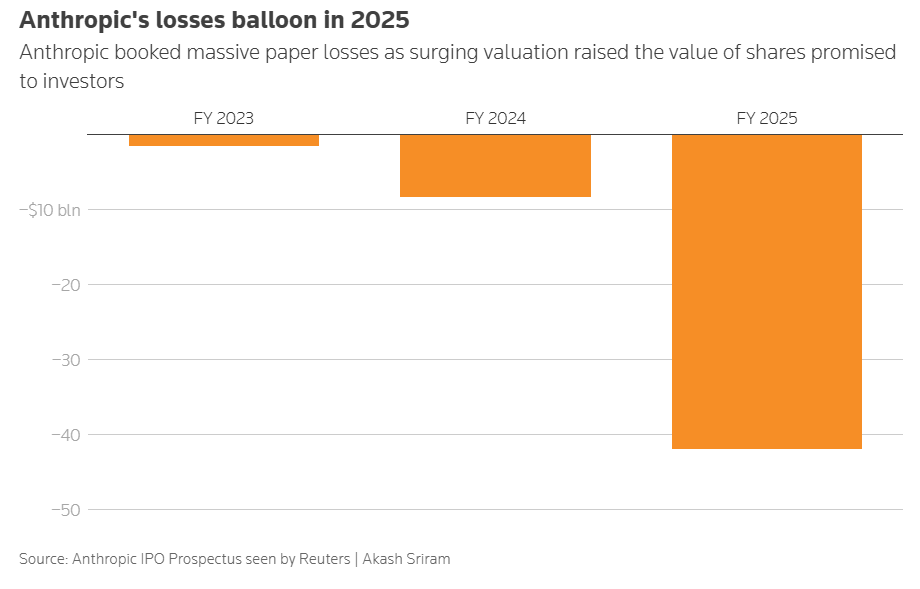
As shown in the chart above, while revenue generation related to AI applications surged, Anthropic's losses also surged in 2025 — as soaring valuations led to an increase in the value of shares promised to investors, Anthropic's book also experienced huge losses at the same time.
The net loss of nearly $42 billion includes accounting expenses of approximately $34 billion. This reflects an increase in the estimated value of financing instruments that may be converted to Anthropic shares in the future, and is not a capital expenditure for the company's day-to-day operations.
Anthropic said nearly a quarter of last year's revenue came from two customers. Among risk factors, the company also warned that many of its largest customers are not bound by long-term contracts and may cut or stop spending.
According to the prospectus, Anthropic held a total of US$20.08 billion in cash, cash equivalents and short-term investments as of December 31.
Anthropic will be listed following SpaceX (SPCX.US)'s recent major IPO. That release brought Elon Musk's company's valuation to $1.77 trillion.
SpaceX's stock price rose 19% to 160 US dollars on the first day of listing on June 12. Currently, it is trading at around $147, which is still higher than the IPO price of 135 US dollars per share.
This performance may make investors more cautious when evaluating the still high valuations of high-growth companies. AI and chip stocks have recently been sold off, and given Anthropic's ambitious growth forecasts, their release will further test whether the market's enthusiasm for AI trading can withstand more strict scrutiny.
Despite high interest rates, economic uncertainty, and market concerns about valuation, the listing is expected to end one of the strongest years since 2021 in the US IPO market.
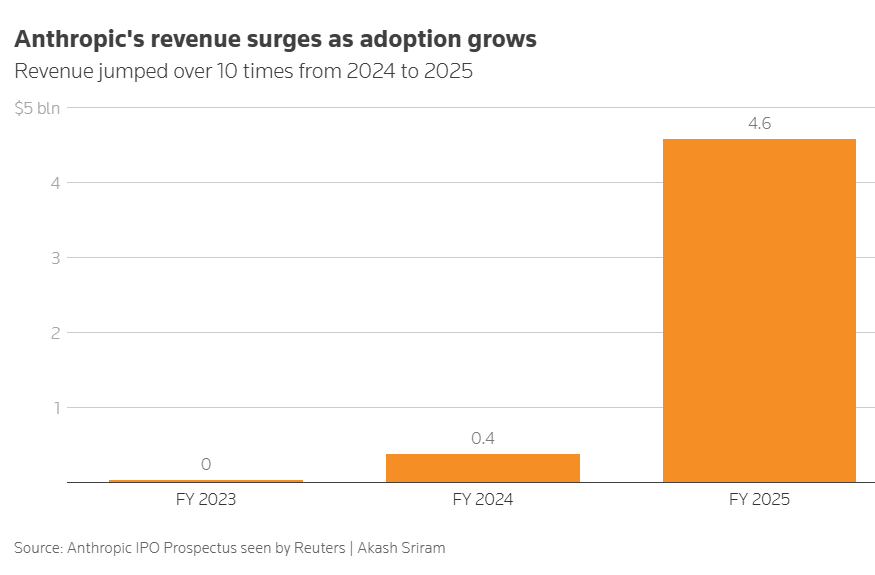
As shown in the chart above, Anthropic's revenue surged as cutting-edge AI applications/AI agents accelerated adoption to the global enterprise side — revenue increased more than tenfold from 2024 to 2025.
Anthropic's biggest competitor is still OpenAI, and the two companies are fiercely competing for corporate clients, talent, and influence in Washington. OpenAI secretly submitted an IPO application in June. According to media sources, the ChatGPT developer is expected to go public in early 2027 or before.
Anthropic was founded by a group of researchers who left OpenAI. They previously disagreed with OpenAI over corporate governance and AI security issues. Anthropic released its first major language model in March 2023 to compete directly with OpenAI.
It also competes fiercely with SpaceX's xAI, Google under Alphabet (GOOGL.US), and Meta (META.US), the parent company of Facebook, in terms of speeding up the expansion of AI computing power infrastructure, which is essential for accelerating the penetration of AI applications/AI agents.
Analysts expect that the first companies to go public will establish valuation benchmarks for the AI industry and attract investors who have been waiting for years and want to bet on this technology through direct investment in companies that want to focus on the AI business.
Amazon (AMZN.US) and Google were two important strategic partners in Anthropic's early days. Both companies invested billions of dollars in the startup while providing the cloud infrastructure needed to train and deploy the Claude model.
Anthropic and its CEO Amodei had clashed with the White House over the use of its tools, causing the Pentagon to blacklist Anthropic for a while; a US judge blocked the measure in August.
AI starts a “capital relay race”: How the explosion of application demand can leverage huge financing and capital investment in vast computing power
The changes driven by Muse, the released GPT-6 Astra, and Claude's next-generation models are handing over more actual work to AI. Derived from the system architecture, a task may include planning, retrieval, code execution, tool call and verification: the GPU or dedicated accelerator undertakes model calculation, the CPU undertakes the browser, sandbox and scheduling, HBM and system memory support the model and operation state, and store and save files, databases, and long-term memory.
Meta's latest technical documentation clearly states that Muse uses a standalone cloud virtual machine configured with CPU, memory, storage, and browser, and supports parallel sub-agents. These major trends in underlying AI technology all mean infrastructure requirements for the popularity of intelligent devices, covering the two levels of model inference and cloud execution environments.
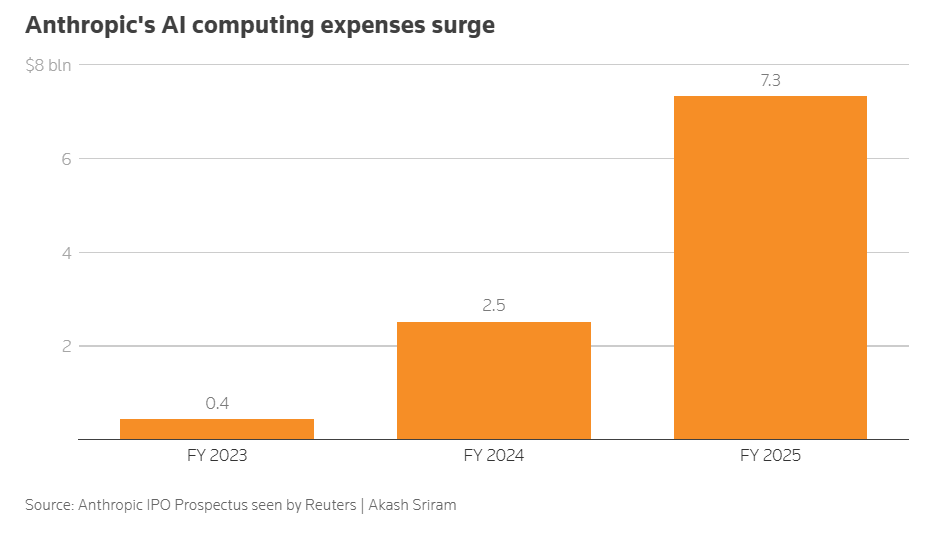
The picture above shows the scale of artificial intelligence computing resource expenditure officially given by Anthropic. It can be described as clearly showing a sharp trend. The memory chip component of the AI data center server cluster is still the clearest supply bottleneck at the AI computing power industry chain level. Market research agency TrendForce predicts that in 2026, the cumulative increase in server DRAM contract prices will be about 270%, and the cumulative increase in enterprise-grade SSD prices will be about 235%; in 2027, HBM contract prices may still rise 70% to 140%, that is, they will continue to double. These data reflect the combination of the continued expansion of AI computing power demand and the increase in memory chip prices. According to TrendForce's latest estimates, the combined share of DRAM and NAND in capital expenditure of major cloud service providers will rise from 47% in 2026 to 68% in 2027, behind which there is a simultaneous increase in procurement volume and price increases.
Application expansion has also benefited from the reduction in the cost of AI agents to efficiently complete complex tasks and deep scientific research. Anthropic said that Opus 5.5, launched on September 22, cost about 40% less than Opus 5 for typical workloads; Sonnet 5.5, which was released on September 28, further covered routine tasks, and the cost of a single task during testing was reduced by up to 30%. This efficiency improvement is expected to make more jobs commercially viable, and the increase in total computing power requirements depends on whether the number of new users and tasks can exceed the reduction in resource consumption per task. The previous rise in the AI “new cloud” investment sector, which is co-led by CoreWeave and Nebius, was also supported by demand and pricing: CoreWeave revealed on September 17 that it continued to sign additional computing power contracts at higher prices in the third quarter, including short-term contracts for a period of about three to six months.
This record potential IPO was used by some Wall Street analysts as a “capital relay” for the global AI industry chain: open market capital continued early investment, providing support for early locking in time differences between computing power and future customer payments. However, some analysts emphasized that Anthropic's customer spending plans may be flexible, and infrastructure commitments span many years, so investors need to evaluate whether customer retention, deduction service margin, procurement execution pace, and cash recovery can match each other. If the IPO is successfully completed, it will help to greatly enhance its computing power procurement capabilities and increase the confidence of the AI computing power core supply chain in meeting demand; what ultimately supports the valuation is Claude's ability to continuously transform technical capabilities into customer payments and operating cash flow.