
MSCI launches 14 AI value chain indices: breaking up AI exposure into “layers” to hedge
The Zhitong Finance App learned that index traders are splitting the word “AI” into a bunch of parts that can be traded separately. MSCI has launched a series of artificial intelligence (AI) value chain indices to help investors hedge their exposure to this sector more accurately. This batch of 14 indices went live at the end of August, covering global companies in the AI supply chain — from physical infrastructure to digital infrastructure to the application side. According to an MSCI document on these products, they enable investors to assess exposure, align positions, and act quickly when bottlenecks arise at the “layer” or “component” level.
“AI is often just that title, but there are many components underneath the title,” said Jana Haines, head of the MSCI Index business, in an interview. “What we keep hearing from customers is that their challenge is not to identify AI exposure, but to unpack it.”
Launch timing: AI hype is no longer just a deal, but dozens
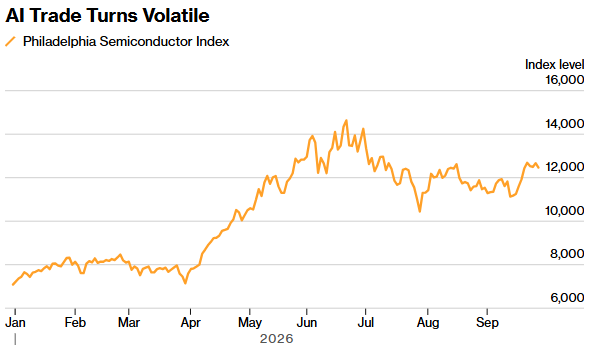
The media pointed out the timing of the product launch: AI trading has become one of the biggest sources of volatility in the stock market, and investors fluctuate back and forth between optimism about the economic prospects of this technology and concerns about the sector's high spending.
Volatility is just a general term; it's more intuitive when taken apart. According to MSCI index data, in the first half of 2026, the semiconductor and equipment industry in the MSCI index system rose 55%, five times the MSCI ACWI Global Index (+11%); while software and services fell 18% over the same period, the worst performing industry — investors are worried that AI intelligence will break through the software industry's fee-for-seat business model. The difference between the two ends of the same “AI” is 73 percentage points.
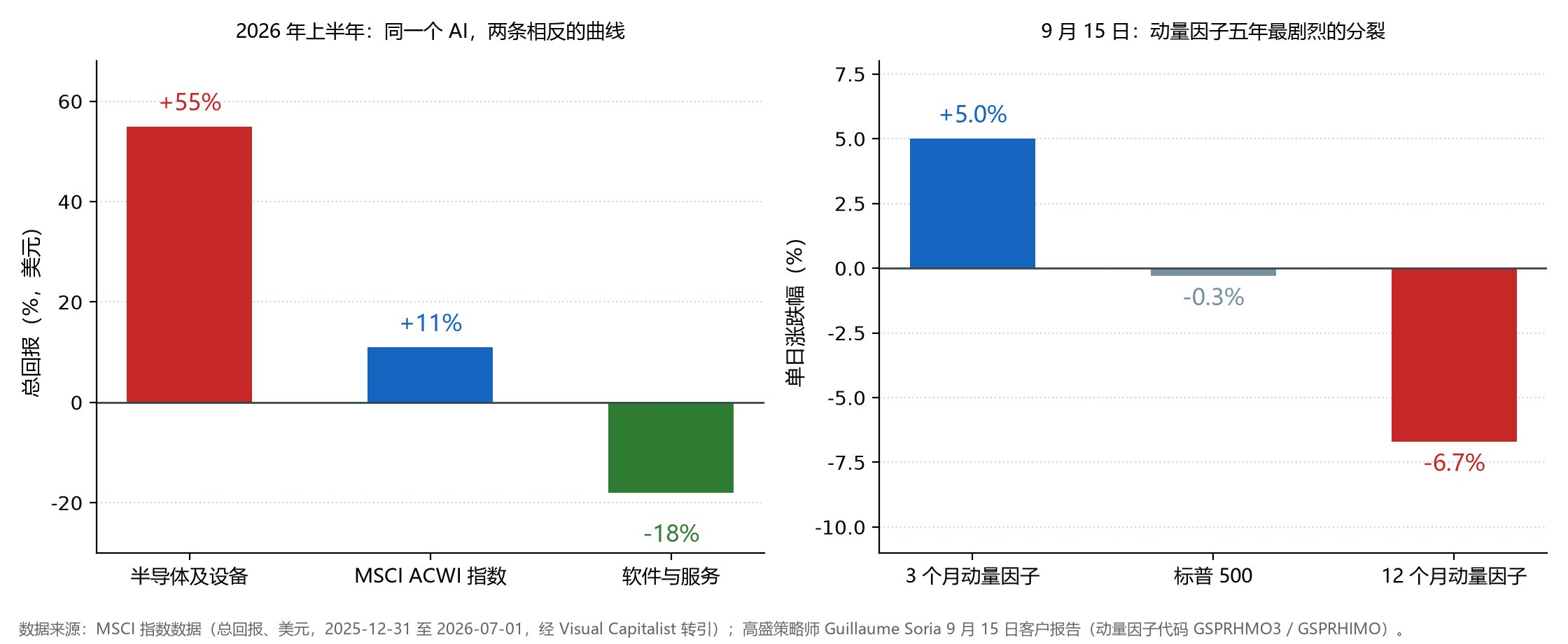
The cracks in the internal structure became apparent in mid-September. According to a report sent by Goldman Sachs strategist Guillaume Soria to top sales and trading clients on September 15, Goldman Sachs's 3-month momentum factor rose 5% on the same day, while the 12-month momentum factor fell 6.7% on the same day, the biggest single-day performance gap between the two in five years; Goldman Sachs's AI themed basket (GSPUARTI) has accumulated a cumulative retracement of nearly 45% from its high point, the deepest retracement since ChatGPT was released. Goldman Sachs pointed out that the correlation between momentum factors and AI topics is still as high as 90% to 96% in different cycles, and clearly recommends that customers with AI exposure buy hedging — the indicative cost of putting options with a one-month AI beneficiary basket and 95% exercise price is about 2.02% for a period of 27 days.
In other words, the customer's question is no longer “whether they want AI”, but “is the AI in my portfolio putting pressure on the chip or software, is it the physical layer or the application layer, and whether it falls down with the market?” This is exactly what Haines said: “Investors today often require a very specific type of exposure, whether it's a sector, a market cap segment, or a specific country. And they wanted to be able to cut the opening accurately to suit their mix.”
The valuation context is also amplifying this demand. According to the MSCI forward-looking equity risk premium model, the forward-looking equity risk premium for US stocks has been reduced to 0.41%, close to the level before and after the collapse of the Internet bubble in 2001 (0.01% in December 2001; the historical low in December 1999 was -3.90%), far below the 4.39% average since 1984 - the market leaves little room for fault tolerance for “high valuation+high real interest rate”, and any single link of falsification may be amplified into fluctuations throughout the chain.
Difficulty of dismantling: Even the “AI Index” itself contains Eli Lilly and GE Vernova
“Deconstructing AI” sounds simple, but the difficulty lies in the layered caliber. MSCI's own practice shows just how inconsistent this is. According to a compilation of MSCI's AI index of 100 constituent stocks by wealth management agency deVere Group (as of August 31), the index was selected from MSCI World, MSCI China, and MSCI Korea, and used MKT MediaStats's AI correlation score, market capitalization weighted, with a single component upper limit of 10% — and among its top ten weighted stocks, it is the third most important after Microsoft (11.67%) and Meta (8.78%) The shares are pharmaceutical company Eli Lilly (8.59%), which also mixed in power grid equipment company GE Vernova and two cybersecurity companies. Instead, chip leader Nvidia did not make the top ten. MSCI does not publish correlation scores at the individual stock level, and the agency speculates that semantic characteristics of semiconductor manufacturers may be one of the reasons for losing the election.
The same company is still running multiple AI products with completely different calibers. According to MSCI's official website, its “Transatlantic AI Industry Selection 40 Index” consists of 20 AI related industry leaders from the US and Europe, covering software, semiconductors and renewable electricity. The total market value of the constituent stocks is 17.57 trillion US dollars, with a price-earnings ratio of 33.22 times and a forward-looking price-earnings ratio of 20.79 times (as of August 31). According to MSCI's “2026 Investment Trends Report”, its AI value chain research framework spans 9 levels and includes about 230 companies, with a market capitalization of about 80% in the US — the capital expenditure of these companies increased 35% year over year, more than 700 billion US dollars, accounting for about 20% of global capital expenditure; R&D expenditure is close to 600 billion US dollars, accounting for more than 40% of global R&D; and the profit growth rate is expected to exceed 20% in 2026. The launch of the 14 value chain indices is equivalent to turning this research framework into a tradable benchmark.
The competition wasn't idle either. According to Nasdaq's dealer notice, three new indices, including the “NASDAQ Global Artificial Intelligence and Big Data Index,” came into effect on September 10; Solactive's announcement showed that its “Dan Ives Wedbush AI Revolution Index” (position adjusted on September 21) and the “Solactive US Artificial Intelligence Index” (re-weighted on October 1) were also intensively adjusted in September. deVere's compilation put it bluntly: AI doesn't have a single benchmark; MSCI alone runs multiple AI indices with different calibers. NASDAQ, S&P, and Solactive each have their own versions — returns vary from currency to currency, and volatility varies from benchmark to benchmark. For organizations, “which index to use to define AI” is itself a risk management decision.
Demand for hedging is already on the table: investment banks are selling protection, and exchanges are building pipelines
If the index is a shelf, the derivative is a pipeline. According to reports, after closing the market on July 23, the SGX announced that it had reached an extended licensing agreement with MSCI to launch up to 100 new derivatives linked to the MSCI index; in the first phase, 40 futures and options contracts will be launched, covering MSCI's flagship developed markets benchmark, major single country indices in the Asia-Pacific region, and the Asian Emerging Markets Industry Index. The report said that this batch of products has now been officially launched, covering developed and emerging markets, as well as major sector indices such as utilities, industry, energy, and finance. The partnership also has a historical footnote: six years ago, MSCI transferred derivatives licensing for a series of indices from Singapore to Hong Kong.
SGX CEO Luo Wencai said at the time that as portfolio management increasingly spans different regions, topics, and benchmark portfolios, the comprehensive MSCI product portfolio allows investors to “manage global stock risk through a trustworthy channel”; MSCI Chairman and CEO Henry Fernandez (Henry Fernandez) said that the agreement reflects MSCI's commitment to ensure that investors can access MSCI's most important benchmark indices no matter where they manage risk.
On the buyer's side, hedging has changed from “whether you want it” to “what to use and how much it costs”. In addition to the put options plan proposed by Goldman Sachs, according to the Bank of America Global Research “Global Stock Volatility Insight”, the bank suggests continuing to use more technology but using an asymmetric structure — QQQ October bullish options in addition to the purchase price, while hedging macro-interest rate risks to the bond market, expressed using a combination of TLT bearish and bullish spreads; Bank of America also suggested that AI-related heavy stocks in the Japanese market already account for 27% of the Nikkei 225 Index, while TOPIX is only 5.5%.
The need for tiered transactions is also supported by data in emerging markets. According to RBC Global Asset Management's fall outlook (as of August 31), the shares of the top five components of the MSCI Emerging Markets Index have reached about 35%, “unprecedented index concentration” — and the top five are AI hardware weighted stocks such as TSMC, Samsung Electronics, and SK Hynix; the bank estimates that there are still 100-150 companies in emerging markets related to AI through semiconductor design, ASIC, power infrastructure, cooling technology, and test equipment. J.P. Morgan Asset Management argues from the other side (index exposure data as of August 11): The AI “enablers” of the European Benchmark Index have less weight than the S&P 500, and are more “adopters,” which allows Europe to resist falling when AI stalls and still be able to share infrastructure dividends when AI is realized.
Going back to Haines' saying — what these AI value chain indices give investors is a modular, rules-based building block that allows them to gradually raise or lower their exposure, rather than treating AI as an overall bet that cannot be selectively dismantled. When the differentiation within a chain reaches “semiconductors +55%, software -18%,” index commerce is actually not a new index, but a new granular level of risk management. As to whether this granularity can beat the “overall bet”, it depends on who will verify it in the next earnings season.