
Ichibanya (TSE:7630) On Stake Sale Talk And Buyback Hopes Still Looks Pricey
UBS has flagged a potential sale of House Foods’ 51% stake in Ichibanya (TSE:7630) by fiscal 2028, linking any deal to capital efficiency reforms and the possibility of shareholder returns through additional buybacks.
Ichibanya has been in focus for months as the stake sale story has unfolded. The share price has responded with a 30 day share price return of 17.53% and a 90 day share price return of 26.26%, while the 1 year total shareholder return of 19.33% and 5 year total shareholder return of 31.69% point to momentum that has been building rather than fading.
Scan for other curry-house style momentum stories by comparing Ichibanya with our curated list of quality operators on the 74 high quality undiscovered gems.
Ichibanya looks like a solid curry franchise operator with fresh momentum behind the share price. The real tension now is whether that strength is already fully captured in today’s valuation or still underappreciated.
Price-to-Earnings of 74.5x: Is it justified?
Valuation has moved well ahead of Ichibanya’s recent earnings profile, with a P/E of 74.5x at a last close of ¥1,106 that sits materially above both its own fair P/E estimate and sector peers.
The P/E ratio compares the current share price to earnings per share and gives a quick read on how much investors are willing to pay for each unit of profit. For a relatively steady curry franchise operator, such a high P/E often signals that the market is paying up for expected earnings growth or for perceived business quality rather than current profitability alone.
That optimism sits against mixed fundamentals. Earnings are forecast to grow 13.3% per year and to be ahead of the wider JP market, yet Ichibanya’s reported earnings fell 27% over the past year and net profit margins eased from 5.2% to 3.5%, with a ¥1.0b one off loss weighing on recent results. At the same time, the stock’s current P/E of 74.5x is significantly richer than the estimated fair P/E of 23.5x. This suggests a level the market could eventually move closer to if sentiment cools.
Relative pricing is even tougher when compared with peers. The same 74.5x multiple is well above the JP Hospitality industry average of 21.7x and also higher than a peer group average of 49.2x. This points to Ichibanya trading on a premium that assumes more resilient or faster improving earnings than the broader hospitality space.
Explore the SWS fair ratio for Ichibanya.
Result: Price-to-earnings of 74.5x (OVERVALUED)
Still, a rich 74.5x P/E could reset quickly if Ichibanya’s earnings recovery stalls or if a stake sale by House Foods weighs on sentiment.
Find out about the key risks to this Ichibanya narrative.
Another View on Ichibanya’s Valuation
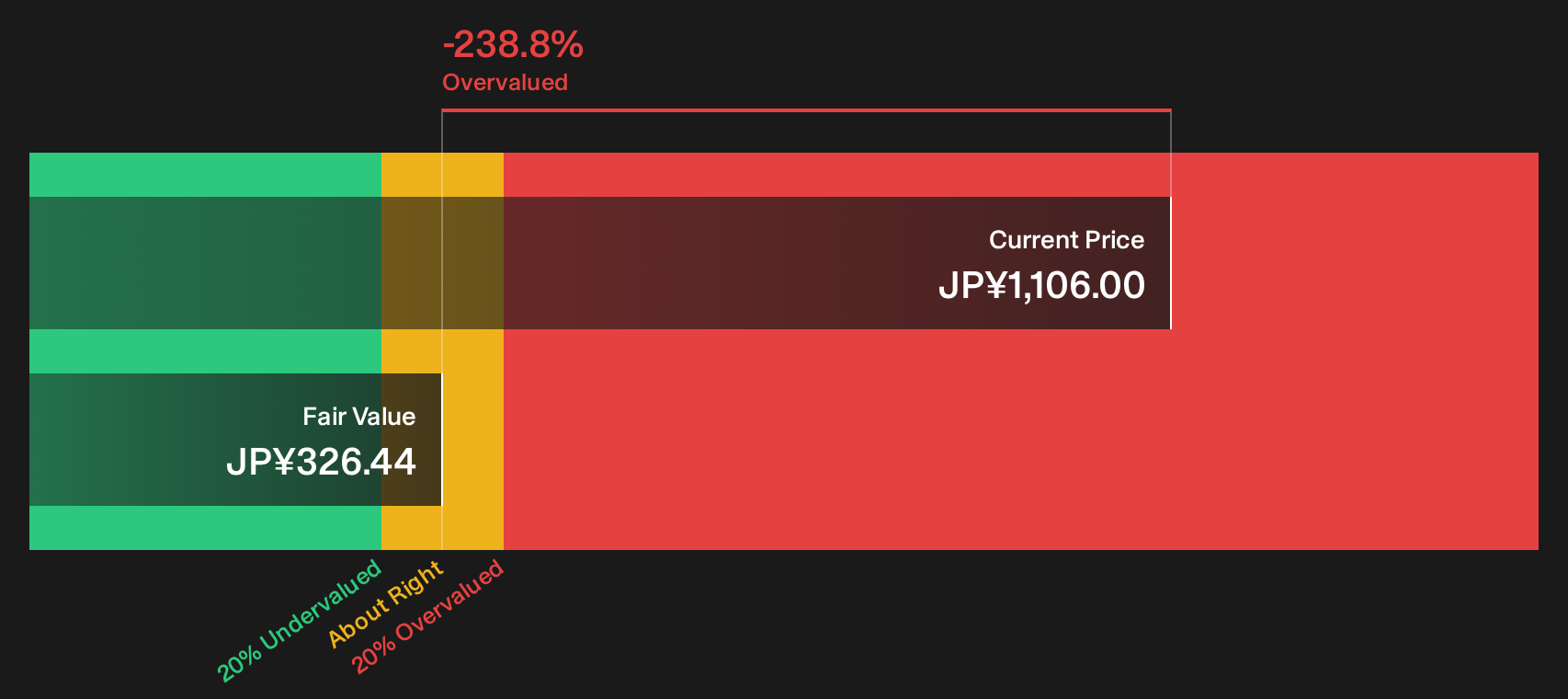
The rich P/E picture for Ichibanya is echoed by our DCF model. At a share price of ¥1,106, the SWS DCF model indicates a future cash flow value of ¥326.44, which points to the stock trading well above that estimate and screening as expensive on this lens too.
That kind of gap raises a simple question for you as an investor: Are you comfortable paying a premium that assumes a long runway of execution, or would you rather wait for expectations and price to get closer to each other?
Look into how the SWS DCF model arrives at its fair value.
Simply Wall St performs a discounted cash flow (DCF) on every stock in the world every day (check out Ichibanya for example). We show the entire calculation in full. You can track the result in your watchlist or portfolio and be alerted when this changes, or use our stock screener to discover 18 high quality undervalued stocks. If you save a screener we even alert you when new companies match - so you never miss a potential opportunity.
Next Steps
Mixed signals and strong opinions often move quicker than the hard numbers. Review the full risk and reward picture for Ichibanya yourself and then decide where you land with the 1 key reward and 2 important warning signs.
Looking for more Ichibanya sized ideas?
If Ichibanya has sharpened your focus on pricing power and quality, do not stop here. Broader idea hunting now could shape your next few years.
- Target resilient value by scanning our 18 high quality undervalued stocks that combine stronger fundamentals with prices the market has not fully appreciated.
- Strengthen your income stream by reviewing the 22 dividend fortresses that aim to pair higher yields with more dependable payouts.
- Reduce portfolio stress by filtering for 20 resilient stocks with low risk scores where balance sheets and risk scores do more of the heavy lifting for you.
This article by Simply Wall St is general in nature. We provide commentary based on historical data and analyst forecasts only using an unbiased methodology and our articles are not intended to be financial advice. It does not constitute a recommendation to buy or sell any stock, and does not take account of your objectives, or your financial situation. We aim to bring you long-term focused analysis driven by fundamental data. Note that our analysis may not factor in the latest price-sensitive company announcements or qualitative material. Simply Wall St has no position in any stocks mentioned.
Have feedback on this article? Concerned about the content? Get in touch with us directly. Alternatively, email editorial-team@simplywallst.com