
From connecting users to undertaking computing power, Philippine telecom giant Globe is betting on AI data centers! Aiming for the next billion-dollar business
The Zhitong Finance App learned that from answering questions to continuing to perform tasks, AI agents are extending growth opportunities from chip and cloud computing service providers to large-scale AI data center operators that provide complete AI computing power infrastructure, power resources, cooling, and high-speed network connection systems. Globe Telecom Inc., the second-largest telecom operator in the Philippines, is betting on this change, hoping to develop the data center joint venture into the next billion dollar business: the company plans to invest at least 1 billion US dollars in capital expenses in 2027, mainly to continue expanding the data business; at the same time, GCash's parent company MyNT — Mynt Inc., a Globe fintech subsidiary of Globe Telecom, plans to raise about 60 billion pesos through an IPO, which is expected to set a Philippine stock market record.
As a result, telecom giant Globe's growth layout covers both digital finance and computing power infrastructure. Globe's investment logic at the AI infrastructure level can be summed up as competing for the “right to implement computing power” — combining reliable power supply, deliverable computer rooms, high-density cooling, and cross-border connectivity to undertake the computing power sales and rental needs of AI cloud computing vendors and large-scale deployment of actual AI applications for the enterprise side.
Last week, the two new cloud forces in the US stock market — CoreWeave and Nebius — received ratings from J.P. Morgan Chase and BNP Paribas, and the sharp rise in stock prices after upgrading ratings and target prices, which is enough to reflect the market's continued focus on computing power infrastructure service providers; Globe's data center joint venture is mainly involved in the computer room infrastructure process, and its value delivery directly depends on customer contracts, power system stability, AI computing capacity delivery, and profitability after leasing.
This layout is already supported at the operational level. Globe revealed in August this year that the first-floor computer room capacity of Fairview Phase I has been ordered by customers, and that subsequent floors are advancing commissioning and development, and supporting high-density AI deployment and liquid cooling requirements; the joint venture also signed a ten-year renewable energy power supply agreement with mPower, involving the total power supply requirements of 40.5 megawatts of Fairview and Cavite facilities. These developments correspond to customer demand and energy procurement respectively, but future returns will still depend on construction progress, electricity costs, shelf life, and financing conditions. For the Philippines, the regional capacity spill has created opportunities, and submarine cable, land, GPU/ASIC supply scale, power supply, and compliance capabilities determine whether orders can actually be retained. The popularity of AI provides growth expectations, delivers on schedule, and generates rental cash flow, which is the threshold for valuations to be realized.
From connecting users to integrating AI computing power resources: Globe is looking for the next billion-dollar business
Globe Telecom is betting on the AI boom, hoping to develop its data center joint venture into the next billion-dollar business; at the same time, its fintech affiliate Mynt is moving towards an initial public offering that is expected to set a record in the Philippines.
Globe President and CEO Carl Raymond Cruz said in an interview on Monday that the company plans to invest at least $1 billion in 2027, mainly to expand its data business. Capital expenditure is expected to equal 23% to 28% of revenue over the next few years.
“We need to continue to invest in artificial intelligence supernetworks,” he said in an interview. “We will continue to do so, but we will carefully select investment areas, clarify priorities, and focus mainly on areas related to data and the digital economy.”
As AI drives global competition to expand computing power, the second-largest telecommunications company in the Philippines is looking beyond traditional business to find the next stage of growth drivers. Cloud service providers and tech companies are looking to meet surging demand, driving billions of dollars into the industry across Asia.
GLOBE has established a foothold in this field through ST Telemedia Global Data Centres Philippines. This is a joint venture between Globe and its parent company Ayala and Singapore Tech Telecom. Cruz said the data center operator operates five facilities and is expected to reach 30 to 35 megawatts of capacity by the end of 2026, then increase to 124 megawatts over the next three years through the construction of new facilities and the expansion of existing facilities.
He said that listing this joint venture is one of the financing options being considered for further expansion. “The market will give a very high valuation to any business related to the digital economy.”
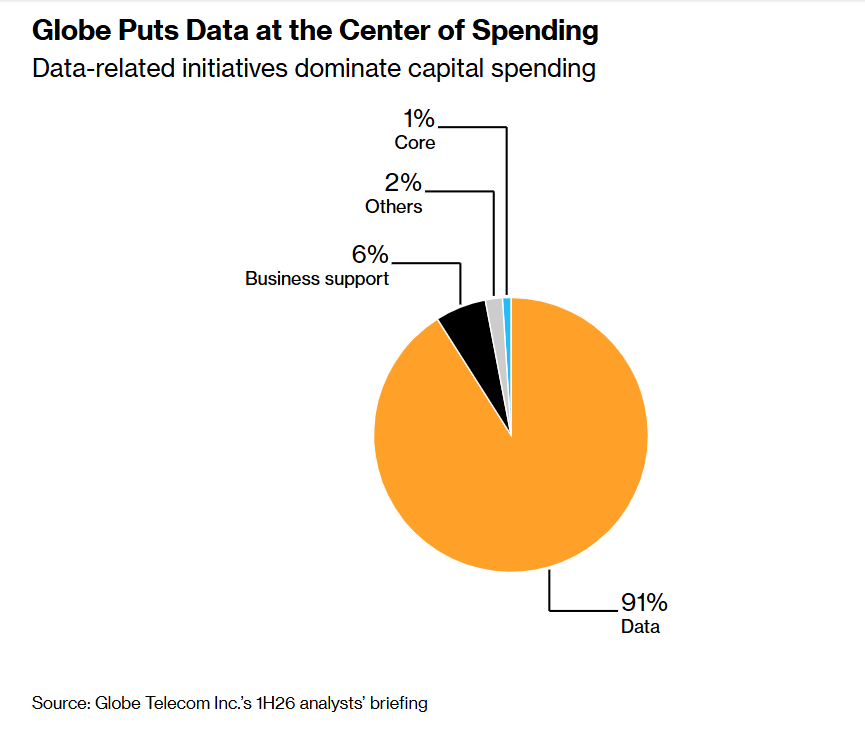
As shown in the figure above, Globe places its data business at the core of its huge capital expenditure layout — data-related projects account for a major portion of capital expenditure. Source: Globe Telecom analyst briefing for the first half of 2026.
He said the capacity restrictions in Thailand, Singapore and Malaysia meant that the Philippines would be the next destination for data center customers. “In the next few years, as AI evolves, you may see a three to five-fold increase in data traffic.”
However, a Fitch Solutions' BMI report indicates that the Philippines cannot rely solely on demand spillover from Malaysia and Indonesia. To compete for large-scale cloud computing projects, the Philippines needs to take advantage of its undersea optical cables connecting developed markets in Asia while ensuring the supply of electricity and land.
The Philippines has 44 data centers, which rank second to last in number in the Asian market tracked by BMI. The capacity already in operation is about 140 megawatts, and another 264 megawatts are under construction or planning.
Domestically, Globe is trying to catch up with a market dominated by rival PLDT. VITRO, a data center subsidiary of PLDT, is seeking to raise up to 24.2 billion pesos, or about 387 million US dollars, through an initial public offering through a real estate investment trust fund. Converge ICT Solutions is also expanding its business layout.
The Philippine government is seeking to attract more data center investment to land in the country. President Ferdinand Marcos Jr. signed an executive order in July requiring the government's most sensitive digital information to remain under Philippine jurisdiction. This move could boost demand for local facilities.
Before betting on data centers, Globe had already had success with Mynt, an important subsidiary of its company. myNT is the parent company of GCash, the largest mobile wallet in the Philippines, and reached a valuation of 5 billion US dollars in the last round of financing in 2024. Its IPO is expected to raise around 60 billion pesos next month, making it the largest initial public offering in the Philippines.
Cruz said that as Mynt expands its credit, investment, savings and insurance services, Globe plans to maintain its single largest shareholder status.
Strong demand associated with AI applications will eventually be realized as computer room cash flow
Globe's data center joint venture mainly participates in computer room infrastructure. Its value delivery directly depends on customer contracts, 24/7 power supply stability, AI computing capacity delivery, and profitability after rental. Strong demand associated with AI applications must eventually be realized as computer room cash flow to reflect the strong growth value of data center operators.
From answering questions to continuing to perform tasks, AI agents are extending growth opportunities from chip and cloud computing service providers to large-scale AI data center operators that provide complete AI computing power infrastructure, power resources, cooling, and high-speed network connection systems.
Muse and Astra are expected to further expand the scope of use of AI agents. The massive expansion of AI inference workloads brought about by them will simultaneously increase the demand for model inference, tool execution, and state management, while deepening competitive pressure on some software companies. Accelerators such as GPUs and TPUs undertake model computation; CPUs run browsers, virtual machines, product search, database queries, and transaction orchestration; HBM and server DRAM carry model data, context, and concurrent working environments; enterprise-grade SSDs store product indexes, task records, and persistent states; high-speed networks and optical interconnections support distributed data exchange.
The intelligent body represented by Muse and the released GPT-6 Astra is expanding the scope of actual work that AI can undertake. The underlying core change focuses on the fact that a single user request can trigger multiple rounds of inference, browser operation, code execution, and result verification, driving the extension of infrastructure requirements from model calculation to task execution and state storage. Meta's technical data clearly states that Muse provides users with independent cloud virtual machines equipped with CPU, memory and storage, and supports parallel sub-agents and scheduled tasks. Therefore, GPUs are responsible for neural network computation, CPU execution of tools and task scheduling, and memory and storage to store operating states, files, and long-term memories; as active users, task frequency, and concurrency scale expand, demand may be transmitted to servers, networks, and computer room capacity on a larger scale and rapidly.