Debt and inflation are the biggest hindrances! Deutsche Bank warns that the “policy safety net” of the global market is failing, and future fluctuations are likely to increase
The Zhitong Finance App learned that the Deutsche Bank Research Institute said in a recent report that large-scale policy interventions to cushion the impact of the global market economy over the past few decades are coming to an end. Rising sovereign debt, high interest rates, and continuing inflation are weakening the traditional “safety nets” of governments and central banks.
Deutsche Bank analyst Henry Allen pointed out that compared to previous crises, policymakers now face unprecedented restraints. He warned that the interventionist policy tools adopted by governments and central banks during the 2008 global financial crisis and the COVID-19 pandemic may no longer be sustainable.
Henry Allen pointed out that higher benchmark debt-to-GDP ratios and increasing interest burdens have limited the ability of policymakers to massively expand fiscal deficits or launch large-scale quantitative easing programs during future economic downturns. This is because taking such measures now risks re-triggering a spiral of inflation, which has only recently been partially controlled. While the government's balance sheet is already under pressure and borrowing costs remain high, the fiscal firepower relied on to respond to the crisis in the past has been drastically reduced.
Henry Allen believes that unless yields fall sharply or inflation collapses, the market should be prepared to deal with higher macroeconomic fluctuations, higher term premiums, and less reliance on quick government bailouts. Over the past 20 years, so-called “monetary policy put options” have provided support for risky assets, and the market's dependence on this policy support mechanism may decrease in the future. He stressed that the “safety net” that the market has become accustomed to is gradually breaking down, and the global economy may soon have to deal with turbulence without large-scale policy intervention to cushion it.
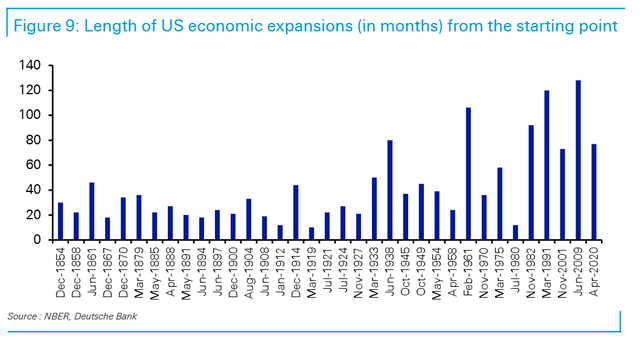
Henry Allen said, “If we look back over the past 40 years, we can see that the 5 most recent expansions in the US economy are among the 7 longest lasting expansions since business cycle statistics began. There are many reasons for this, some of which reflect a gradual shift in the economy from an economic model based on agriculture, where output depends on factors such as weather. But preventative policy interventions have also played a key role, such as stopping the economic slowdown from turning into a recession by cutting interest rates.”
Henry Allen added, “In addition to actual policy interventions, these measures have also had a confidence effect, thereby supporting financial markets. The fact that policymakers are ready to act helps create a virtuous cycle, as optimism about the economic outlook boosts the value of financial assets, creates a wealth effect, and avoids a tightening of the financial environment, which itself may cause economic growth to slow.”