
The Big Seven's “Killing Valuation” is nearing its end! Muse and Astra ignite “AI FOMO Deal”, tech stocks are poised for a major counterattack
The Zhitong Finance App learned that after the Nasdaq 100 index reached a new high last week, Wall Street financial giant J.P. Morgan Chase began to follow the bullish pace of US technology stocks from giants such as Goldman Sachs, Jefferies, and Yardeni Research. This also encouraged institutional and retail investors to focus more and more on low layout strategies during the US stock market correction on Monday. J.P. Morgan believes that the overall valuation adjustments of the seven major US tech giants (that is, Magnificent Seven, Mag 7), which have a high weight in US stocks, may have been largely completed, and profit growth is expected to once again become the main force supporting stock prices; J.P. Morgan said that the ratio of the Big Seven's expected price-earnings ratio over the next 12 months to the market has fallen to about one standard deviation below the historical median, which is at a ten-year low.
US stocks closed on Monday, September 28. Prices of most popular AI-themed stocks, including AMD, Micron, and SanDisk, were heavily pressured by rising oil prices and US bond yields, but the “AI chip hegemon” NVDA.US (NVDA.US) shares bucked the trend after announcing an additional 150 billion US dollars in record share repurchase authorizations. J.P. Morgan's positive judgment did not ignore changes in the business model: AI capital expenditure has increased capital intensity, increased financing demand, and pressure on free cash flow should indeed respond to a certain degree of valuation concessions. However, the current market has absorbed quite a few adjustments, and subsequent profit growth may still exceed the drag caused by continuing to reduce valuations.
Apple, Microsoft, and Google parent companies Alphabet, Amazon, Meta, Nvidia, and Tesla are not only an important part of the US stock market capitalization weighted index, but also influence global AI investment expectations through AI chips/AI semiconductors, cloud computing, AI applications, and a wide range of terminal layouts. Previously, up to the end of 2025, the market value of the S&P 500 super bull market expanded by about 30 trillion US dollars over a three-year period. The seven major tech giants and the broader AI computing power infrastructure supply chain were important driving forces. Therefore, changes in the profits and valuations of the Big Seven can simultaneously affect the performance of the benchmark index, risk appetite in the global stock market, and the growth prospects of the AI computing power industry chain.
At a time when Meta Muse and OpenAI's GPT-6 Astra are fully detonating the big wave of AI agents, “AI FOMO transactions” (meaning investors are worried about missing out on rising opportunities in AI-related assets, and are therefore chasing down or making up for previously lowered positions) can be described as making a comeback. Looking at the underlying architecture of AI computing power infrastructure, Muse and Astra are expected to further expand the scope of use of AI agents. The massive expansion of AI inference workloads brought by them will simultaneously increase the demand for model inference, tool execution, and state management, while deepening competitive pressure on some software companies. Accelerators such as GPUs and TPUs undertake model computation; CPUs run browsers, virtual machines, product search, database queries, and transaction orchestration; HBM and server DRAM carry model data, context, and concurrent working environments; enterprise-grade SSDs store product indexes, task records, and persistent states; high-speed networks and optical interconnections support distributed data exchange.
The so-called “Magnificent Seven” (Mag 7), which have a high weight (over 40%) of the S&P 500 Index and the Nasdaq 100 Index, are the core driving force behind the S&P 500 Index's record highs, and are also regarded by many top Wall Street investment institutions as the combination most capable of bringing huge returns to investors in the context of the biggest technological changes since the Internet era.
J.P. Morgan Chase: The valuation reset of the Big Seven US stocks may have been largely completed
According to a recent research report released by J.P. Morgan's stock strategy team led by Mislav Matejka, the Big Seven US stock companies have experienced significant valuation resets. The ratio of their expected price-earnings ratio for the next 12 months to the market is currently close to one standard deviation below the historical median, and is at a ten-year low.
The J.P. Morgan strategist team believes that as the technology sector in the US stock market decreases in bullish position congestion, strong profit performance, and more realistic valuations, technology stocks will regain some of the momentum lost since the end of the first half of the year, so investors are advised to re-enter this sector when the market recovers.
Technology stocks are still leading the S&P 500 index by a large margin this year, but gains have cooled down in recent months, and the market is worried that huge investment in AI may not bring the returns that optimists assume. Within the technology sector, the valuation of the “Big Seven” of US stocks is at its lowest level in 10 years, while semiconductor stocks are coming out of a difficult phase — Anthropic's Dario Amodei and OpenAI's Sam Altman have previously called for coordination to slow down the development of advanced AI, making the sector's plight worse.
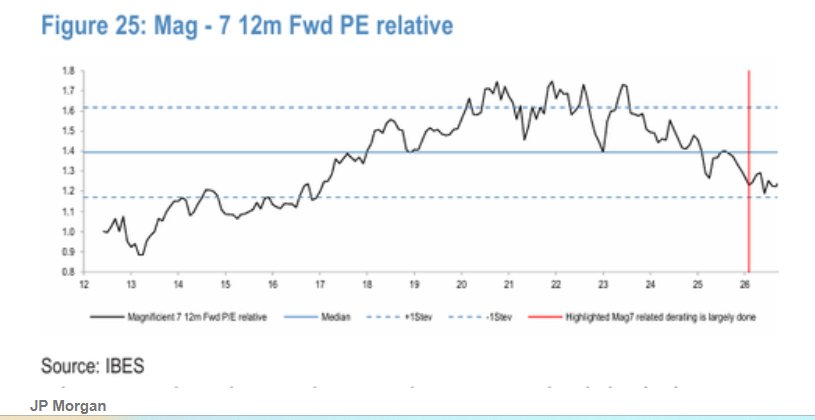
“We doubt there will be any significant slowdown in the end, as this race is still a game about survival and winner-take-all,” wrote the J.P. Morgan Stock Strategy team led by Mislav Matejka. J.P. Morgan said that although the increase in the first half of the year is unlikely to be repeated, significant opportunities still exist.
The “Big Seven” valuation is not an isolated judgment of J.P. Morgan Chase. According to data from the Morgan Stanley Wealth Management Global Investment Committee, the valuation premium of the “Big Seven US stocks” compared to 493 other stocks in the S&P 500 index is currently only 10%, the lowest level in more than 10 years, and the seven giants as a whole still have an annual profit growth advantage of about 45%.
Lisa Shalett, chief investment officer at Morgan Stanley Wealth Management, wrote in the report: “By contrast, we think these hyperscale cloud giants simply look too cheap right now.”
J.P. Morgan strategists added that the seven major tech giants in the US stock market, along with other parts of the tech sector, have experienced valuation cuts, and this valuation adjustment process has largely been completed. The bank previously indicated in March that the valuation reduction may have been excessive.
The strategists added that changes in these companies' business models provided a reasonable basis for some valuation multiples reduction, including rising leverage levels and declining free cash flow as AI-related capital expenditure continued to increase dramatically. However, they said that quite a few valuation adjustments have already occurred, and the extremely strong profit performance of hyperscale cloud computing vendors may continue to support their stock price performance, although some of this support may still be offset by further valuation cuts.
From “killing valuations” to “taking over profits”: J.P. Morgan Chase and Goldman Sachs see a new round of upward momentum in the technology sector
What the J.P. Morgan strategist team is optimistic about is a rearrangement opportunity formed by easing position congestion, falling valuations, and profit resilience. They particularly prefer semiconductors. According to the latest research report released by the agency, since June, semiconductor's earnings forecast per share for the next 12 months has been raised by about 30%, and software profit forecasts have not improved accordingly; the capital expenditure forecasts for hyperscale cloud vendors quoted are: about US$950 billion in 2026, US$1.4 trillion in 2027, and about US$3 trillion in 2030.
Based on this, J.P. Morgan Chase favors the relative trading model of “going long on semiconductors and shorting some high-momentum software”. At the same time, it believes that software valuations have been drastically adjusted and are not suitable for simply shorting out completely.
Muse and Astra have strengthened the application foundation of this AI-driven strong profit logic based on “profit takeover”: the agent transforms a user request into multi-stage tasks such as search, planning, calling tools, execution code, and verification results, so that CPU scheduling, memory capacity and storage access, and high-speed data transmission over optical interconnection other than GPU computing are simultaneously driven by computational demand. Muse already has a dedicated cloud virtual machine, browser operation, back-office continuous work and memory mechanism; Astra enhances computer operation, software use, and multi-step professional task execution capabilities.
What is more important in terms of investment strategy is whether the large-scale expansion of AI complex task workloads can exceed the impact of falling unit inference prices and translate into cloud service revenue, chip orders, and sustainable profits. The market has reacted to app popularity expectations: Nasdaq's official weekly report confirmed that Muse's early performance and the AGI buzz sparked by Astra have greatly boosted AI FOMO trading. The NASDAQ 100 Index reached a record high on September 22, with a cumulative increase of about 3% last week.
What Goldman Sachs strategists have provided is another path of support. Mark Wilson, senior strategist and partner at Goldman Sachs, believes that opportunities for growth at the end of the year do not necessarily have to wait for the midterm elections to end: if inflation slows down and growth moderately cools without falling into recession, it may be difficult to fully implement the further tightening expected by the market. Goldman Sachs economist Jan Hatzius emphasized the weakening of market risks in the growth market, while Goldman Sachs stock market strategist Ben Snider believes that some industries have excessive profits, but overall profit bubbles have not yet formed. The key to the “Golden Girl Market” scenario, which Goldman Sachs strategists unanimously approved, is that while inflation and interest rate pressures ease, core profits can still remain resilient. This line of business is a conditionally optimistic judgment of Goldman Sachs strategists.
The AI bull market seems to be looking for a “profit takeover window” — that is, as valuation compression slows down, as long as earnings per share continue to grow, stock prices do not need to rely on the price-earnings ratio rising again to a high level to rise; if interest rate pressure then eases, stable valuations may also increase earnings space. J.P. Morgan Chase values profit trends and positions showing positive signs at the same time. Goldman Sachs is concerned about improving the macro environment. Together, the two point to the importance of AI-driven technology companies delivering strong performance.
Wall Street financial giant Jefferies recently said that the S&P 500 index is expected to soar to 8,000 points by the end of 2026 and further hit 9,000 points in 2027, driven by the dual engine of AI investment frenzy and rising profits of AI-related companies exceeding expectations. Jefferies's core logic is clear and powerful: in a cycle where AI-driven profit growth exceeds the historical average by more than two times the historical average, fighting against profit trends is dangerous. Jefferies's 2026 8,000-point S&P 500 benchmark forecast is based on earnings per share (EPS) reaching $373 (up 35% year over year, well above 29% of market consensus) and a price-earnings ratio of 21.5 times.