
Meta Just Launched Its New Charm Gadget for Muse AI. What This Means for META Stock.
Physical AI has arrived, and companies are competing to release innovative products. Social media pioneer Meta Platforms (META) recently pitched its new physical AI product at its Connect 2026 event, with features that may appeal to younger audiences.
Specifically, Meta introduced an AI amulet called the Muse Charm for its popular personal Muse AI agent. The device features microphones, speakers, cameras, and more, as well as a customizable virtual character called Jolly with options to personalize its appearance and voice. Basically, the Muse experience is being packed into a small gadget with an avatar communicating with the user.
Although the AI wearables space has become a bit saturated, this device's approachable feel could be a winning point, especially given Muse's growing popularity. Moreover, this launch feels like a relatively low-stakes way to get into the AI wearables business. With Muse Charm shipments expected to begin in December, let's take a closer look at what's going on with Meta Platforms and META stock.
About Meta Stock
Meta operates social media apps including Facebook, Instagram, WhatsApp, Messenger, and Threads, while increasingly pivoting its strategy and capital toward artificial intelligence. Headquartered in Menlo Park, California, Meta is investing billions of dollars annually in AI infrastructure, data centers, and advanced models such as Llama and its Muse AI agent.
The shift has driven workforce reallocation, with thousands of employees moved into AI-focused units and hiring concentrated in AI research and infrastructure. Currently, the company commands a massive market capitalization of $1.9 trillion.
META stock is down about 4% over the past year because massive AI-driven revenue growth has been largely offset by surging costs, heavy capital spending, and investor concerns about the timing of returns on investment. However, the stock has gained 36% over the past six months. META stock reached a 52-week high of $779.82 on Sept. 24 and is only down 8% from that level.
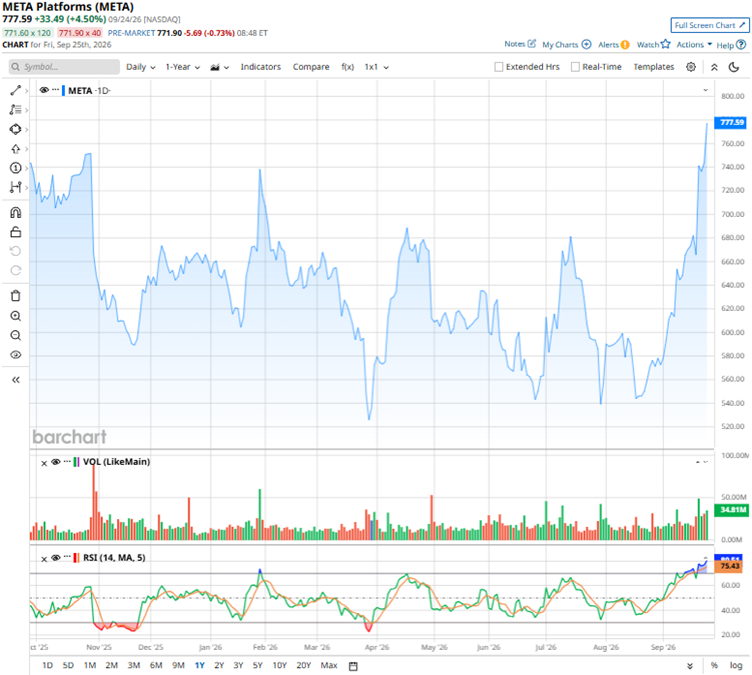
Meta’s 14-day RSI was in overbought territory after the stock skyrocketed following the Muse launch. Since then, however, the 14-day RSI has fallen down to around 60. Considering its growth, META stock also still trades cheap, with its PEG ratio of 1.3 times in-line with the industry average.
Meta Reports Q2 Earnings
For the second quarter of fiscal 2026, revenue climbed 28% year-over-year (YOY) to $60.8 billion. Revenue was driven largely by the company's Family of Apps segment, which saw sales increase 28% to $60.37 billion. Ad impressions across Meta's app family rose 14% YOY in Q2, while average price per ad rose 12% YOY.
However, surging expenses pressured profitability. Meta’s costs and expenses jumped 55% YOY to $42.03 billion, while capital expenditures reached $31.08 billion as the company accelerated AI investment. As a result, quarterly EPS fell 13% to $6.18 per share.
Wall Street analysts have mixed feelings about Meta’s future earnings. For the current fiscal year, EPS is projected to decrease 6% YOY to $27.93, then grow 23% to $34.36 in the next fiscal year. Moreover, analysts expect EPS to decline 12% YOY to $6.39 in the current quarter.
What Do Analysts Think About Meta Platforms Stock?
Strong AI momentum has led Wall Street analysts to reiterate their bullish stances on META stock. Recently, JP Morgan analyst Doug Anmuth maintained an “Overweight” rating on Meta Platforms stock and raised the price target from $820 to $920.
Tigress Financial also recently raised its price target on META stock from $945 to $995 while maintaining a “Strong Buy” rating. The firm described the Muse launch as a paradigm shift that could convert Meta’s global network into a personal AI platform. Analyst Ivan Feinseth believes Meta now has multiple new avenues for AI investment monetization.
Finally, analysts at RBC Capital kept an “Outperform” rating on Meta with a $770 price target. RBC highlighted management’s announcement of several major retail partners for Muse.
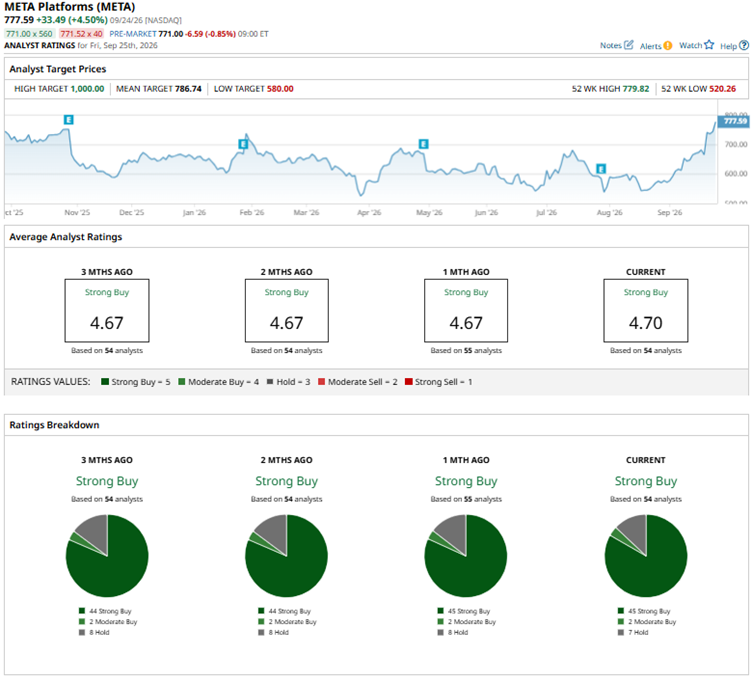
Meta has been in the spotlight on Wall Street, with analysts awarding it a consensus “Strong Buy” rating. Of the 54 analysts rating the stock, 45 analysts have a “Strong Buy,” two analysts suggest a “Moderate Buy” rating, and seven analysts have a “Hold” rating. The average price target of $794.24 represents potential upside of 11% from current levels, while the Street-high price target of $1,000 suggests shares could rise as much as 40% from here.
On the date of publication, Anushka Dutta did not have (either directly or indirectly) positions in any of the securities mentioned in this article. All information and data in this article is solely for informational purposes. For more information please view the Barchart Disclosure Policy here.