
Innodata May Be Helping Power Meta’s Muse. What That Means for INOD Stock.
Innodata (INOD) has emerged as one of the most intriguing picks-and-shovels plays in the artificial intelligence (AI) boom. The company provides data engineering, model evaluation, and human-feedback services that major technology companies and frontier AI labs use to train and improve increasingly sophisticated AI systems. That positioning has already translated into strong growth, but a potentially major new catalyst has now come into focus: reports suggesting Innodata may be involved in work tied to Meta Platforms’ (META) new Muse personal AI agent.
The potential connection has attracted attention because Meta is reportedly Innodata’s largest customer, while recent disclosures from the company appear to overlap with the type of work required to develop increasingly capable AI agents. If those links prove meaningful, Muse could add another dimension to Innodata’s already fast-growing business. Still, there are important questions about how much work Innodata may actually be doing for Meta, whether that work is incremental, and how much of an impact it could ultimately have on revenue.
So, could Meta’s push into personal AI agents become a meaningful growth driver for Innodata, and what could it mean for INOD stock? Let’s take a closer look.
About Innodata Stock
Innodata is a global data engineering and AI services company that helps technology companies, frontier AI labs, and enterprises develop, train, evaluate, and deploy advanced AI systems. Its services span training and post-training data development, model alignment and preference optimization, safety and capabilities evaluation, and broader AI enablement, making the company a “picks-and-shovels” provider to the generative AI ecosystem. It works with several major technology companies, including some of the so-called “Magnificent Seven,” and has benefited from rising demand for high-quality data and human expertise needed to improve large language models (LLMs) and other AI systems.
Shares of the AI data services company have climbed 32% year-to-date (YTD), fueled by strong demand for its AI data engineering, evaluation, and enterprise AI services. However, INOD stock pulled back sharply from its early June highs amid investor concerns that its largest customer, reportedly Meta, could bring more work in-house after taking a sizable stake in Scale AI.
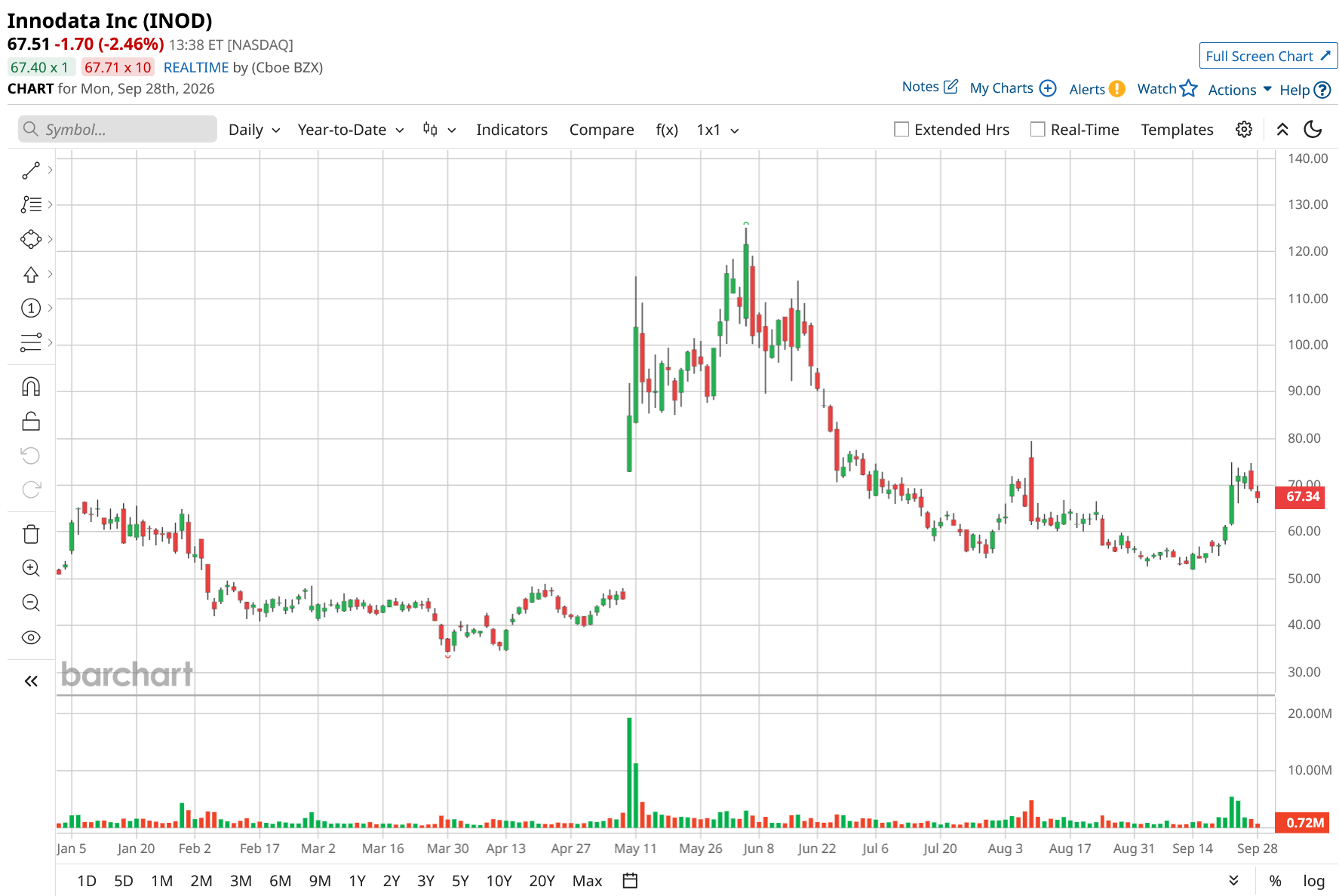
INOD Stock Pops as Hunterbrook Flags a Potential Meta Muse Role
INOD stock popped over 14% last Tuesday after Hunterbrook said in a report that the company could be involved in training Meta Platforms' new Muse personal AI agent.
Hunterbrook said Meta is Innodata’s largest customer, citing interviews with former employees and an analysis of job postings. It estimated that Innodata had roughly 400 full-time equivalent employees working on the Meta account in 2024, based on information from a former director, and said the business has expanded since then.
The connection becomes more notable in light of Innodata’s August disclosure. Alongside reporting record second-quarter results, which we’ll return to later, the company unveiled a new program centered on the “personalization of long-horizon agents” for its largest customer, again identified by Hunterbrook as Meta. And the program’s description appears to overlap with some of the work required to develop sophisticated AI agents such as Muse. Hunterbrook said it may be only the beginning of a broader opportunity.
Now, allow me to clarify things a bit. When Innodata released its Q2 results and disclosed the program, Meta had not yet launched its Muse personal AI agent. At the time, there was only Muse Spark 1.2, a coding-focused update to Muse Spark 1.1, the advanced multimodal reasoning and agentic AI model released in July. Notably, Innodata disclosed the program the day after Muse Spark 1.2 was released, saying it was “now scaling,” which suggested that work in the area was continuing. And in early September, Meta released Muse Spark 1.3, an advanced, natively multimodal reasoning model optimized for long-horizon agentic workflows that serves as the underlying AI engine for its personal AI agent.
Meanwhile, Hunterbrook Media affiliate Hunterbrook Capital disclosed that it held a long position in INOD stock at the time the report was published.
What Meta’s Muse Success Could Mean for Innodata
Meta launched Muse on Sept. 8 as a consumer AI agent capable of browsing the web, managing email and calendars, and completing errands, and the app quickly became one of the most downloaded consumer AI products in the U.S. Hunterbrook noted that Muse rose to the top spot among free apps on the U.S. App Store within 10 days of launch. As of last Friday, Muse had amassed more than 3.4 million downloads, according to Sensor Tower data, while Apptopia estimated installs at as many as 4.3 million.
While Muse’s rapid rise in popularity provided a significant boost to Meta’s stock, a different factor matters more for Innodata. It is the prospect that Meta’s continued development of Muse will require repeated rounds of training data, testing, and human feedback. The disclosed program appears to closely match the nature of that work.
It is also worth noting that the company has not disclosed the program’s financial terms or duration. The program could also partly replace older assignments rather than represent entirely incremental work. That puts the spotlight squarely on Innodata’s Q3 results, due Nov. 5, and any related commentary from management on the earnings call.
Strong Q2 Sets Up a Key Q3 Test for the Muse Thesis
Innodata reported its Q2 results on Aug. 6. The company’s revenue surged 57.7% year-over-year (YoY) to $92.1 million, driven by higher volumes for AI data engineering services across existing customer programs. The top-line figure beat consensus estimates by $5.78 million. Its GAAP EPS came in at $0.41, topping expectations by $0.20. Despite beating on both lines, INOD stock fell more than 4% after the report due to factors unrelated to the company’s numbers.
The stock took a hit after the company announced a leadership transition, with Chief Revenue Officer Rahul Singhal set to replace founder Jack Abuhoff as CEO on Sept. 30, along with plans to raise up to $300 million through an at-the-market offering of common stock.
Returning to the company’s results, its largest customer accounted for 37% of total revenue in Q2, down from 56% in Q1. If Meta is indeed Innodata’s largest customer, that share will be closely watched in the company’s Q3 print. Notably, another customer accounted for 34% of revenue, up from 17% in Q1. Together, the two largest customers generated about 71% of total revenue, underscoring Innodata’s significant customer-concentration risk.
Looking ahead, management reiterated its FY26 revenue growth guidance of at least 40% YoY, adding that several large potential programs from new and prospective customers—which it views as likely wins—are not included in the outlook. Alongside revenue trends for the company’s largest customer, it will be worth watching for an upward revision to guidance to help gauge whether Muse is making a meaningful contribution to Innodata’s financial results.
What Do Analysts Expect for INOD Stock?
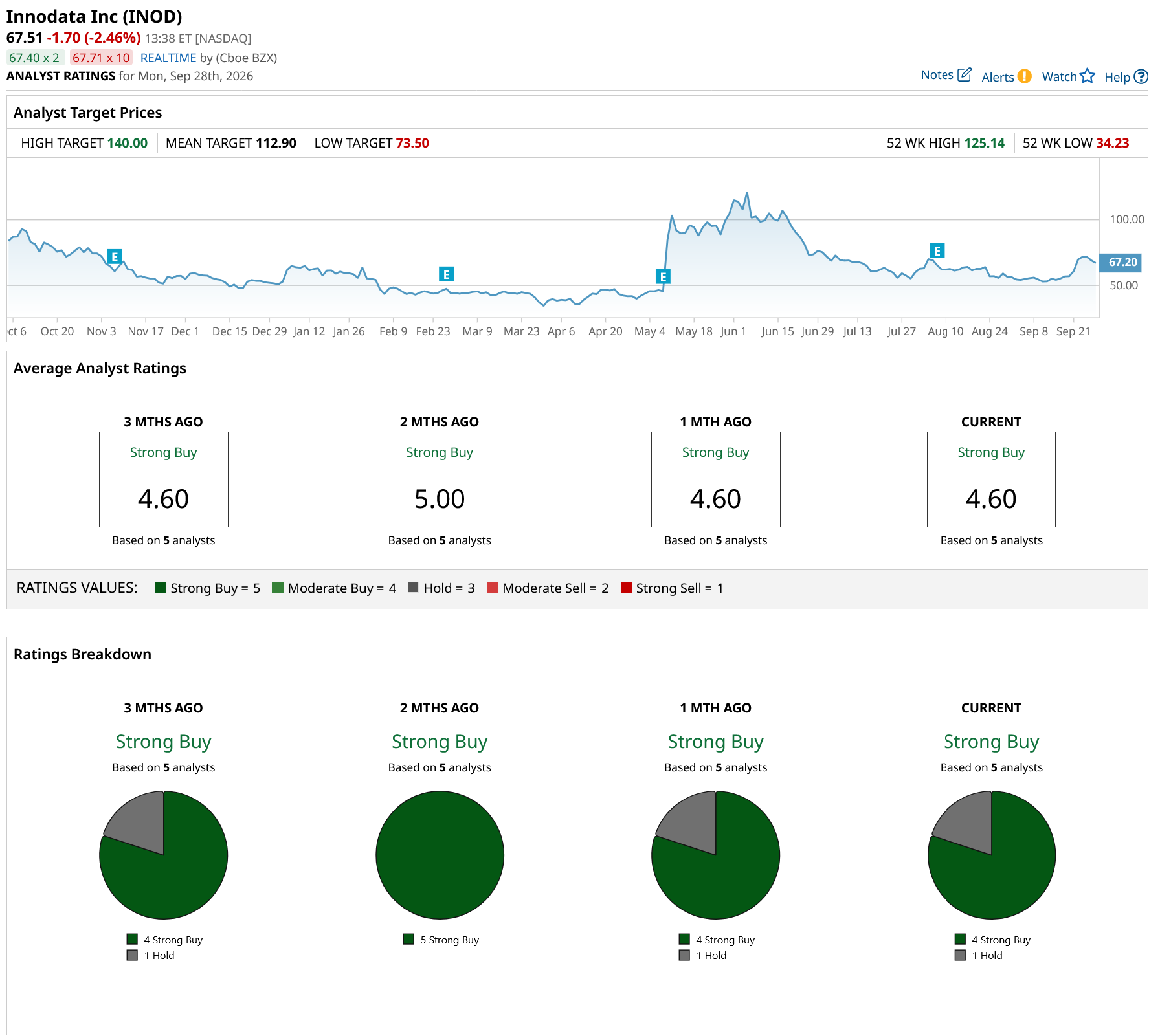
Wall Street analysts have a consensus “Strong Buy” rating on INOD stock. Coverage remains relatively light, however, with just five analysts tracking INOD. Four rate it a “Strong Buy,” while one assigns a “Hold” rating. The average price target stands at $112.90, implying 63.1% upside from Friday’s close.
Putting it all together, I believe investors should closely watch Innodata’s Q3 results for signs that confirm—or fail to confirm—the company’s role in Meta’s agentic AI push. The first area to monitor is the revenue trend for its largest customer. If that customer’s share of revenue rises and overall top-line growth exceeds consensus estimates, it could suggest that Innodata is doing more work for Meta, potentially Muse-related work. The second area to watch is any upward revision to full-year guidance, which could indicate that Meta expects to require more work from Innodata on Muse. With that, a larger revenue contribution from Innodata’s biggest customer, coupled with the guidance raise, could drive a post-earnings pop in INOD shares and, more importantly, provide the strongest evidence yet for the Muse thesis.
On the date of publication, Oleksandr Pylypenko had a position in: META . All information and data in this article is solely for informational purposes. For more information please view the Barchart Disclosure Policy here.