
How Investors May Respond To CoreCivic (CXW) CEO Resignation
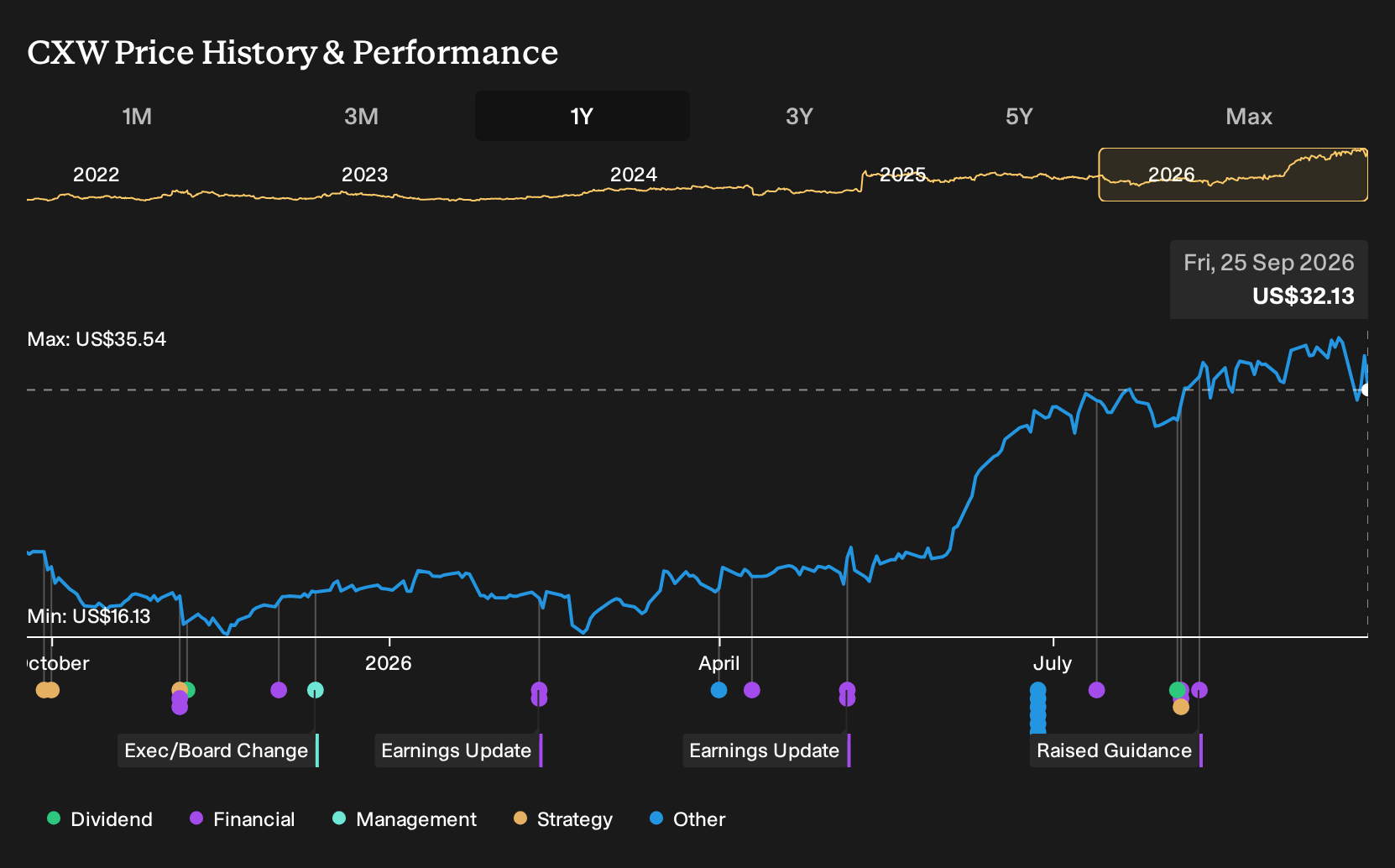
- CoreCivic announced that long serving executive Lucibeth N. Mayberry was appointed President, CEO and director after Patrick D. Swindle resigned from all roles due to serious health issues, marking a rapid leadership handover at the top of the organization.
- Mayberry’s two decade track record inside CoreCivic across strategy, real estate and operations means the leadership change comes from within and could focus investor attention on continuity of execution rather than a reset of the existing business plan.
- We will explore how CoreCivic's existing investment narrative aligns with an internally sourced CEO transition after Swindle’s health driven resignation.
Scan how investors are repricing leadership risk at CoreCivic, and then compare it with other hand picked value opportunities using the 32 high quality undervalued stocks.
CoreCivic Investment Narrative Recap
To own CoreCivic, you need to believe that federal detention and border security funding stays supportive enough for its facilities to remain well used, and that contracts with agencies like ICE and the U.S. Marshals Service remain intact. In the near term, a key swing factor is how quickly idle or underused beds convert into paid occupancy as government partners source permanent capacity.
On the risk side, the biggest operational overhang is still policy and contract concentration, not the CEO change itself. Lucibeth Mayberry has been leading strategy, real estate and innovation for years, so the succession appears operationally aligned with the existing playbook and does not appear to alter the main short term drivers.
The most relevant disclosure tied to this news is Mayberry’s appointment as both President and CEO, alongside her move onto the CoreCivic board. Her long internal tenure, from real estate to chief strategy officer, gives her direct oversight experience of the three operating segments and the push to reactivate capacity for ICE and Marshals contracts.
For you as a shareholder, the central question is execution under a leader who has supported the current capital allocation and facility readiness approach. The key test is whether management can translate elevated federal funding into durable contracts while managing debt and higher fixed costs, in a business where policy reversals and ESG pressure remain structural risks.
CoreCivic's current analyst narrative points to revenues of US$3.4b and earnings of US$515.5m by 2029, off current earnings of US$127.9m. That profile assumes 11.5% yearly top line growth and an earnings increase of about four times from today’s level.
Uncover why CoreCivic's fair value indicates a 30% potential upside to its current price that may not last much longer.
Exploring Other Perspectives
Some of the most optimistic analysts focus on CoreCivic’s capital return story rather than detention risk. They were modeling revenue of about US$3.6b by 2029 and earnings near US$162.1m before this CEO news, paired with a higher future P/E. You can now ask whether that upbeat script still fits or needs a rewrite.
Explore 2 other CoreCivic fair value estimates, including one that suggests as much as 30% upside from the current price.
Form Your Own Verdict
Don't just follow the ticker. Dig into the data and build a conviction that's truly your own.
- A great starting point for your CoreCivic research is our analysis highlighting 2 key rewards and 3 important warning signs that could impact your investment decision.
- See our latest analysis for CoreCivic. The report includes a comprehensive fundamental analysis summarized in a single visual, the Snowflake, making it easy to evaluate CoreCivic's overall financial health at a glance.
Looking For More Ideas Beyond CoreCivic?
Once you have a handle on CoreCivic, it can help to widen the lens and compare it with other opportunities that fit different risk and income profiles. The Simply Wall St Screener lets you quickly filter for businesses that line up with the type of portfolio you are trying to build.
- For investors who want potential mispricing with strong fundamentals, scan a curated set of undervalued opportunities through the 32 high quality undervalued stocks.
- If capital preservation and steadier profiles matter more to you than rapid swings, filter for businesses with stronger financial footing using the 30 resilient stocks with low risk scores.
- When the goal is to uncover less crowded ideas with solid underlying numbers, broaden your watchlist by reviewing the 16 high quality undiscovered gems.
This article by Simply Wall St is general in nature. We provide commentary based on historical data and analyst forecasts only using an unbiased methodology and our articles are not intended to be financial advice. It does not constitute a recommendation to buy or sell any stock, and does not take account of your objectives, or your financial situation. We aim to bring you long-term focused analysis driven by fundamental data. Note that our analysis may not factor in the latest price-sensitive company announcements or qualitative material. Simply Wall St has no position in any stocks mentioned.
Have feedback on this article? Concerned about the content? Get in touch with us directly. Alternatively, email editorial-team@simplywallst.com