
Midterm election risks have yet to explode US stock fluctuations J.P. Morgan Chase: VIX may rise in the next few weeks
The Zhitong Finance App learned that the US midterm elections are one of the major events receiving the most attention in the global financial market for the rest of this year, yet signals released by the derivatives market show that traders are not currently betting that the election will cause sharp fluctuations in US stocks.
Options market data shows that as the November elections approach, the implied volatility of US stocks is still at a relatively low level, and the forward curve of the Chicago Options Exchange Volatility Index (VIX) is significantly lower than the level before the previous US midterm elections.
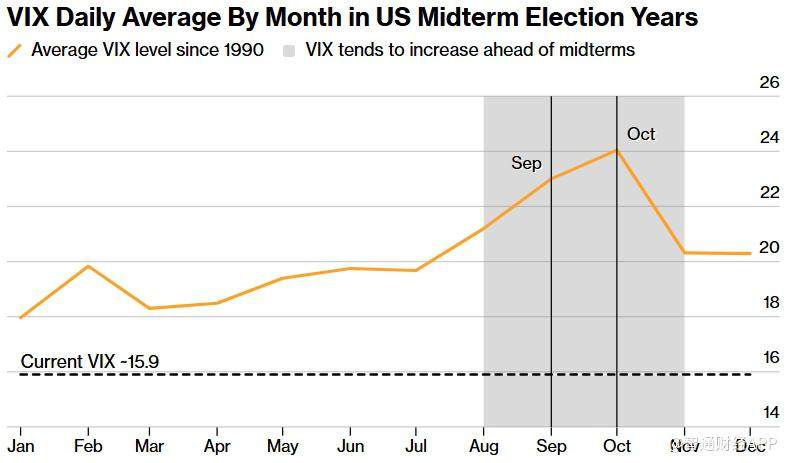
The US 2026 midterm elections will be held in November. At that time, all 435 seats in the US House of Representatives and about one-third of the Senate seats will face re-election. Derivatives strategists at J.P. Morgan Chase, led by Bram Kaplan, pointed out that the impact of the midterm elections on macroeconomics and policy prospects is likely to be relatively limited because the market believes that a political impasse is likely to occur after the elections are more likely. This judgment is also reflected in the S&P 500 options pricing. Currently, the market only takes into account the moderate election event risk premium.
Specifically, the options market expects the implied fluctuation of the S&P 500 index to be slightly higher than 0.8% on November 4 after the voting ended, which is roughly the same as the expected fluctuation corresponding to the Fed's interest rate decision a few days before the election.
This means that although the midterm elections received great attention from investors, judging from the current pricing, traders did not regard it as a risky event that could cause a sharp shock in US stocks. However, J.P. Morgan strategists pointed out that judging from historical rules, the volatility of US stocks often gradually rises several months before the midterm elections, usually reaches a high point about a month before voting day, and then falls back down again after the election is over. J.P. Morgan Asset Management's recent research on historical data also shows that midterm election years are often accompanied by higher realized volatility, but market turbulence in some years was actually mainly driven by other factors such as monetary policy, rather than the election itself.
It is worth noting that the current VIX forward curve is still significantly lower than the level before the previous midterm elections, while investors also face a range of other macro risks, including market disruptions caused by artificial intelligence, as well as inflation and economic risks caused by the Iran war driving up oil prices.
As a result, J.P. Morgan strategists believe that although the options market's reaction to the midterm elections itself is lackluster, there is still room for growth in the future. The strategist advises investors to pay attention to the possibility that pre-election volatility will increase. The reason is that VIX may repeat the historical upward trend before the midterm elections, while other key macro risks may further intensify before the election.