
Learn Why The Bull Case For Western Digital Stock Could Change Following Positive S And P Outlook
- Western Digital has received a positive outlook from S&P Global Ratings, supported by lower leverage, accelerating cash flow, and a move to redeem its remaining 3% convertible notes, alongside a growing focus on AI oriented NAS and cloud storage products.
- The business is leaning into AI and quantum era infrastructure, using high capacity storage platforms and targeted quantum error correction work to position its drives more deeply in hyperscale and advanced computing workloads.
- We will now explore how Western Digital’s investment narrative shifts with stronger balance sheet signals and credit outlook momentum from S&P.
Western Digital Investment Narrative Recap
To own Western Digital, you need to believe its AI focused cloud and NAS drives can stay relevant as data demands increase and as buyers keep favoring HDDs for cheaper bulk storage. The S&P move to a positive outlook reinforces the idea that Western Digital has more financial headroom, but it does not remove execution risk on high capacity products.
In the near term, the key swing factor is whether pricing and mix on large ePMR and UltraSMR drives can offset any pressure on margins that investors worried about after the softer fiscal 1Q27 outlook. The largest risk is the upcoming HAMR transition. If Western Digital’s costs stay elevated while a rival scales faster, profitability could come under pressure.
The clearest announcement tied to this credit update is Western Digital’s decision to redeem its remaining 3% convertible notes. Retiring that piece of debt simplifies the capital structure and follows a period of strong free cash flow, which S&P flagged as part of its more constructive stance.
For investors, the link to catalysts is straightforward. Cleaner funding and a BBB minus rating with a positive outlook can support continued investment in higher capacity drives for AI data centers, while also giving management room to handle bumps in the HAMR rollout or any future margin wobble without immediately stressing the balance sheet.
Western Digital Consensus Assumptions and Valuation Setup
Analysts frame Western Digital around a fairly aggressive growth path in AI heavy storage, paired with a willingness from creditors and equity holders to fund that plan. The consensus view ties the company’s debt clean up to a model where high capacity drives and long term contracts support bigger revenue, even as profit margins are projected to compress from current levels.
On the top line, those forecasts point to revenue expanding at 35.3% per year over the next three years. That is a steep climb for any hardware focused business. It relies on cloud, hyperscale and enterprise customers continuing to build out data infrastructure that pulls in Western Digital’s ePMR, UltraSMR and later HAMR based platforms for bulk AI and analytics workloads.
Profitability assumptions tell a more cautious story. Margins that are listed at 71.9% today are expected to move to 47.6% in three years. That kind of step down can reflect mix effects as very high value cycles moderate, competitive pricing on large accounts or higher cost to qualify and ramp new high capacity drives in the early HAMR era.
Earnings forecasts sit at the center of the analyst model. Consensus expects profit to reach US$15.2b by about 2029, with earnings today at US$9.3b. That implies an earnings increase of roughly US$5.9b over the forecast window, before factoring in any changes in share count, which analysts currently see rising by 5.45% per year for the next three years.
Western Digital's narrative projects US$32.0b revenue and US$15.2b earnings by 2029. This requires 35.3% yearly revenue growth and an earnings increase of about US$5.9b from US$9.3b.
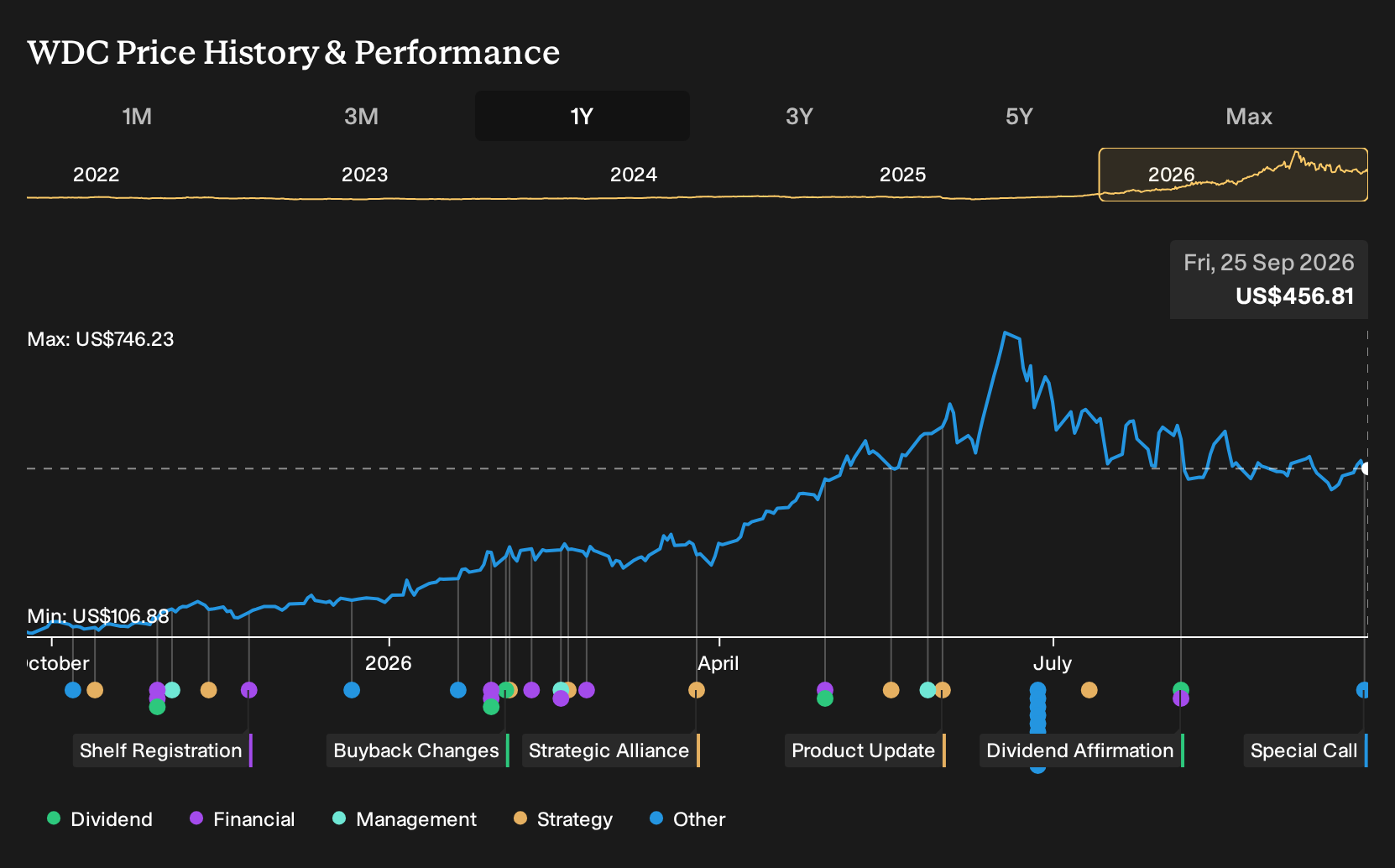
Those profit expectations feed straight into the valuation math. At a consensus price target of US$664.92 per share, the stock would be trading on a P/E of 23.6x the projected 2029 earnings. Analysts compare that multiple with a current 17.1x P/E for Western Digital and a 25.2x P/E level flagged for the wider US tech sector, which places the forecast valuation somewhere between today’s pricing and industry averages.
Revenue forecasts round out the picture. To line up with the analyst targets, Western Digital would be generating about US$32.0b of sales by 2029, matched with the US$15.2b of earnings and that 23.6x P/E. The current share price of US$441.36 sits below the consensus target, which is 33.6% higher on this set of inputs, so readers need to decide whether the growth, margin and multiple assumptions fit their own expectations for AI and cloud storage demand, especially through the upcoming HAMR transition and any bumps in margin guidance along the way.
Uncover why Western Digital's fair value indicates a 46% potential upside to its current price that may not last much longer.
Exploring Other Perspectives
One alternate Western Digital storyline leans hard into AI demand as a catalyst. The most optimistic analysts were already penciling in revenue of about US$36.1b and earnings of US$16.5b by 2029 before this S&P outlook shift. That is far more upbeat than consensus, so treat it as one of several viewpoints worth comparing.
Explore 6 other Western Digital fair value estimates, including one that suggests as much as 200% upside from the current price.
The Verdict Is Yours
Disagree with existing narratives? Extraordinary investment returns rarely come from following the herd, so consider conducting your own research.
- A great starting point for your Western Digital research is our analysis highlighting 4 key rewards and 3 important warning signs that could impact your investment decision.
- See our latest analysis for Western Digital. The report includes a comprehensive fundamental analysis summarized in a single visual, the Snowflake, making it easy to evaluate Western Digital's overall financial health at a glance.
Looking for more Western Digital style investment ideas?
If the Western Digital story has sharpened how you think about balance sheets, growth assumptions and risk, it can be useful to compare it with a wider set of stocks that share similar financial traits or payout profiles.
- If capital preservation matters most to you, focus on businesses with lower risk scores and steadier fundamentals by scanning 30 resilient stocks with low risk scores.
- For readers who care about cash returns today, point your research toward companies with strong yields by checking out 8 dividend fortresses.
- To cast a wider net across lesser known opportunities with solid underlying numbers, broaden your search through 16 high quality undiscovered gems.
This article by Simply Wall St is general in nature. We provide commentary based on historical data and analyst forecasts only using an unbiased methodology and our articles are not intended to be financial advice. It does not constitute a recommendation to buy or sell any stock, and does not take account of your objectives, or your financial situation. We aim to bring you long-term focused analysis driven by fundamental data. Note that our analysis may not factor in the latest price-sensitive company announcements or qualitative material. Simply Wall St has no position in any stocks mentioned.
Have feedback on this article? Concerned about the content? Get in touch with us directly. Alternatively, email editorial-team@simplywallst.com