
How to Play Bloom Energy Stock Amid Oracle Data Center Force Majeure Rumors
Bloom Energy's (BE) AI power story just hit a bump, and it came from an unexpected place — Oracle (ORCL). The tech giant sent a force majeure notice to the developer of Project Jupiter, its massive New Mexico data center, as the project faces delays that could threaten its planned 2028 launch. Oracle says the project remains on schedule and that it is still committed to New Mexico, while Blue Owl Capital (OWL) said the notice does not change its financial commitments to the multiyear project.
The bigger issue for Bloom Energy is power. Project Jupiter was designed to use Bloom’s gas-powered fuel cells, but a key natural-gas pipeline needed to supply the site has been pushed back to February 2027 after permitting setbacks. That puts the timing of Bloom’s deployment under a brighter spotlight, even though the company has other projects and customers in its pipeline. That uncertainty was enough to send Bloom Energy’s shares lower, adding risk after the stock’s sharp run-up.
And that’s not the only thing investors have to weigh. Bloom is also dealing with a pending securities class action lawsuit tied to allegations about its scandium supply chain, with a Sept. 28 lead-plaintiff deadline.
With investors now weighing the potential impact of a Project Jupiter delay against Bloom’s broader AI-power opportunity, along with a legal overhang, how should investors approach BE stock from here? Let’s take a closer look.
About Bloom Energy Stock
Power has become the Achilles’ heel of the AI boom, and Bloom Energy wants to be part of the solution. Founded in 2001 and headquartered in San Jose, California, Bloom makes solid oxide fuel cell (SOFC) systems that allow businesses to generate electricity onsite, rather than waiting for the grid to catch up.
Its customers span data centers, semiconductor companies, utilities, hospitals, universities, and retailers. Bloom also makes solid oxide electrolyzers (SOECs) for hydrogen production. With more than 2,000 employees worldwide and more than 25 years of experience in onsite energy, the company has built its business around the idea of bringing reliable power closer to where it is needed. Today, Bloom has a market capitalization of about $81 billion.
That positioning has put Bloom right in the middle of the AI infrastructure race, and BE stock has faced its share of ups and downs along the way. Shares got a fresh jolt when Nebius Group (NBIS) said its planned 300-megawatt New Jersey AI data center would use Bloom’s fuel cells. The move helped the project work around local zoning and community hurdles while offering quiet, ultra-low-emission power, sending BE stock roughly 12.3% higher.
The bigger catalyst, however, came in late June. Bloom expanded its partnership with Brookfield Asset Management (BAM), lifting the financing capacity for AI infrastructure projects to $25 billion. For investors, that was a shot in the arm because financing can be just as important as technology when customers are looking to bring massive data centers online quickly.
But the road soon got bumpy. In July, short-seller Hunterbrook Capital alleged that Bloom had secretly relied on China for scandium oxide, a material used in its fuel cells. Bloom pushed back, calling the allegations “false and misleading,” but the controversy still put pressure on the shares.
Then the broader market turned against high-beta AI and growth names. Even Bloom’s blockbuster second-quarter results in late July could not completely keep the selling pressure at bay. The stock fell 31% that month, showing just how quickly the mood can change when expectations are sky-high.
More recently, BE slipped again after reports that Oracle had invoked a force majeure clause related to Project Jupiter.
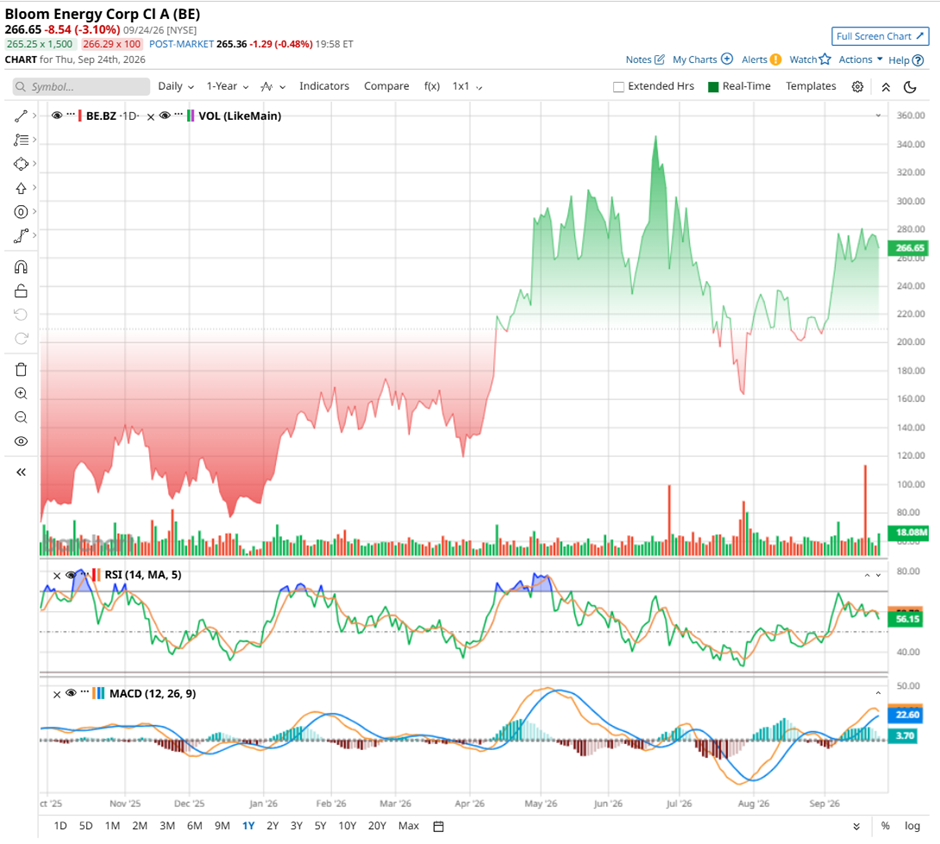
Still, the bigger picture tells a different story. Despite trading 24.1% below its June peak of $351.28, BE stock remains up a staggering 285.4% over the past 52 weeks and 206.9% in 2026. Just over the past month, BE stock climbed nearly 31%.
Technically, the picture is steady. The 14-day Relative Strength Index (RSI) is around 56, keeping the stock in neutral territory, while the MACD has crossed above its signal line and the histogram remains positive, suggesting that buying momentum may be returning.
When it comes to valuation, Bloom Energy is not exactly bargain-priced. The stock trades at about 101.7 times forward adjusted earnings and 19.69 times forward sales, both well above the sector averages. Investors are already paying up for Bloom’s growth potential and its exposure to the surging demand for power from AI data centers. That can work if the company keeps delivering strong growth, but with expectations this high, there’s not much room for execution to slip.
A Snapshot of Bloom Energy’s Q2 Earnings Report
Bloom Energy’s second-quarter numbers showed why the company has become such an interesting name in the AI power race. The company crossed a major milestone, generating $1.065 billion in revenue, up a stunning 166% year over year (YOY) and marking the first quarter in which revenue topped $1 billion. Product revenue, which includes its core solid oxide fuel cell (SOFC) systems, was even stronger, climbing 215.4% to $935.4 million.
Meanwhile, non-GAAP gross margin improved to 34.3% from 28.2% a year earlier, while adjusted EPS jumped to $0.78 from $0.10. That result comfortably topped Wall Street’s expectations and marked Bloom’s seventh consecutive quarterly earnings beat.
Cash flow provided another encouraging sign. Operating cash flow swung to a $226.4 million inflow, compared with a $213.1 million outflow in the year-ago quarter. Bloom ended Q2 with roughly $2.67 billion in cash, giving the company considerable financial flexibility as it works to scale.
Bloom is also trying to remove one of the biggest hurdles for customers — the upfront cost of deploying its systems. During the quarter, the company expanded its financing partnership with Brookfield Asset Management, increasing the financing capacity available for customer projects to $25 billion. In theory, that could make it easier for customers to bring Bloom’s power systems online as electricity demand keeps climbing.
Management is bullish, raising its full-year 2026 revenue outlook to the $3.9 billion to $4.2 billion range, with the midpoint representing roughly another doubling from 2025 revenue. The company expects non-GAAP EPS to be between $2.55 and $2.85, driven by converting its existing backlog as customer sites become ready while continuing to secure new bookings.
Analysts monitoring Bloom Energy anticipate Q3 revenue to be $1.06 billion, with EPS of $0.57. Looking further out, analysts see fiscal 2026 EPS reaching $2.06 and then climbing by another 110.2% annually to $4.33 in fiscal 2027. That kind of earnings growth could give investors another reason to keep BE stock on their radar.
What Do Analysts Expect for Bloom Energy Stock?
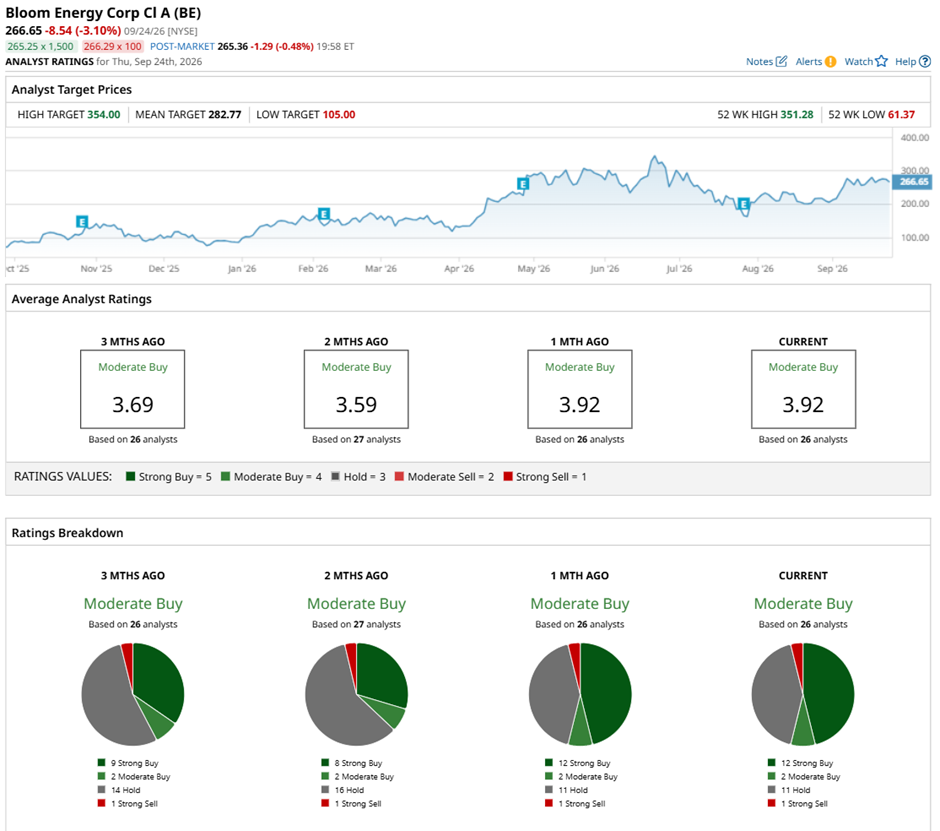
Overall, BE stock carries a consensus “Moderate Buy” rating. Among the 26 analysts covering the company, 12 suggest a “Strong Buy,” two advise a “Moderate Buy,” 11 analysts are on the sidelines with a “Hold” rating, and the remaining one has a “Strong Sell.”
The stock has a mean price target of $282.77, implying upside potential of 6% from the current price levels. The Street-high price target of $354 suggests that the stock could rise as much as 32.8%.
Final Thoughts on Bloom Energy
Bloom Energy’s strong quarterly results, rising AI power demand, and improving cash flow keep the long-term story intact. But BE stock is no longer flying under the radar. Shares are already up sharply this year, putting the spotlight firmly on valuation. At current levels, investors are paying a hefty premium for Bloom’s growth potential, leaving less room for disappointment if execution falls short or project delays persist.
The recent pullback could look tempting, but jumping in simply because BE has fallen may be premature. With Oracle-related uncertainty still hanging over Project Jupiter, investors may be better served by keeping some powder dry and waiting for clearer signs that Bloom can turn its huge AI opportunity into sustained earnings growth.
On the date of publication, Sristi Suman Jayaswal did not have (either directly or indirectly) positions in any of the securities mentioned in this article. All information and data in this article is solely for informational purposes. For more information please view the Barchart Disclosure Policy here.