
98,828 Reasons to Sell Rivian Stock
Rivian Automotive (RIVN) is facing a fresh potential headwind after the electric vehicle (EV) maker recalled 98,828 vehicles in the U.S. over a rearview-camera software issue. The recall affects certain R1S, R1T, and R2 vehicles from the respective 2022–2027 model years, with the National Highway Traffic Safety Administration (NHTSA) warning that a notification could obstruct the rearview-camera image when the vehicle is in reverse, potentially reducing visibility and increasing crash risk.
Rivian has issued a free over-the-air software update to address the problem, limiting the immediate need for a hardware repair. However, the scale of the recall adds another issue for investors to monitor as Rivian ramps production, strengthens its financial position, and builds confidence in its next-generation vehicles.
About Rivian Automotive Stock
With a market cap of around $22.1 billion, Rivian Automotive is an electric vehicle manufacturer focused on developing premium electric pickup trucks, SUVs, and commercial delivery vans. Headquartered in Irvine, California, the company also provides proprietary software, vehicle technology, and charging solutions to support its growing EV ecosystem. Rivian’s flagship products include the R1T pickup, R1S SUV, and the R2 midsize SUV, helping expand the company’s addressable market.
Rivian Automotive stock has come under pressure in 2026, with shares down about 22.4% year-to-date (YTD) and 3.2% over the past year. The weakness is pronounced as RIVN recently closed at $15.29, compared with its 52-week peak of $22.69, leaving the shares around 32.6% below that high. Rivian reached its 52-week high on Dec. 22, 2025, while the stock has struggled to regain momentum.
The decline reflects several investor concerns, including Rivian’s ongoing losses and cash needs, dilution concerns following its 75 million-share offering, and uncertainty surrounding the production ramp of its more affordable R2 lineup. The stock has also faced pressure as investors weigh the company’s ability to scale deliveries while improving profitability. The recall of nearly 99,000 vehicles over a rearview-camera issue adds another execution and quality concern.
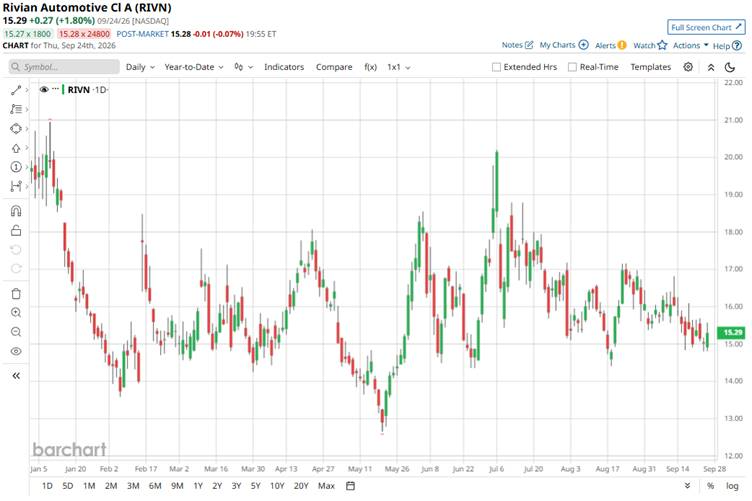
The stock is currently trading at a premium compared to industry peers at 4.07 times sales.
Rivian’s Deliveries Remain Steady
On July 2, Rivian released its second-quarter 2026 production and delivery results. The company produced 12,613 vehicles and delivered 12,194 vehicles during the quarter, surpassing its previously issued delivery guidance of 9,000 to 11,000 vehicles.
Deliveries also increased from 10,661 vehicles in the second quarter of 2025, reflecting improving demand for Rivian’s R1 lineup, commercial delivery vans, and the initial rollout of its new R2. Rivian said it began external R2 deliveries on June 9 and hosted more than 57,000 demo drives during the quarter, a company record.
Meanwhile, its production reached 10,236 vehicles and deliveries increased to 10,365 vehicles in the first quarter of 2026.
For 2026, Rivian raised its vehicle-delivery guidance to 65,000-70,000 units from 62,000-67,000, reflecting stronger expected production and deliveries in the second half as R2 production ramps.
Bottom-Line Improving, but Still in the Red
Rivian reported its second-quarter 2026 results on July 30, delivering a notable improvement in profitability metrics as it began external deliveries of its lower-priced R2 SUV. Revenue increased 27% year-over-year (YOY) to $1.7 billion, supported by higher vehicle deliveries, regulatory-credit revenue, and strong growth in software and services.
The biggest improvement came at the gross-profit level. Rivian generated $179 million of gross profit, compared with a $206 million gross loss in the prior-year quarter, while gross margin improved to 11% from negative 16%. The automotive segment remained slightly unprofitable, but its gross loss narrowed dramatically to $36 million from $335 million a year earlier. However, automotive revenue rose 23% to $1.1 billion.
Rivian’s software and services segment continued to be an important source of profitability. Revenue jumped 37% to $515 million, while segment gross profit climbed to $215 million, driven primarily by vehicle electrical architecture, software development services from the Volkswagen joint venture, vehicle repair and maintenance services, and the Autonomy+ offering. The Volkswagen-related business generated $308 million of the segment’s Q2 revenue.
Rivian also reduced its adjusted operating losses. Adjusted EBITDA improved to a loss of $379 million from a $667 million loss in Q2 2025, giving it an adjusted loss of about $0.47 per share. That was significantly narrower than the adjusted loss of $0.80 per share in Q2 2025 and beat the consensus estimate.
On the other hand, cash flow remained a concern. Rivian used $487 million in operating cash during Q2, compared with $64 million of operating cash provided in the year-ago quarter. Capital expenditures declined to $362 million from $462 million, but free cash flow deteriorated to an outflow of $849 million from a $398 million outflow a year earlier.
For 2026, the company improved its adjusted EBITDA outlook by $50 million at the midpoint, now expecting adjusted EBITDA losses of $1.8 billion to $2.0 billion. Capital-expenditure guidance was reduced to $1.7 billion to $1.8 billion, with the midpoint cut by $250 million because of project efficiencies and the timing of spending.
Additionally, analysts anticipate loss per share to improve 1% to $2.98 in fiscal 2026, and again improve 16.8% to $2.48 in fiscal 2027.
What Do Analysts Expect for Rivian Stock?
Most recently, Citigroup initiated coverage of Rivian Automotive, with a “Neutral” rating and an $18 price target. Citi’s view centers on Rivian’s ability to transition from being a relatively low-volume producer to a higher-volume automaker, with the successful ramp-up of its new R2 SUV emerging as a key determinant of the company’s long-term outlook. The firm highlighted the risks surrounding the R2 launch, particularly the company’s ability to execute the production ramp at scale and maintain manufacturing efficiency as volumes increase.
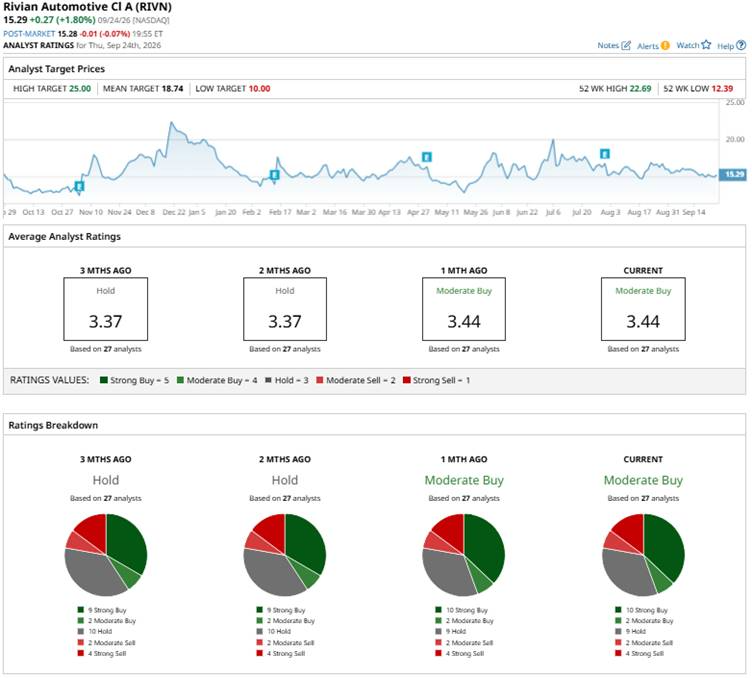
However, Rivian stock has a consensus “Moderate Buy” rating overall. Out of 27 analysts covering the stock, 10 recommend a “Strong Buy,” two give a “Moderate Buy,” nine analysts stay cautious with a “Hold” rating, and two suggest a “Moderate Sell." Four rate it a “Strong Sell.”
RIVN’s average analyst price target of $18.74 suggests an upside potential of 22.6%, and the Street-high target of $25 suggests growth of 63.5% ahead.
On the date of publication, Subhasree Kar did not have (either directly or indirectly) positions in any of the securities mentioned in this article. All information and data in this article is solely for informational purposes. For more information please view the Barchart Disclosure Policy here.