
How Data Lawsuit Settlement Will Impact CVS Health Stock Investors
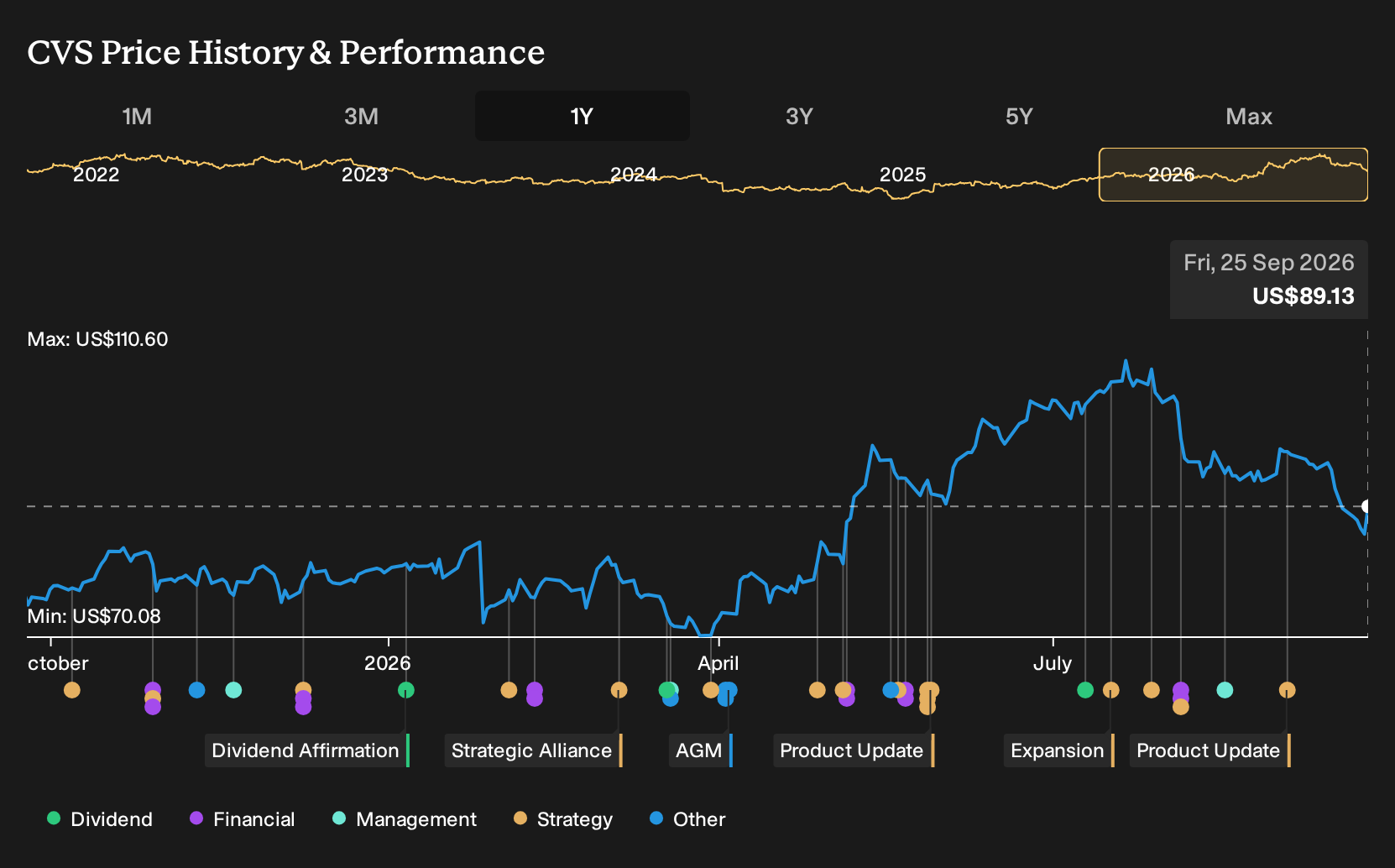
- CVS Health recently agreed to a US$20.5 million settlement over allegations that its website shared personal and protected health information with ad tech firm Criteo without user consent, resolving a data tracking dispute that had raised privacy and compliance questions.
- The legal resolution lands at the same time CVS Health is working with improved full year guidance, stronger cash generation and better Aetna medical benefit ratios. Together, these factors sharpen attention on how execution and risk management affect the overall health of its integrated model.
- This development raises questions about how CVS Health's investment narrative is influenced by improved guidance alongside the resolution of a major data privacy case.
Compare how CVS Health stacks up against other large, cash generative operators facing their own legal and regulatory overhangs by screening for 30 resilient stocks with low risk scores in one place.
CVS Health Investment Narrative Recap
To own CVS Health, you need to believe its integrated model can turn disciplined Aetna underwriting, steadier pharmacy and PBM economics, and tech driven cost savings into more predictable earnings and cash generation. The key short term swing factor remains execution on medical benefit ratios in Aetna and Health Care Delivery, which drive how much of that premium revenue actually sticks.
The biggest risk near term is that elevated medical costs, membership losses or renewed weakness at assets like Oak Street dilute that margin story and offset progress elsewhere. The Criteo data settlement looks manageable in size, so the direct financial hit to those operational goals and near term catalysts appears limited.
The Criteo settlement ties back to operational risk management rather than core insurance pricing or pharmacy volumes. For an investor following CVS Health, the relevance sits in how data governance and compliance processes keep pace with a business that depends heavily on digital engagement, online scripts and GLP 1 programs that cross Aetna, Caremark and retail.
That legal clean up arrives while CVS Health is working against a clear to do list: restore Aetna margins toward targets, keep PBM contracts disciplined despite 340B pressure, and harvest more of the US$20b tech spend into tangible cost savings. Execution on those levers, not this single settlement, still looks like the main catalyst and risk cluster.
CVS Health's narrative projects US$458.7b revenue and US$11.3b earnings by 2029. This scenario assumes revenue grows at 3.6% per year and earnings increase by about US$6.4b from US$4.9b today.
Uncover how CVS Health's fair value indicates a 30% potential upside to its current price before the discount to CVS Health closes.
Exploring Other Perspectives
Five fair value views from the Simply Wall St Community span roughly US$104 to more than US$274 per share, which signals how far apart private investors can be on CVS Health. Those opinions sit alongside governance investigations and medical cost risks, so you are weighing wide valuation gaps against execution and oversight questions.
Explore 4 other CVS Health fair value estimates, including one that suggests it could be worth just $104.01.
Decide For Yourself
Don't just follow the ticker. Dig into the data and build a conviction that's truly your own.
- A great starting point for your CVS Health research is our analysis highlighting 4 key rewards and 2 important warning signs that could impact your investment decision.
- See our latest analysis for CVS Health. The report includes a comprehensive fundamental analysis summarized in a single visual, the Snowflake, making it easy to evaluate CVS Health's overall financial health at a glance.
Looking For More Ideas Beyond CVS Health?
Once you have a view on CVS Health, it can help to widen the lens and compare it with other businesses that share some of the traits you care about most, whether that is resilience, balance sheet strength or income potential.
- For investors who want potential upside without ignoring balance sheet discipline, scan through a carefully filtered 16 high quality undiscovered gems that already pass strict fundamental checks.
- If capital protection is high on your list, focus your search on a 30 resilient stocks with low risk scores that screens for companies with more resilient risk profiles.
- For those building an income stream, start with a 8 dividend fortresses that highlights higher yielding payers with an emphasis on durability.
This article by Simply Wall St is general in nature. We provide commentary based on historical data and analyst forecasts only using an unbiased methodology and our articles are not intended to be financial advice. It does not constitute a recommendation to buy or sell any stock, and does not take account of your objectives, or your financial situation. We aim to bring you long-term focused analysis driven by fundamental data. Note that our analysis may not factor in the latest price-sensitive company announcements or qualitative material. Simply Wall St has no position in any stocks mentioned.
Have feedback on this article? Concerned about the content? Get in touch with us directly. Alternatively, email editorial-team@simplywallst.com