
Policy bottom+valuation rebound, the real estate industry ushered in an inflection point?
Increased “supply and demand” policies are restructuring the fundamentals of the industry. Policies such as the 15th Five-Year Plan, loan interest rates, and provident fund management plans continue to gain strength on the demand side. Can a “strong policy” in the real estate industry change the status quo of “weak demand”?
The Zhitong Finance App learned that the real estate industry has entered an era of inventory. Both development volume and sales volume have declined sharply, corporate losses have been seriously passively cleared, and both supply and demand sides are strong in terms of policy, and high-quality real estate development has become the focus of the “15th Five-Year Plan”. The Securities Regulatory Commission recently formulated “Opinions on Capital Market Support for Building a New Model of Real Estate Development”, which is compounded by large-scale loan interest rates across the country, and calls for an inflection point have emerged in industry fundamentals.
However, based on multiple benefits in the industry, the real estate sector is already showing signs of starting up, but differences have arisen in different markets. A-shares have continued to be strong. Since September 17, Vanke (02202) has surged more than 25%. I Love My Family (000560.SZ) still had momentum after three consecutive days. The rise in Hong Kong stocks was weak. Most of the shares declined after two days of rising. After Vanke's pullback, the increase was less than 10%. Sunac China almost returned to its original form, and Hong Kong stocks did not seem to buy.
However, valuations in the real estate industry have already entered the bottom zone, so is this rise short-lived or is it a sign of an inflection point in the industry?
The bottom of the policy has emerged, and the industry may bottom out or shift to a pro-cyclical cycle
The Zhitong Finance App learned that since the “Three Red Lines” was fully implemented in 2021, debt reduction, leverage reduction, and financing contracted due to the epidemic. Demand for home purchases was sluggish, demand for marriage homes continued to decline, the real estate industry entered a period of decline, and various indicators such as industry sales and sales area declined across the board. From 2022 to 2025, commercial housing sales fell by about 40%, “volume and price fell sharply”. The double-digit downward trend continued in 2026, but the downward trend stabilized.
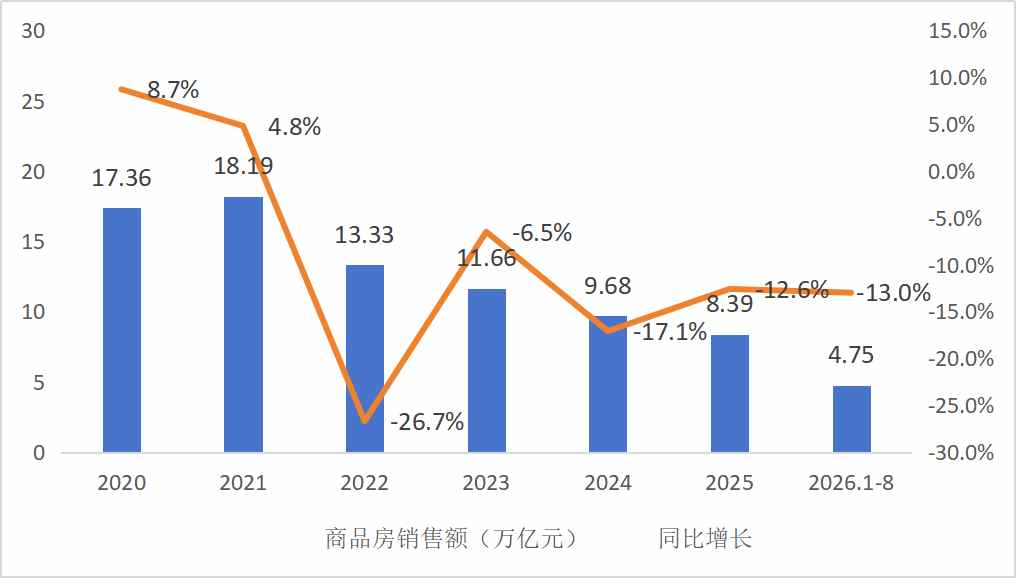
Data source: Publicly disclosed data
From January to August 2026, investment in real estate development decreased by 19.9%, with residential investment falling 19.7%, new housing construction area falling 23.7%, commercial housing sales area falling by 23.7%, commercial housing sales area of 499 million square meters, a decrease of 12.1%, sales of 4.75 trillion yuan, a decrease of 13%, and an average unit price of 0.95 million yuan/square meter. As of August, the area of newly built commercial housing for sale was 753 million square meters, a decrease of 1.1%, maintaining a slow pace of removal.
In fact, looking at the past few years, the recession cycle has gone haywire. Bankruptcy, bankruptcy, and delisting represented by Evergrande, most leading housing enterprises are still in the bankruptcy and restructuring stage. Although the 6-year downward cycle has yet to “fully stabilize”. However, there are signs of an inflection point in the development trend of the real estate industry. The bottom of the policy has emerged. Continued efforts on both the supply and demand sides, coexist with fundamental adjustments, and the downturn cycle is expected to gradually shift to a pro-cyclical cycle.
The country's “15th Five-Year Plan” underpins the basic market for the real estate industry. On August 28 of this year, departments such as the Ministry of Housing and Construction, the Central Bank, and the General Administration of Financial Supervision issued a series of new real estate policies. The new policy continues to unleash a combination of both supply and demand. For example, the China Securities Regulatory Commission formulated “Opinions on Capital Market Support for Building a New Real Estate Development Model”. The “trade-in” loan interest rate discount program has covered the whole country. At the end of September, the newly revised “Housing Provident Fund Administration Regulations” were officially implemented. At the same time, it is speeding up the promotion of the existing housing sales model, and “one hand pays, one hand hands over the house” comprehensively improves the supply and demand pattern.
The inflection point has yet to be confirmed. Leading high-quality real estate companies are “strong and strong”
Judging from the current state of the industry, the real estate industry is seriously divided. Judging from the financial report for the first half of 2026, most housing companies' income continued to decline by double digits, and overall losses have narrowed. In the real estate industry, “stability” can only go a long way. “Strong people”, housing enterprises with low debt ratios and central state-owned enterprise backgrounds showed resilience, maintaining profits as represented by Poly Development, China Resources Land, and China Overseas Development. The net profit for shareholders in the first half of the year was 9.842 billion yuan and 7.03 billion yuan, respectively. Among them, China's overseas development revenue bucked the trend, increasing 17.28% year on year, and the net shareholder interest rate was 7.2%.
Looking at full-caliber sales, the only real estate companies with sales of 100 billion yuan or more in the first half of the year were Poly Development, China Overseas Development, and China Resources Land. All three companies had leading positions in debt management in the industry. Among them, China Overseas Development and China Resources Land had the lowest balance ratio in the industry at the end of the period. However, after six years of industry adjustments, the short-term cash debt ratio of most key housing enterprises can still be maintained at more than 1.0 times. As financing policies tend to be relaxed, housing enterprises have followed the trend of lengthening debt periods, and most of the short-term interest-bearing debts of key housing enterprises account for less than 35%.
Facing downward pressure on the industry, real estate agents are cautious in acquiring land. Central state-owned enterprises with abundant cash flow are the main players in land acquisition. Poly Development had the highest amount of land acquisition in the first half of the year, followed by China Resources Land, which continued to enrich high-quality land storage. New projects focused on core areas of core cities, gaining a greater competitive advantage during the industry recovery cycle. As of the end of June 2026, it has been revealed that Vanke, China Resources Land and China Overseas Development had the highest land storage construction scale among housing enterprises.
It is worth mentioning that based on resilient performance and maintaining profits, the market capitalization of the three high-quality housing companies, Poly Development, China Resources Land, and China Overseas Development, had little impact on the industry cycle. In the case of China Resources Land, the market capitalization increased by more than 5% this year and more than 25% in the past two years. On the other hand, high-debt housing enterprises, such as Sunac China, dropped 99% this year. It can be seen that “the strong are always strong” is very obvious in the comprehensive indicators of the real estate industry.
So, when will the real estate industry reach an inflection point? Excess returns can only be obtained proactively. Refer to the lithium battery industry, which entered an adjustment period in 2022. The “volume price” bottomed out in the first half of 2025, and the sector fell by more than 70%. Industry leaders Ganfeng and Tianqi Lithium were no exception. However, in the second half of 2025, the cycle began, and lithium carbonate prices began to rise. The industry began to make money after losing several years, and capital favored the leaders. Among them, Ganfeng rose all the way from a low of HK$16.2 to a high of HK$91.2, an increase of 4.63 times. After May 2026, the sector followed the decline in lithium carbonate prices.
The bottom inflection point has high premium appeal, but the confirmation of the inflection point in real estate is uncertain. First, the supply-side scale shrinks to the valley, but the demand side is still relatively weak, expectations of “volume and price” increases are weak, and under a policy where housing is not speculated, performance expectations fall on demand rather than price; secondly, policy support and policy release, including solutions such as loan interest rates and provident funds, require time to be verified on the demand side.
Overall, the real estate industry is still in its infancy. This year's “15th Five-Year Plan” and the 8.28 New Deal support the high-quality development of the industry and bring expectations to the demand side. At this stage, the industry's overall losses, and the performance of targets is divided. The leading high-quality real estate company “Strong Man Hengqiang”, Poly Development, China Overseas Development, and China Resources Land are all at the leading level of the industry in terms of performance, finance, and business.
There are structural opportunities in the industry. Leading high-quality housing enterprises are “strong and strong” in the bottoming cycle, and leading high-quality housing enterprises will also benefit the most if the inflection point cycle of the industry arrives, leading high-quality housing enterprises will also benefit the most, and market capitalization premium opportunities are highly certain. Of course, there is a greater chance of having the expected lower valuation target. Vanke's PB value is only 0.2 times lower than Poly Development, China Resources Land, and China Overseas Development. If the industry's inflection point market capitalization is more flexible, the value ratio is higher.