
After the Federal Reserve raised interest rates, is the Reserve Bank of Australia ready to take continuous action? The market focuses on “restarting interest rate hikes in September and adding again in November”
The Zhitong Finance App learned that the central choice the Reserve Bank of Australia (RBA) is about to face is whether to follow the Federal Reserve and other global central banks to further tighten their policies while inflation is still above target and energy costs rise again, even if the real estate and job markets are already showing signs of cooling down.
According to an economist survey data from the agency, the market expects the Reserve Bank of Australia to raise the cash interest rate by 25 basis points to 4.6% on September 29, reaching the highest level since November 2011; the more important disagreement is whether it is necessary to continue raising interest rates to 4.85% in November. Factors underpinning expectations of austerity include higher-than-expected inflation and economic growth data, and the erosion of firms' confidence in whether the central bank can restore price stability.
According to data from the Australian Bureau of Statistics, the overall CPI rose 3.5% year on year in July, and the average inflation rate at the end was 3.6%, all above the target range of 2% to 3%; among them, although overall inflation fell from June, core inflation did not decline further. Up to now, the cash interest rate is still 4.35%, and this rate hike has yet to be implemented.
The Australian Federal Reserve is expected to restart interest rate hikes, and the pressure on high global interest rates continues to accumulate
The Federal Reserve's return to a trajectory of interest rate hikes has placed Australia's policy dilemma in the midst of a broader revaluation of global interest rates. It is worth noting that the Reserve Bank of Australia previously embraced the interest rate hike cycle before central banks such as the Federal Reserve and the Bank of Japan. The Reserve Bank of Australia raised interest rates by 25 basis points each in February, March, and May of this year, with a cumulative total of 75 basis points, raising the cash interest rate from 3.60% to 4.35%; the Federal Reserve only resumed interest rate hikes on September 16.
The Federal Reserve previously raised interest rates by 25 basis points on September 16, raising the policy interest rate range to 3.75% — 4.00%. Schwab Wealth Management's September 25 analysis showed that federal funds futures at the time included expectations of close to three additional interest rate hikes as of June 2027. Long-term treasury bond yields reflect future short-term interest rate paths and term premiums. Therefore, even if the central bank has not implemented subsequent interest rate hikes, the market will adjust long-term capital prices ahead of schedule.
Citing the New York Federal Reserve's analytical model, Carson's team of analysts pointed out that the rise in 10-year US Treasury yields this year is mainly due to an increase in expected short-term interest rates, rather than being dominated by term premiums, which indicates that the market is re-evaluating how high and how long it will actually take to suppress inflation.
This revaluation is already reflected in long-term interest rates in the US and Australia. During the New York trading session on September 25, US 10-year and 30-year Treasury yields hit about 5.23% and 5.53%, respectively, reaching their highest levels since 2007 and 2004, before falling back to about 5.16% and 5.49%. On the same day, OTC interbank quotes compiled by Trading Economics showed that Australian 10-year and 30-year treasury yields were about 5.40% and 5.75%, respectively, up about 38 and 18 basis points over the past month, respectively. Long-term interest rates in both countries are under pressure from energy inflation and a revised policy path, yet Australia is compounding its own core inflationary stickiness with expectations of another rate hike.
From suspension to further austerity? Patience with high inflation is gradually running out, and the Australian Federal Reserve is expected to restart interest rate hikes
As policymakers gradually lose patience with continued high inflation, the Bank of Australia is expected to start raising interest rates on Tuesday, and the debate over whether further rate hikes are needed thereafter is heating up.
According to an agency survey of economists, the Reserve Bank of Australia's nine-member monetary policy committee will raise the cash interest rate by 0.25 percentage points to 4.6% in a resolution announced at 2:30 p.m. Sydney time, reaching the highest level since November 2011. Against the backdrop of a sharp rise in global energy prices, traders are also setting prices for the Reserve Bank of Australia to end two consecutive meetings where interest rate hikes have been suspended.
Investors will keep a close eye on the interest rate statement, as well as Governor Michelle Bullock's press conference an hour later. They will look for clues to determine whether the Reserve Bank of Australia is preparing to continue to raise interest rates in November, forming a rhythm of two consecutive sessions of interest rate hikes, or whether they prefer to stay on the sidelines for the rest of the year.
Belinda Allen, head of Australian economic research at Commonwealth Bank of Australia, said: “Considering the inflationary background, the risk is that monetary policy will still need to be further tightened after September. However, further strengthening the restrictive nature of monetary policy is not an easy decision to make.”
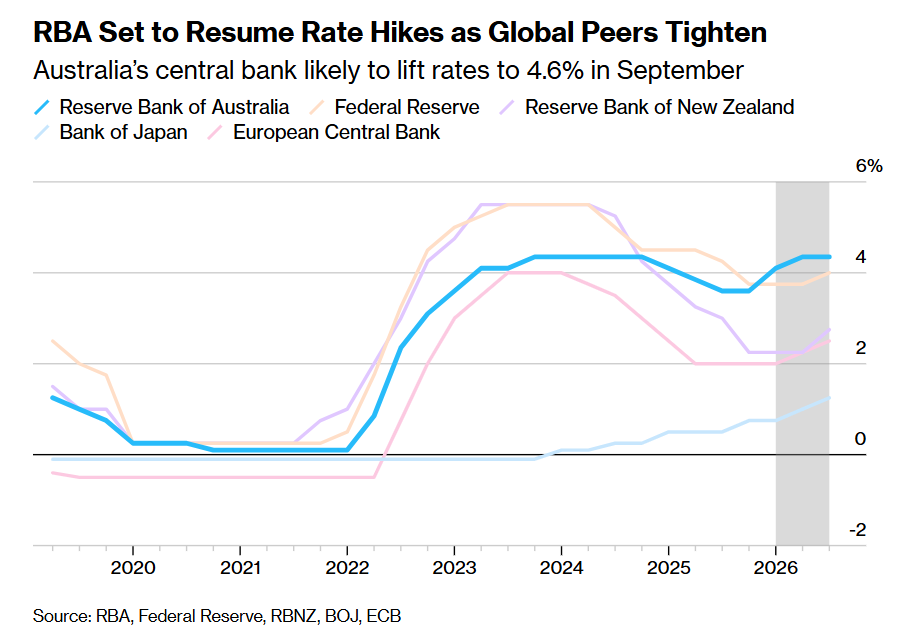
As shown in the chart above, the Australian Federal Reserve is expected to restart interest rate hikes. Many central banks around the world are simultaneously tightening their policies, and Australia may raise interest rates to 4.6% in September.
The RBA's signs of restarting policy austerity can be traced back to its surprisingly hawkish August meeting minutes. In the minutes, which are biased towards austerity, the decision-making committee, which is divided on the policy outlook, lists three key figures to focus on before the September 28-29 meeting:
July Monthly Inflation Data: Overall and Core Inflation Exceed Expectations
Q2 GDP: Growth Exceeded Expectations
August employment data: the unemployment rate has been rising for two consecutive months
According to this, two of the three figures are moving in a direction that is not conducive to cooling inflation. This series of better-than-expected data was accompanied by the central bank's increasingly hawkish policy communication. Senior officials have repeatedly stressed that they have little tolerance for continued high inflation and are willing to raise interest rates again if necessary.
They also expressed concern about whether inflation expectations could return to the target range of 2% to 3%. Bullock reminded a parliamentary committee that the business community is beginning to “pop up” the opinion that the Reserve Bank of Australia cannot reduce the CPI increase below 3%.
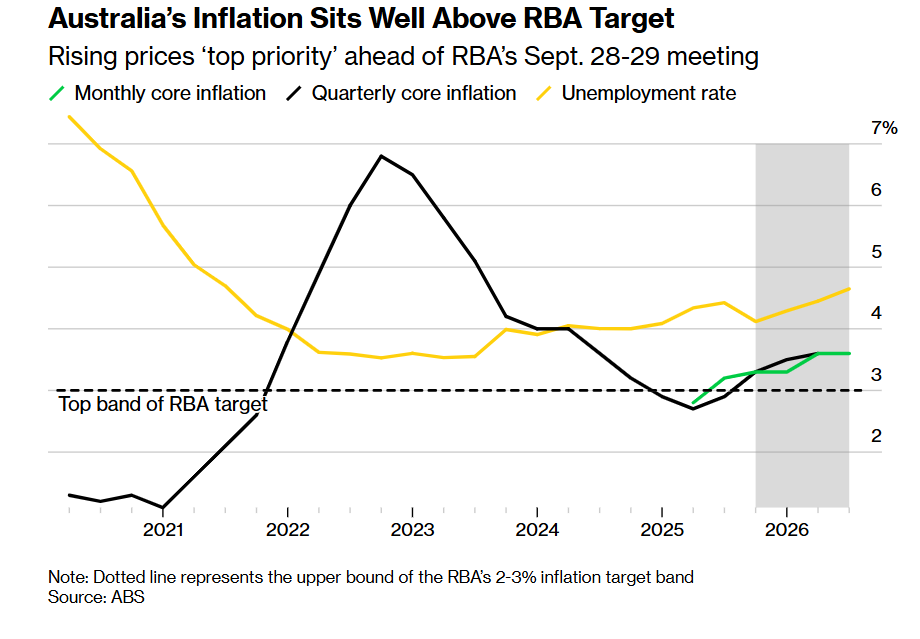
As shown in the chart above, Australia's inflation rate is significantly higher than the central bank's target — rising prices became the “primary concern” before the Reserve Bank of Australia's September 28-29 meeting. Note: The dotted line represents the upper limit of the Reserve Bank of Australia's 2% — 3% inflation target range. Source: Australian Bureau of Statistics
Robert Thompson of Royal Bank of Canada Capital Markets said after Bullock testified on September 18 that the strong policy signals released by officials “leave us with almost no doubt that central bank insiders have already made a decision — raising interest rates in September is a necessary action.” The Royal Bank of Canada anticipates further interest rate hikes in November, raising the cash interest rate to 4.85%, the highest level since November 2008.
The Reserve Bank of Australia took active interest rate hikes at the beginning of the year. The first three meetings raised interest rates, and since then it has maintained interest rates at 4.35% since May.
Most banks, including Commonwealth Bank of Australia and Goldman Sachs Group, expect the Commission to tighten policy on Tuesday. ANZ, UBS Group and HSBC Holdings also anticipate that the Reserve Bank of Australia will raise interest rates for two consecutive sessions.
As a result, HSBC Australia's chief economist Paul Broxham anticipates a “hawkish rate hike” on Tuesday and said the two rate hikes he predicted would have an impact on the economy. “We expect this will cause economic growth to stagnate between the end of this year and the beginning of next year, and we think the risk of recession is rising,” he said.
The Middle East conflict and the Russian-Ukrainian conflict are also increasing inflationary pressure in the global environment. Both clashes seem unlikely to end anytime soon, and both are driving fuel prices higher. The boom in artificial intelligence investment is also driving up prices.
Major central banks are responding — the Federal Reserve, the Bank of Japan, and the European Central Bank have all raised interest rates in the past month, while the Bank of England has warned that policy tightening may be necessary.
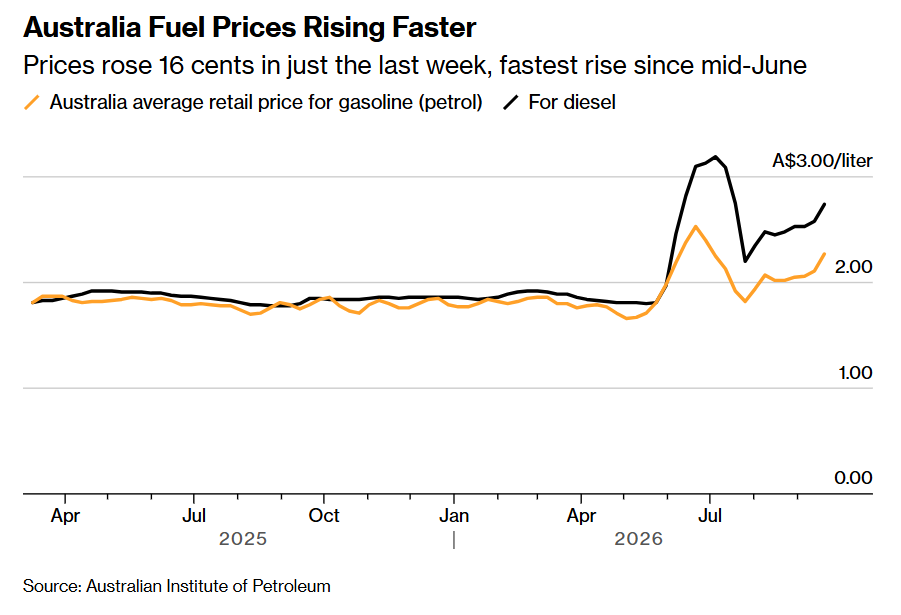
As shown in the chart above, fuel prices in Australia have accelerated — in the past week alone, prices have risen 16 Australian cents, the biggest increase since mid-June.
The Organization for Economic Cooperation and Development predicts that inflation in wealthy countries will continue in 2027, and warns central banks, including the Bank of Australia, to “maintain high vigilance” and take stronger intervention measures than in the post-pandemic period. The International Monetary Fund also issued a similar warning directly to the Reserve Bank of Australia this month, urging it to be ready to raise interest rates at any time.
Australia was already dealing with an accelerated rise in consumer prices long before US and Israeli attacks on Iran caused fuel costs to soar. The country's current inflation rate is among the highest among developed economies.
However, other factors suggest that the Reserve Bank of Australia may not have to push interest rates to such a high level as some of the more hawkish forecasts assume. The Australian housing market, which is closely linked to many sectors of the economy, is in a downturn, and another rate hike could further exacerbate this decline. The unemployment rate is also rising, and the Commonwealth Bank of Australia's household spending insight data shows that household spending is slowing broadly after showing resilience previously.
AMP economist Mai Bui said, “The current upward trend in unemployment shows that interest rate hikes are taking effect, albeit very slowly.” But she added that this “won't stop the Reserve Bank of Australia from raising interest rates further.”