
Is Weilizhibo-B (09887), which continues to fall unilaterally, getting closer to a key turning point in the next round of the market?
Recently, Velissin® (opatisumimab, PD-L1/4-1BB dual antibody), the core product of Verishibo-B (09887), has attracted much attention in the international academic community.
On September 14, at the WCLC 2026 conference, Weilizhibo released updated data on the phase II clinical study of first-line treatment of NSCLC with this drug in the form of an oral report; later, the company also announced that the key registered phase IIB study for the single-agent treatment of advanced EP-NEC was selected for the LBA at the European Society of Medical Oncology Annual Meeting (2026 ESMO) in October this year, and the three studies were selected for oral presentation.
For an 18A company that currently uses “clinical data/BD options” as the pricing logic, this is certainly an obvious benefit. However, in the secondary market, Verishibo does not seem to have received a premium from these benefits.
The Zhitong Finance App observed that after the intraday stock price hit a phased high of HK$78.40, Weilizhibo began to enter a continuous downward channel in stock prices. Even after disclosing favorable announcements on September 14 and September 21, it did not significantly boost the stock price. Therefore, when will Weilizhibo's stock price reap the benefits has become the focus of investors' attention at this stage.
When will the one-sided downtrend stop?
Judging from market performance, since August 17, the biggest retracement in Weilizhibo's stock price has reached 33.16%. In this process, it showed a complex structure of “strong short trend, deep overselling+contraction to a new low” on the technical side.
From the perspective of the moving average, after the 5th line was officially confirmed to cross the 10-day line on September 1, Weilizhibo's stock price began to move towards a downward trend in the overall bearish arrangement of the moving average indicators. Although on September 24, its 60-day line remained above the 20th line, since September 16, Verishibo's market moving average has been completely broken through by the stock price, and the company's stock price is also completely below the BBI index for the day. This shows that while the current market is confirmed to be dominated by bears, it has moved from short-term weakness to medium-term weakness in terms of technology.
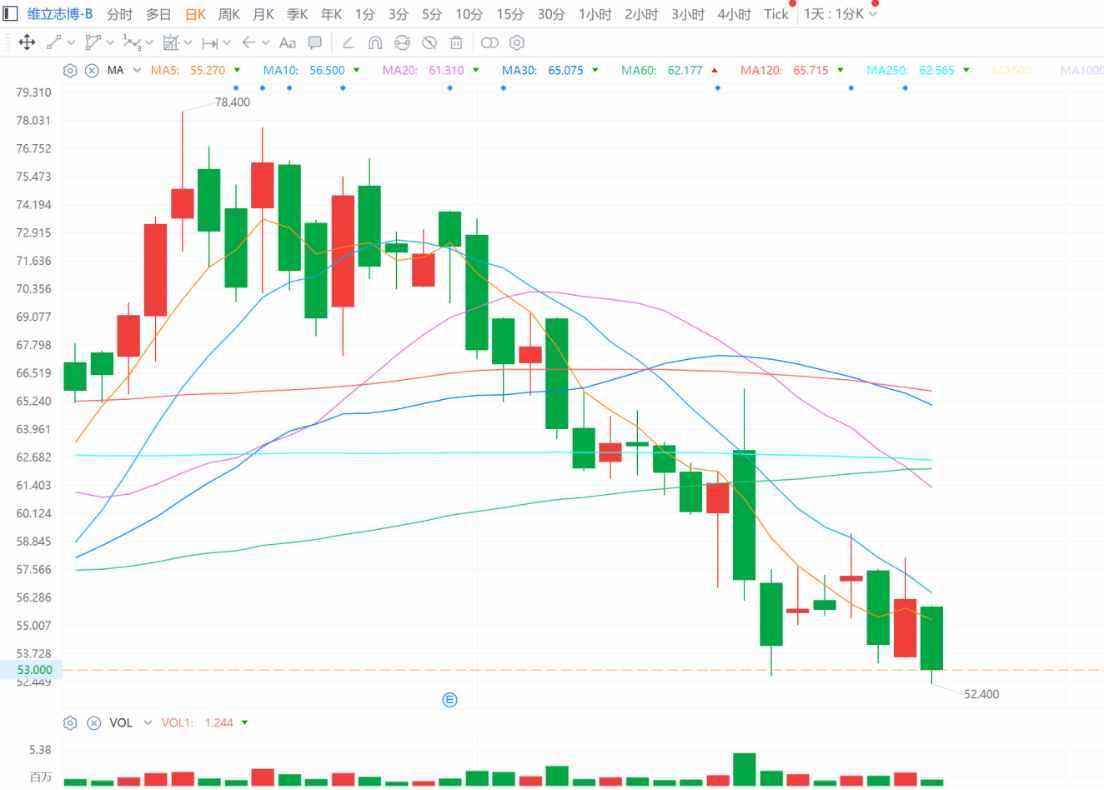
The above conclusion was also cross-verified by market momentum indicators and price performance over the same period.
In terms of momentum indicators, both the RSI, CCI, and WR indicators show serious oversold signals. Among them, the RSI and CCI have been in the overbought range for more than 10 days; at the same time, the market KDJ index also indicates deep overbought. Not only did a very low J value of -10.11 appear within the range, but a dead cross appeared again on September 24, indicating that the company's stock price will still be under inertial downward pressure in the short term.
In terms of quantitative performance, since September, Weilizhibo's stock price has continued to drop in volume. On the day the company's stock price plummeted on September 15, the trading volume reached 6.4323 million shares. The characteristics of panic selling were obvious.
Looking back at the entire process of Weilizhibo's stock price decline in this round, investors can easily see that while the EMA bears line up, it also resonates with the high level of the ADX index.
To a certain extent, this may indicate that this round of Weilizhibo's market is not an ordinary correction, but a trend decline. In particular, the day after the company disclosed the data at the WCLC conference on September 14, the company's stock price plummeted 7.15% in a single day, confirming that the decline in the market had accelerated.
Since then, although there has been a slight rebound in the company's stock price, the volume has shrunk, and the strength of the rebound has decreased markedly. However, after the sharp drop in the market volume energy structure on September 15, there was still a certain marginal change.
According to the Zhitong Finance App, from September 16 to September 24, the average daily trading volume of Weilizhibo shares shrank significantly compared to September 15. At one point, it was only 1.031 million shares. This indicates to a certain extent that active sales pressure in the market showed a declining trend. Furthermore, the on-market OBV index also rebounded from a low of -3.06 on September 16 to -2.57 on September 23, forming an OBV bottom divergence, showing an early trend of marginal improvement in funding, as well as passivation in the midst of weak shocks. However, if there is a continuous positive trend in the company's market in the future, it may be an important sign that Weilizhibo's stock price will end this round of unilateral downward trend in the future.
When does the market price the benefits?
As mentioned above, for an 18A company, the many benefits recently announced by Weilizhibo are enough to be an important driving force for its short-term stock price reversal, but judging from feedback from the secondary market, investors seem to be waiting for a more important time window.
Judging from the stock price performance of Weilizhibo's early shareholders after the ban was lifted on July 25 this year, the biggest increase in the company's stock price between July 30 and August 17 reached 58.06%. However, the main reason driving the company's stock price out of the above market situation is that the ban has been lifted on the market side, and the other is that the core product Velisin® has continuously released favorable R&D milestones.
The Zhitong Finance App learned that although Weilizhibo's early shareholder ban lifted on July 25 involved 42 early shareholders of the company, with 104 million unbanned shares, accounting for 52.22% of the company's total share capital, involving the unbanned market capitalization of HK$5.271 billion, and the company also experienced a large inventory change before the ban was lifted, the company announced on July 24 that the CEO voluntarily extended the ban period, stabilizing market confidence to a certain extent.
In terms of market performance, Weilizhibo's three-day turnover rate from July 27 to 29 was about 20%, and the trading volume soared from one million shares per day to the level of 10 million shares; although its stock price closed at HK$50.90 on July 30, the turnover rate also quickly fell back to 1.18% at the same time. As the ban is lifted and the selling pressure is fully digested in the Weilizhi Expo, it also indicates that the chip structure will be reset in the short term.
Since then, on July 30, August 3, and August 6, respectively, Verisign® has released R&D and regulatory milestones for the core product Velisin®. Coupled with the market's NDA expectations for early trading of the drug, this has driven the company's stock price to rise continuously, eventually reaching a phased high.
On August 21, the day the company announced the acceptance of the Velisign® NDA, its stock price closed down 6.44%. This actually reflects that the pricing rhythm of the market is “anticipating first, implementing and fulfilling”. In other words, the benefits mentioned above have been fully traded before.
This pricing pace is also reflected in the WCLC conference data disclosure. Although Verissimo only officially disclosed updated data from the Phase II clinical study on first-line treatment of NSCLC with Velisin® on September 14, in fact, some key data had already been disclosed as early as August 20 when the summary was published. The company's stock price closed up 8.02% on the same day, and it was already priced according to “positive data”.
Since the WCLC conference summary was released, Weilizhibo's profit ratio in the market was already in the 80% range, so this advantage was more like a “mood amplifier” that drove the company's stock price trend to accelerate at the time, and became an important “driver” for the subsequent implementation of benefits and stock price correction.
If the market continues to “anticipate and deliver” on the pricing rhythm of Verishibo, then this stage is probably getting closer to the key turning point of the next round of the market, and the key catalytic factor is the 2026 ESMO annual meeting.
For Verishibo, the data disclosed by the company at the ESMO annual meeting is particularly important because it disclosed “decisive evidence” that the core product Velisign® was approved for NDA.
In an announcement issued on September 21, Wei Libo clearly stated that the EP-NEC IIb study was selected for the LBA and was selected for the oral report, “indicating that the study has a groundbreaking innovative nature and significant clinical value, and its findings are expected to change existing clinical practice”. This study evaluated advanced EP-NEC patients with previous second-line treatment with vilixin monotherapy, and it was the core registration study on which the NDA declaration was based.
Simply put, the core variety data to be revealed at ESMO's 2026 meeting is essentially a “commercial entry verification” for Weilizhibo. For this 18A company that has yet to commercialize its products, the above data disclosure may become a key variable in determining its future medium- to long-term valuation center.