
Postal Savings Bank Of China (SEHK:1658) Stock Looks Reasonably Priced On Earnings
Postal Savings Bank of China has delivered a 60.2% gain over the past three years, a strong outcome for a large retail-focused lender. With the share price recently closing at HK$5.33, the key issue for investors is whether that level is adequately supported by the earnings power of the business.
- The 60.2% return over three years puts real weight on the question of whether Postal Savings Bank of China’s current price is aligned with what its profits can sustain over time.
- The bank’s nationwide deposit base and fee-driven services can influence how reliably earnings convert into capital and support its ongoing ability to generate returns for shareholders.
- There is a second opinion on Postal Savings Bank of China worth weighing. See what analysts think Postal Savings Bank of China's shares could be worth.
For investors, the debate is whether Postal Savings Bank of China’s current share price is justified by the earnings it is producing today and is expected to deliver in the future.
If you are comparing Postal Savings Bank of China with other opportunities that emphasize valuation, a focused stock screen built around 180 high quality undervalued stocks can be a useful next step in your research.
Where Does Postal Savings Bank of China Sit on Earnings?
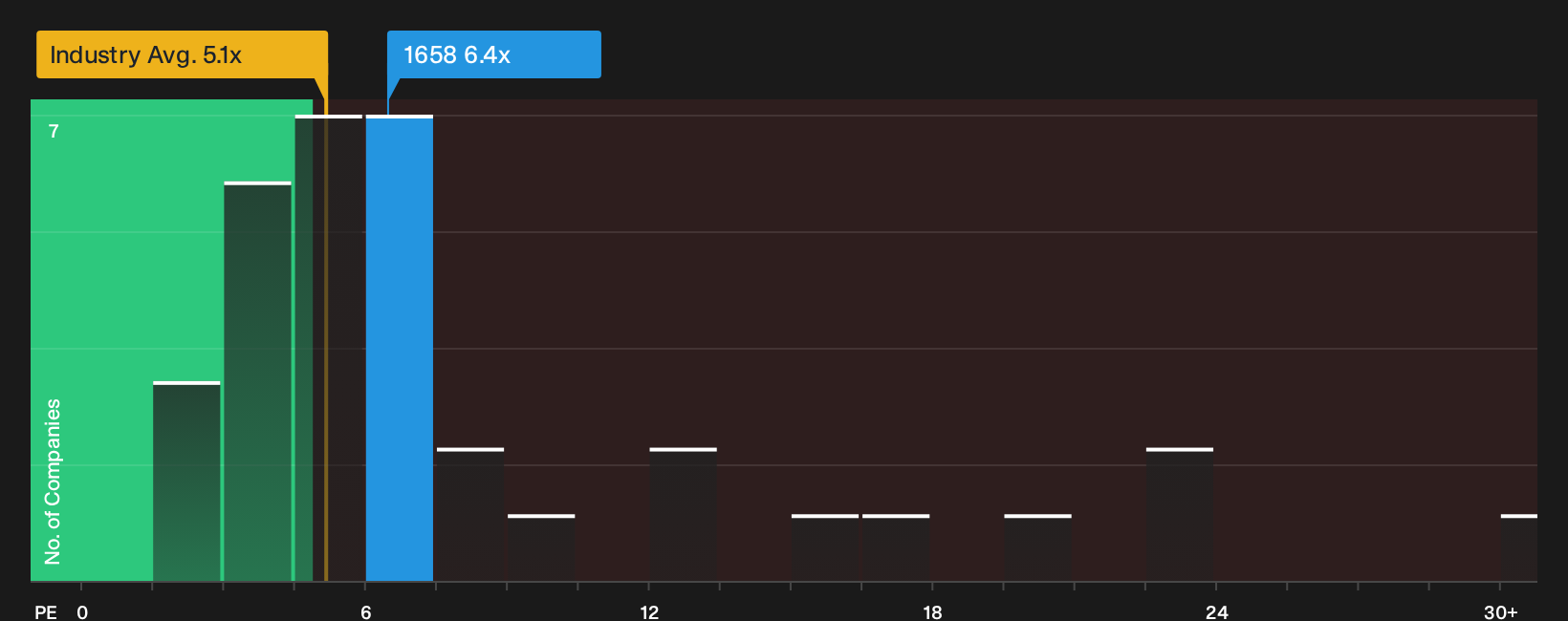
The P/E ratio fits Postal Savings Bank of China because earnings are a central anchor for valuing a large, established lender. At a current P/E of 6.5x, the stock trades below the peer average of 8.3x, yet above the broader Banks industry on 5.1x. That places the shares neither at the top nor at the bottom of the sector range, but in an area where investors need to think about how reliable and repeatable its profit base is.
A tailored fair-value P/E, which blends the company’s profitability profile, growth expectations, size and risk level, points to a level close to where Postal Savings Bank of China is priced today. The current 6.5x sits near that reference point rather than on either extreme, so the market is not obviously paying a large premium or assigning a steep discount on this measure alone. For any investor weighing the shares, the key question is whether the quality and durability of those earnings justify that middle-ground multiple relative to other banks. Explore the numbers behind Postal Savings Bank of China's P/E valuation.
The Postal Savings Bank of China Narrative: What Would Justify Today's Price?
Simply Wall St Narratives for Postal Savings Bank of China pick up where the P/E discussion leaves off and explain which combinations of future growth, margins and earnings would need to occur for the stock to be worth materially more or materially less than today’s price on the Community page. Instead of stopping at a single valuation output, they break down the assumptions behind it so you can monitor over time whether the business is tracking the scenario that number relies on.
A clear, number-driven narrative on Postal Savings Bank of China gives you a concrete way to test your view on where its earnings, margins and execution go from here as fresh results arrive. It turns a loose opinion into specific assumptions that can be revisited, challenged and refined as the bank’s actual performance unfolds.
Share your own Narrative for Postal Savings Bank of China and set out the assumptions behind your valuation.
One more Postal Savings Bank of China check that belongs next to the P/E
Price and earnings only tell part of the story for Postal Savings Bank of China, because the people steering the business and how their incentives line up with shareholders can heavily shape what happens next. See who runs Postal Savings Bank of China and how they are paid.
This article by Simply Wall St is general in nature. We provide commentary based on historical data and analyst forecasts only using an unbiased methodology and our articles are not intended to be financial advice. It does not constitute a recommendation to buy or sell any stock, and does not take account of your objectives, or your financial situation. We aim to bring you long-term focused analysis driven by fundamental data. Note that our analysis may not factor in the latest price-sensitive company announcements or qualitative material. Simply Wall St has no position in any stocks mentioned.
Have feedback on this article? Concerned about the content? Get in touch with us directly. Alternatively, email editorial-team@simplywallst.com