
Ford Is Expected to Lose Market Share in Q3. Don’t Panic-Sell F Stock on the News.
Cox Automotive released its Q3 2026 sales forecast yesterday, Sept. 24, which is not music to the ears of the Detroit Big 3. Of the lot, it expects only Stellantis (STLA) to gain market share in the first three quarters of the year while forecasting losses for both General Motors (GM) and Ford (F). Importantly, it expects the combined market share of the three to fall to around 36%, an all-time low.
Hyundai Expected to Outsell Ford in Q3
Cox expects GM’s market share to fall to 16.7% in the first three quarters versus the 17.4% share the Mary Barra-led company held last year. The firm forecasts Toyota Motors (TM) to gain share and close its gap with GM. It forecasts Ford’s U.S. sales to fall 8.8% in the first three quarters and sees its market share dropping to 12.5%, which is one percentage point lower than last year. Cox further expects the combined sales of Hyundai and Kia to top Ford, which would be a first. If it were to happen, it would be a remarkable feat for Hyundai, which was the butt of jokes in the 1980s and 1990s over the build quality. Remember that old joke from comedian Jay Leno that you could double the value of a Hyundai car by filling it up with gas!
Meanwhile, Ford is dismissive of these findings, and in its statement, it said, “Even lumped together, Ford outsold the two Korean companies combined year to date. By revenue, the gap between Ford and Hyundai Kia is much higher.”
F Stock Has Turned Negative for 2026
Markets did not buy that argument, though, and the Blue Oval closed 2.6% lower yesterday, extending its year-to-date (YTD) decline to almost 4%. The stock is now down 28% from its 2026 highs it hit in late May amid the optimism about its energy storage business. The gains were not sustainable, as I then noted. Meanwhile, while I have been bearish on Ford for most of this year given its relatively high valuations versus GM, execution, recall issues, and a capital allocation policy heavily tilted towards dividends, I believe the stock is not a panic sell on forecasts of it losing market share.
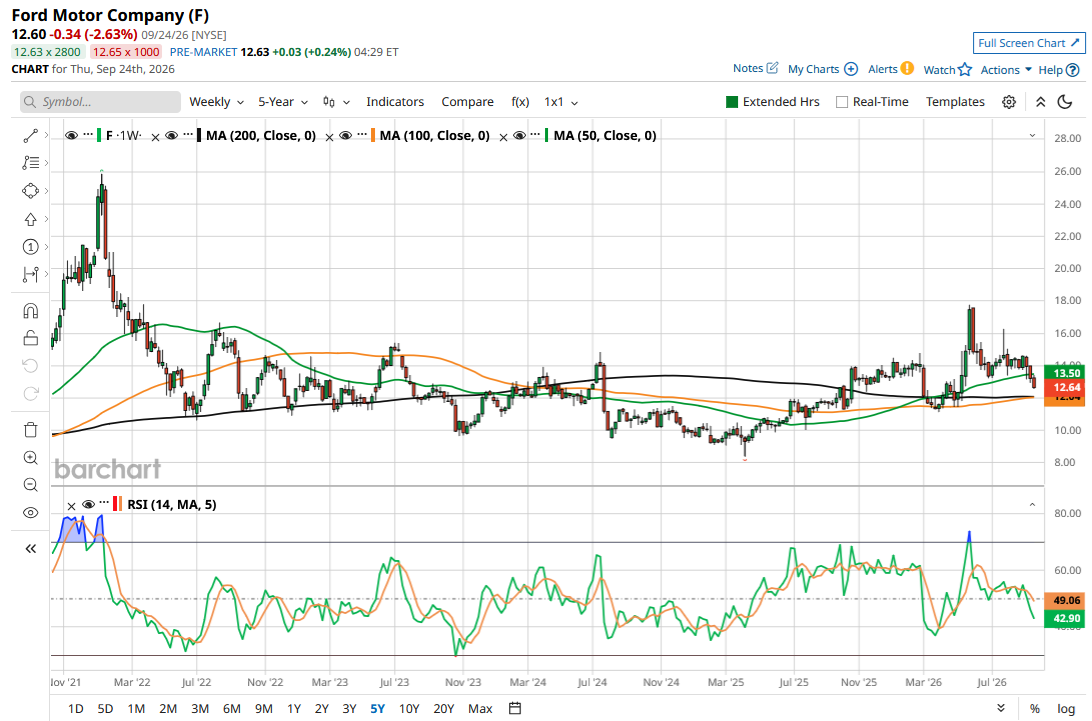
Why Is Ford Losing Market Share
First, the market share loss isn't that surprising, as a fire at aluminum supplier Novelis’s Oswego, New York plant in November hurt Ford’s production and sales this year. Furthermore, Ford and GM have prioritized profitability and exited unprofitable or low-margin products and markets. The duo consciously moved away from sedans towards high-margin pickups and SUVs. If anything, the Detroit automakers have doubled down on gas-guzzlers after the Trump administration rolled back fuel economy standards. Ford also discontinued its popular Escape compact SUV to focus on higher-margin products.
However, higher gas prices have pushed many Americans towards fuel-efficient cars and hybrids. Hybrid demand has been strong stateside, as the product appeals to buyers who are wary of battery electric cars due to reasons ranging from high initial buying price to range anxiety. The product has gained further traction due to high gas prices. While Ford does have hybrids in its arsenal, Toyota is the industry leader in the U.S. and is seeing market share gains this year.
Detroit automakers are facing headwinds due to higher gas prices, and the rise in interest rates might further dampen car sales. In the short term, it would be foolhardy to predict gas prices, and even JPMorgan has given up forecasting the Iran war endgame. It would, however, be reasonable to say that crude over $100 per barrel might not be sustained forever and would eventually settle down, which would then propel demand for bigger SUVs and pickups that Ford sells.
Ford also has long-term growth drivers in its energy storage business. There is also the upcoming low-cost electric vehicle platform dubbed the “next Model T,” but I am a bit circumspect on that lineup given the flurry of low-cost electric cars swamping the market.
That said, amid the recent selloff, Ford’s valuation has corrected, and the forward price-to-earnings (P/E) multiple has fallen to 6.97x. I believe the price has started to look attractive, and while it might not be a screaming “Buy” yet given the macro headwinds, it is definitely not a “Sell” at these prices.
On the date of publication, Mohit Oberoi had a position in: F , GM . All information and data in this article is solely for informational purposes. For more information please view the Barchart Disclosure Policy here.