
Phillips Edison (PECO) Has Investors Looking Twice, But What Is Driving It?
Phillips Edison (PECO) drew fresh attention after highlighting a 10.1% increase in its annualized dividend, a 48% payout ratio, and a stated 3.72% dividend yield for investors.
Set against a recent share price of $37.12, Phillips Edison’s 30-day share price return has declined 6.99% and the 90-day move is down 12.33%, yet the 1-year total shareholder return of 12.16% and 5-year total shareholder return of 43.34% point to momentum that has built over a longer horizon, with the latest dividend news influencing how investors weigh income stability against these shorter-term price swings.
Spot income opportunities like Phillips Edison, and compare its payout profile to a curated 7 dividend fortresses that investors are watching right now.Phillips Edison looks like a solid, income focused REIT on the surface, yet the stock has slipped in recent months. Is that dividend story already fully reflected in today’s price, or not?
Most Popular Narrative: 17% Undervalued
Against the last close at $37.12, the most followed valuation storyline pegs Phillips Edison’s fair value at $44.77, which frames the recent pullback as a pricing gap that dividend focused investors will want to understand.
Active portfolio recycling and disciplined acquisitions of high-growth, grocery-anchored properties, often below replacement cost and at 6%+ cap rates with 9%+ target IRRs, enhance asset quality and earnings potential. At the same time, cash acquisitions and low leverage (5.4x EBITDAre, 5.7 years weighted avg. maturity, 95% fixed-rate debt) allow for opportunistic external growth without the need for dilutive equity issuance, supporting long-term FFO/EPS expansion.
See why 5 investors see Phillips Edison as 17% undervalued.
Result: Fair Value of $44.77 (UNDERVALUED)
Still, the Phillips Edison story could look very different if e-commerce adoption accelerates or a major grocery anchor stumbles and drags on occupancy.
Find out about the key risks to this Phillips Edison narrative.
Another View: Phillips Edison Through The Earnings Lens
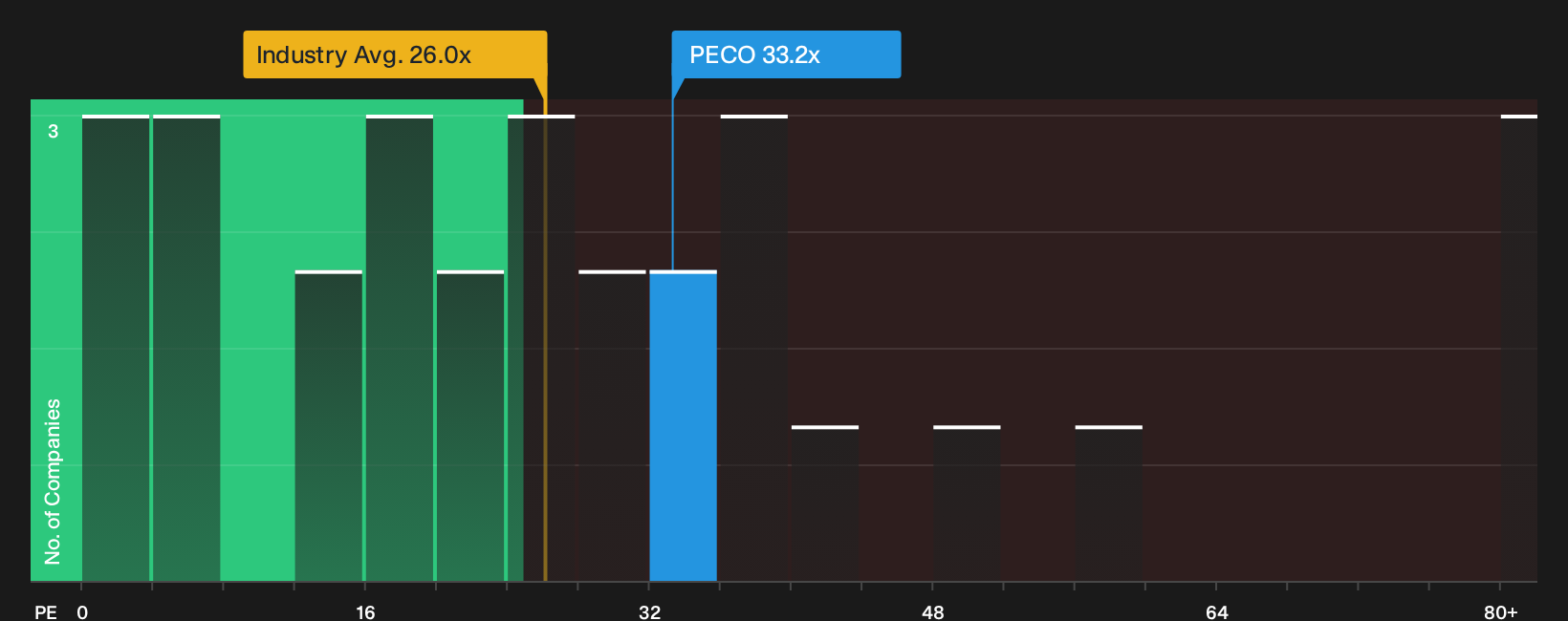
That 17% discount to fair value looks appealing on paper, yet the P/E story for Phillips Edison points in a different direction. The shares trade on a 33.2x P/E, compared with 26x for the US Retail REITs group, while the fair ratio sits even lower at 28.9x.
Those gaps mean investors are paying a richer multiple than both the sector and the fair ratio the market could move towards. Anyone leaning on the undervalued narrative needs to ask whether slower forecast earnings and a lower expected return on equity justify that premium or call for more caution.
See what the numbers say about this price — find out in our valuation breakdown.
Next Steps
Mixed messages so far on Phillips Edison. If you want to move quickly and ground your view in the numbers, weigh up the 3 key rewards and 3 important warning signs.
Looking for more investment ideas beyond Phillips Edison?
If the Phillips Edison setup has you thinking more broadly about income, value, and risk, the next smart move is lining up a few fresh candidates.
- Target sturdier portfolios by scanning a list of solid balance sheet and fundamentals (24 results) that can help you focus on businesses with stronger financial foundations than the typical stock.
- Hunt for mispriced opportunities through a 16 high quality undiscovered gems that filters for quality fundamentals before the crowd catches on.
- Stack your watchlist with income ideas using a 7 dividend fortresses that highlights payouts investors are tracking closely right now.
This article by Simply Wall St is general in nature. We provide commentary based on historical data and analyst forecasts only using an unbiased methodology and our articles are not intended to be financial advice. It does not constitute a recommendation to buy or sell any stock, and does not take account of your objectives, or your financial situation. We aim to bring you long-term focused analysis driven by fundamental data. Note that our analysis may not factor in the latest price-sensitive company announcements or qualitative material. Simply Wall St has no position in any stocks mentioned.
Have feedback on this article? Concerned about the content? Get in touch with us directly. Alternatively, email editorial-team@simplywallst.com