
Meta (META.US) surged 36% in September: Muse validates AI strategy, market capitalization points to $2 trillion
The Zhitong Finance App learned that Meta Platforms (META.US) stock price has finally ushered in a breakthrough. The stock price of Facebook's parent company surged 36% in September, after the company released Muse, a personal AI assistant. The assistant quickly climbed to the top of the US app rankings and allayed market concerns that huge AI investments would not pay off. Meta's stock price is expected to record its best monthly performance since July 2013, only about 1% of the increase from joining the $2 trillion market capitalization club.
Muse became a catalyst, and the stock price reversed dramatically
“Meta's stock price has remained largely flat over the past year and a half due to uncertainty about whether AI will have a positive or negative impact, and now Muse has clearly verified the correctness of its AI strategy and positioning.” Rob Biederman, co-founder and managing partner of Asymmetric Capital Partners, added: “It is logical that AI agents will become an entry point for many people to enter the internet, which also gives Meta an advantage in the competition.”
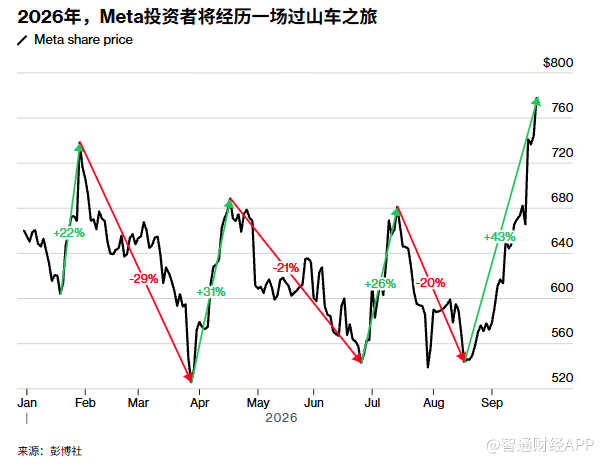
This month's rebound marks a dramatic reversal in Meta's share price. Meta's stock price has been sluggish for most of this year due to market skepticism about its huge AI investments and the legal risks posed by lawsuits against social media businesses. Less than six weeks ago, after Meta released a disappointing revenue forecast at the end of July, its stock price fell 18% during the year. As of August 18, the stock ranked among the 50 worst performing stocks in the S&P 500 index.
Since then, however, Meta became the third-best performing constituent in the benchmark index, rising 43%. The backlash began at the end of last month when Meta agreed to pay up to $18 billion to settle a social media lawsuit, removing a major downside. However, the biggest driving factor was optimism about new AI products and their potential revenue growth, which convinced investors such as Biederman that Meta's stock price still has room to rise.
One sign of the enthusiastic response from investors to Muse is that they have been selling shares of companies in multiple industries, fearing that these companies may be disrupted, similar to the sell-off triggered by AI startup Anthropic earlier this year.
Meta has announced a grocery sales partnership with Instacart's parent company Maplebear and a partnership with online travel company Expedia. At an event on Wednesday, Meta unveiled a number of products praised by analysts, including a handheld device used with Muse and a camera-less version of the smart glasses series.
J.P. Morgan analyst Doug Anmuth wrote in the September 10 report: “Meta is still in the early stages of releasing cutting-edge models and AI-driven products other than advertising, and there is still significant upside potential.” He upgraded the stock's rating from “neutral” to “overweight.”
AI gambling is squeezing cash flow, and differences in valuation still exist
Of course, Meta still has a long way to go, and it needs to prove that its AI investment can generate sufficient returns to support huge expenses. This year's capital expenditure is expected to be close to 140 billion US dollars, which is double the approximately 70 billion US dollars in 2025. This figure is expected to rise to $1970 billion next year and reach $215 billion in 2028.
Massive spending is putting pressure on the financial situation. After generating $46 billion in free cash flow last year, Meta expects negative free cash flow of $6.4 billion in 2026 and negative $29.2 billion next year.
This has put pressure on the company to grow. Analysts on average expect sales to grow 26% to $254 billion in 2026, and net profit is expected to grow 33% to $80.6 billion. However, revenue and profit growth are expected to slow to 20% and 9%, respectively, next year.
According to the data, Meta's price-earnings ratio based on expected profits over the next 12 months is 21 times. Although it is a significant increase of less than 14 times from the June low, it is roughly equivalent to the average valuation multiple of the past three years, and is slightly discounted compared to 22 times the Nasdaq 100 Index.
“Currently, Meta's valuation multiplier is below the market average, but the growth rate is higher than the market average, which in itself is very attractive, and it also has huge scale and distribution channels. These advantages are difficult for competitors to surpass,” Biederman said.
Wall Street is still generally optimistic about Meta. More than 90% of analysts tracked by the agency give it a “buy” rating, but its stock price is close to analysts' average target price, which means there may be limited room for growth over the next 12 months.
Brandon Pizzurro, chief investment officer of GuideStone Funds, said that given the magnitude of this increase, Meta's stock price is likely to recover because the views of the AI service market are changing rapidly. He helped manage $29 billion in assets.
“As new AI models continue to be released, the market's perception of big tech companies seems to change just as frequently. “Products like Muse will bring a new catalytic and brief excitement to the market, but now that the threshold to impress investors is getting higher and higher, people also have reason to worry about whether these companies can deliver on their promises.” Pizzurro display.