
MIPI Partnership Could Be A Game Changer For Rambus Stock (RMBS)
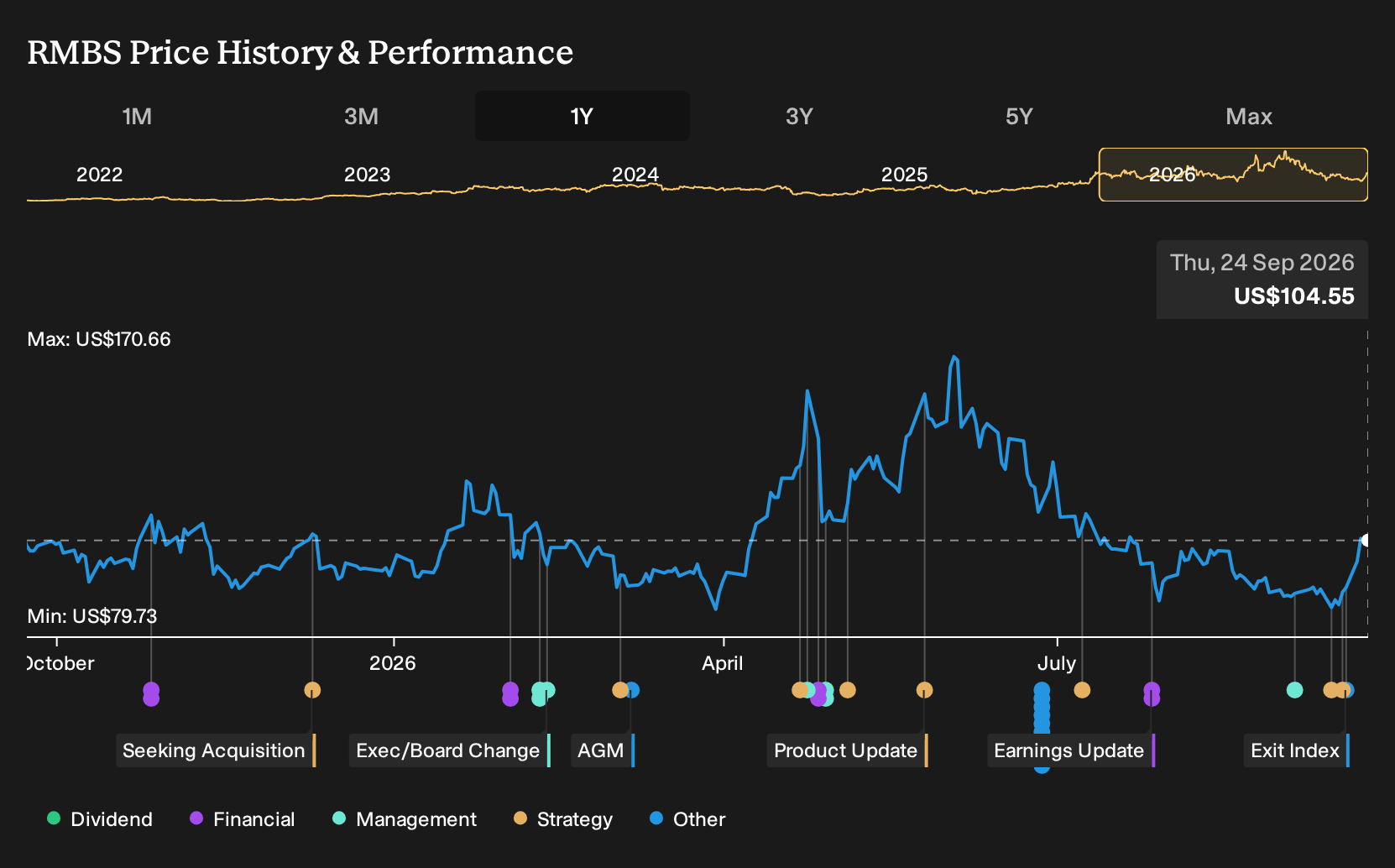
- Rambus was removed from the PHLX Semiconductor Sector Index on 18 September 2026, shortly after M31 Technology Corporation announced a collaboration that combines Rambus MIPI CSI and DSI controllers with the M31 silicon proven MIPI PHY portfolio.
- The M31 partnership positions Rambus IP inside complete MIPI subsystems for high resolution imaging and display, which may reshape the firm’s role in smartphones, automotive ADAS cameras, and AI edge devices.
- We will now consider how Rambus's investment narrative could shift given its PHLX Semiconductor Index removal and expanded MIPI collaboration.
Scan how Rambus fits into the broader chips story by comparing it with 84 AI infrastructure stocks that are powering data centers, edge AI, and the high-speed connections in between.
Rambus Investment Narrative Recap
To stay comfortable as a Rambus shareholder, you need to believe the core memory interface and security IP story still matters more than index membership. Removal from the PHLX Semiconductor Index is mainly a trading and flows event, not a change in DDR5, HBM or security chip demand. The more immediate swing factor is how consistently Rambus converts design wins into volume shipments across data center and AI infrastructure.
The biggest risk remains concentration in a few high value memory product lines and exposure to cyclical AI, PC and data center spending. If MRDIMM and next generation interfaces take longer to ramp or module makers push back on pricing, earnings could turn more volatile. Index exclusion does not materially change those core business variables.
The CryptoManager Root of Trust supporting the Caliptra specification lines up most directly with the current AI and data center narrative around Rambus. It gives chip designers a packaged way to add hardware security to CPUs, GPUs and accelerators, which fits the firm’s focus on interface and security IP rather than full systems.
For catalysts, this Caliptra aligned platform matters because it lives where customers are investing heavily, in mission critical infrastructure. Execution risk sits in how quickly hyperscalers and chip makers adopt the solution, how smoothly it integrates into complex SoCs and whether rivals compress pricing on comparable security IP.
Rambus' current analyst blueprint points to revenue of US$1.2b and earnings of US$418.1 million by 2029. That path assumes 17.0% yearly revenue growth with profit rising from US$230.0 million today to US$418.1 million in 2029, which is an earnings increase of about US$188 million.
Uncover how Rambus' fair value indicates a 43% potential upside to its current price, which could narrow quickly.
Exploring Other Perspectives
Some of the most optimistic analysts focus on the M31 style subsystem opportunity rather than index flows. They were already modeling revenue of about US$1.2b and earnings near US$480.1 million by 2029, above the US$418.1 million consensus path. You should assume those pre news forecasts may shift once this index exit and partnership bed in.
Explore 3 other Rambus fair value estimates, including one that suggests as much as 43% upside from the current price!
Reach Your Own Conclusion
Don't just follow the ticker; dig into the data and build a conviction that's truly your own.
- A great starting point for your Rambus research is our analysis highlighting 3 key rewards that could impact your investment decision.
- See our latest analysis for Rambus. The report includes a comprehensive fundamental analysis summarized in a single visual, the Snowflake, making it easy to evaluate Rambus' overall financial health at a glance.
Looking For More Ideas Beyond Rambus?
If you want to cross check the Rambus thesis against other potential opportunities, the Simply Wall St screener can help you quickly surface companies that match your preferred mix of quality, risk and income.
- If capital preservation is front of mind, start with companies that screen well for balance sheet strength and fundamentals through the list of solid balance sheet and fundamentals (23 results).
- If value is your priority, compare Rambus with a wider set of quality companies trading at undemanding prices by scanning the 30 high quality undervalued stocks.
- If you lean toward income, put yield and resilience side by side by reviewing the 7 dividend fortresses.
This article by Simply Wall St is general in nature. We provide commentary based on historical data and analyst forecasts only using an unbiased methodology and our articles are not intended to be financial advice. It does not constitute a recommendation to buy or sell any stock, and does not take account of your objectives, or your financial situation. We aim to bring you long-term focused analysis driven by fundamental data. Note that our analysis may not factor in the latest price-sensitive company announcements or qualitative material. Simply Wall St has no position in any stocks mentioned.
Have feedback on this article? Concerned about the content? Get in touch with us directly. Alternatively, email editorial-team@simplywallst.com