
3 Brazil Logistics Stocks Tied To Port Volume Growth
A historic wave of new containerships, a potential reset in Suez routings and Strait of Hormuz risk are quietly reshaping how global trade moves and where the profit pool goes. That shift creates a window for investors who focus on ports and intermodal hubs rather than the ships themselves. This article examines those developments in more detail and profiles 3 stocks exposed to these news catalysts that some investors may want on their watchlist.
The three ports and intermodal operators profiled below are just a sample, with the broader screen surfacing 15 more listed businesses with equally interesting cargo volume stories and balance sheet profiles that are not covered in this article.
If you want to go straight to the source, use the Global Container Ports and Intermodal Logistics Operators screener to identify, filter and analyze the higher conviction port and intermodal ideas aligned with your own risk and return preferences.
Rumo (BOVESPA:RAIL3)
Rumo taps directly into the screener’s theme through its rail corridors that feed Brazil’s main export ports. This gives you exposure to cargo volumes rather than volatile freight rates.
Rumo S.A. runs rail and intermodal logistics across Brazil, linking grain producing regions to export terminals. Most revenue comes from North Operations at about R$11.5b, with South Operations around R$2.0b and Container Operations roughly R$855 million, and the group carries a market value near R$29.1b.
"Stable, long-term take-or-pay contracts with agribusiness clients, and the company's central role in high-growth export regions, provide revenue visibility and margin stability, reducing earnings volatility and allowing Rumo to capitalize on secular trends in agricultural output and trade."
What happens to that earnings profile if a single pressure on rail demand and pricing plays out differently than the market expects?
If that question is on your mind, read the full narrative for Rumo to see how that rail demand risk could be decoupling from Rumo’s long-term cash story.

Tegma Gestão Logística (BOVESPA:TGMA3)
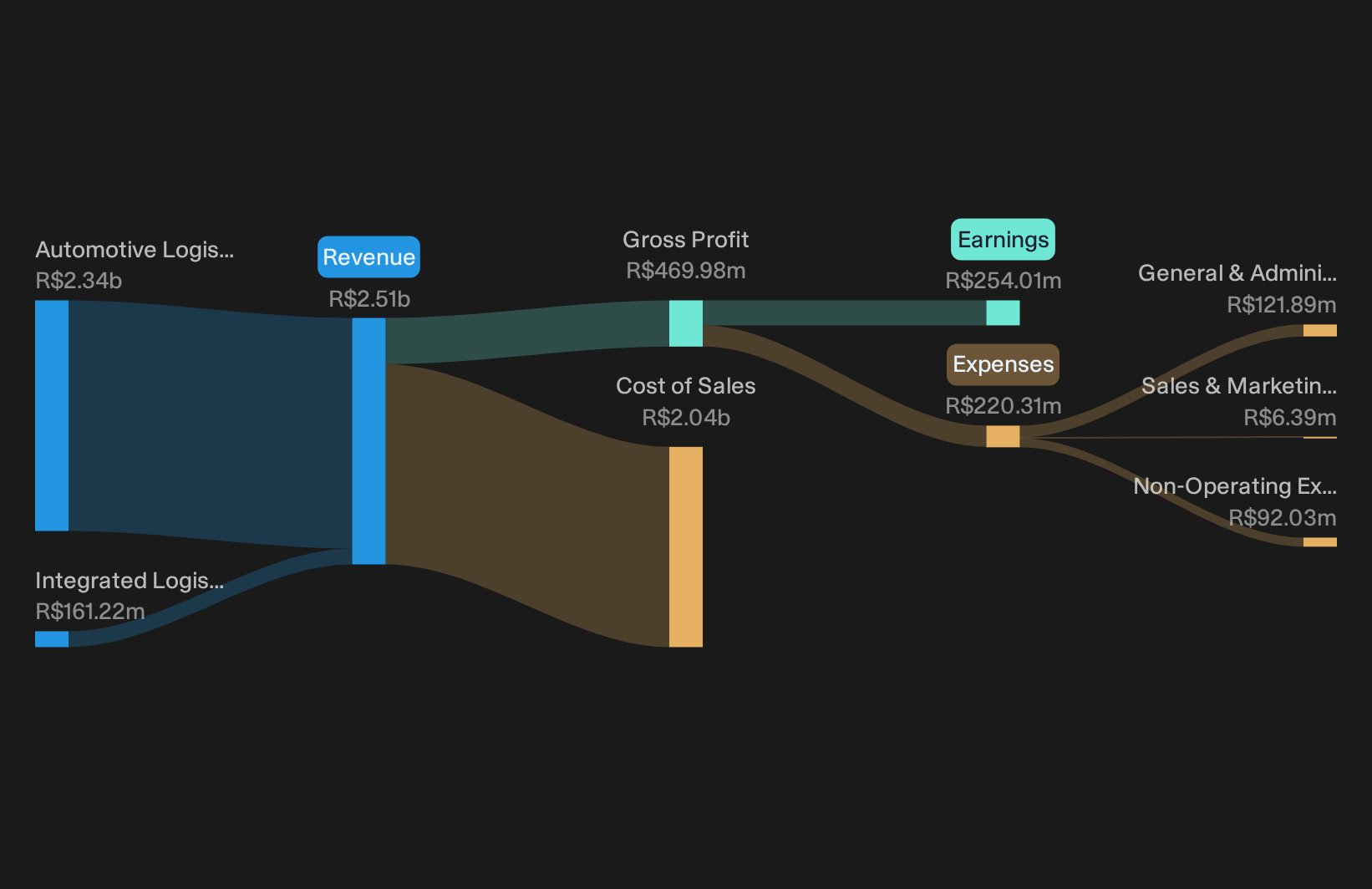
Tegma Gestão Logística plugs into the Global Container Ports and Intermodal Logistics Operators theme through its vehicle flows, warehousing and multimodal links, with most revenue of about R$2.3b from Automotive Logistics and roughly R$161 million from Integrated Logistics, and a market value near R$2.4b.
For investors watching how cargo flows move through Brazil’s ports and yards, Tegma Gestão Logística offers a way to focus on vehicle and goods throughput rather than freight rates, with growth projects now starting to reshape where that volume gets handled.
"Tegma's acquisition of Buskar.Me, a logistics platform focused on pre-owned vehicles, and the ongoing expansion of warehousing and bonded areas (notably the 200,000 square meter GDL site) position the company to capture increasing freight volumes and higher utilization rates as Brazil's vehicle trade (including imports of electric vehicles and heavy machinery) grows, which could boost total revenues and support multi-segment growth."
What happens to Tegma Gestão Logística’s margins and cash generation if a single pressure on contract mix and pricing unfolds differently from current expectations?
If that pressure on Tegma Gestão Logística’s contract mix is what you care about, the full narrative for Tegma Gestão Logística shows where pricing power, volumes and risk could be quietly decoupling.
Hidrovias do Brasil (BOVESPA:HBSA3)
Hidrovias do Brasil gives you exposure to the same cargo volume story as ports and terminals, but through river corridors that feed those gateways and depend on how efficiently contracts and assets are deployed along those routes.
"Refocus on core waterway corridors after the sale of Coastal Shipping and renewed executive leadership is creating a simpler business model centered on the North, South and Santos operations, which can concentrate capital and management attention on contracts and assets that are most relevant for revenue and EBITDA."
The big swing factor is what happens to margins if one key assumption about how reliably those corridors run year round starts to shift.
If that reliability question is what you care about, the full narrative for Hidrovias do Brasil explains how Hidrovias do Brasil’s corridor risk, contracts and capital plans could be quietly decoupling.

Seeking Alternatives Before The Crowd Moves
Fresh ideas move first, and the strongest breakout stories often fly under the radar for now. Screen new momentum, catch quality before it gets crowded, and act now.
- Track cash rich, lower volatility opportunities built to handle shocks by scanning the curated list of solid balance sheet and fundamentals (200 results) before others catch on.
- Spot potential income workhorses while payout momentum is still building by screening the carefully filtered 158 dividend fortresses today.
- Position ahead of possible AI infrastructure tailwinds by reviewing the curated group of 85 AI infrastructure stocks while the story is still forming.
This article by Simply Wall St is general in nature. We provide commentary based on historical data and analyst forecasts only using an unbiased methodology and our articles are not intended to be financial advice. It does not constitute a recommendation to buy or sell any stock, and does not take account of your objectives, or your financial situation. We aim to bring you long-term focused analysis driven by fundamental data. Note that our analysis may not factor in the latest price-sensitive company announcements or qualitative material. Simply Wall St has no position in any stocks mentioned.
Have feedback on this article? Concerned about the content? Get in touch with us directly. Alternatively, email editorial-team@simplywallst.com