
Bure Equity (OM:BURE) Stock Dropped, So What Is Driving Attention Now?
How Bure Equity Stock Has Been Trading
Bure Equity (OM:BURE) has drawn fresh attention after recent share price swings, including a modest pullback of about 2% in the latest session from a last close of SEK 313.2.
Short term performance has been mixed. The share price inched higher over the past week, was slightly down over the past month, and showed a stronger positive move across the past 3 months and year to date.
Over the past year, total return has also been positive, although the 5 year figure points to a weaker outcome for long term holders. That contrast between recent and longer track records is central to how many investors will frame the current setup.
Recent trading hints at momentum rebuilding for Bure Equity, with the latest 1 day share price move down 2% from SEK313.2. This sits against a stronger 90 day share price return of 20.7% and a 1 year total shareholder return of 16.3%, even though the 5 year total shareholder outcome remains slightly negative at about 9.8% lower.
Compare Bure Equity's recent rebound with other potential opportunities by scanning our hand picked list of 619 high quality undiscovered gems for ideas that may still be under the radar.
Bure Equity has rallied hard while intrinsic value estimates still sit far below the market price. Is this a temporary gap, or a sign the valuation framework needs updating?
Price-to-Earnings of 4.6x for Bure Equity: Is it justified?
Bure Equity trades on a P/E of 4.6x, which is low relative to many listed investment firms, while the last close sits at SEK313.2.
The P/E ratio compares the current share price with earnings per share and helps you see how much investors are paying for each unit of profit. For a private equity style investor such as Bure Equity, this yardstick often reflects how the market views the sustainability and quality of portfolio earnings rather than day to day trading swings.
On this measure, the company is flagged as good value compared both with the Swedish Capital Markets industry P/E of 17.4x and a peer average of 16x. That big gap suggests the market is pricing Bure Equity's earnings at a meaningful discount, despite the firm now being profitable again and reporting what is described as high quality earnings.
The contrast between a 4.6x P/E and much higher industry and peer levels is hard to ignore, and the SWS DCF model adds another layer by marking the shares as trading well below an intrinsic value estimate based on future cash flow projections. See what the numbers say about this price — find out in our valuation breakdown.
Result: Price-to-Earnings of 4.6x (UNDERVALUED)
Still, Bure Equity depends on successful exits from private holdings, and any drop in portfolio earnings quality could quickly challenge the current value story.
Find out about the key risks to this Bure Equity narrative.
Another View on Bure Equity's Value
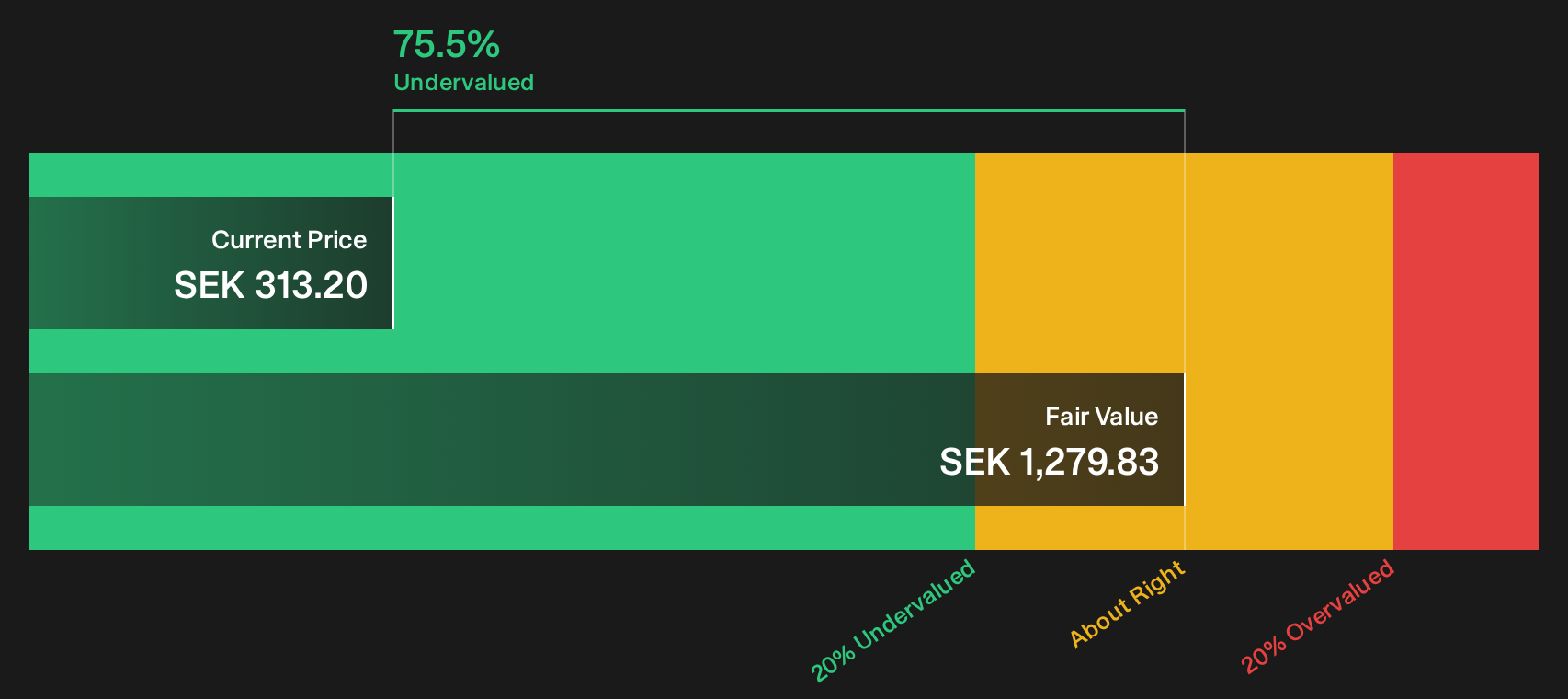
The earlier P/E comparison presents Bure Equity as lowly priced, yet the SWS DCF model offers a very different perspective. At SEK313.2 per share against an estimated future cash flow value of SEK1,279.83, the stock appears deeply undervalued on this framework as well.
That kind of gap points to either a generous DCF set of assumptions or a market that is heavily discounting the durability of those future cash flows. For anyone considering which signal to place more weight on, the key question is which side of that story appears more vulnerable if conditions change suddenly.
Look into how the SWS DCF model arrives at its fair value.
Simply Wall St performs a discounted cash flow (DCF) on every stock in the world every day (check out Bure Equity for example). We show the entire calculation in full. You can track the result in your watchlist or portfolio and be alerted when this changes, or use our stock screener to discover 177 high quality undervalued stocks. If you save a screener we even alert you when new companies match - so you never miss a potential opportunity.
Next Steps
Mixed signals around Bure Equity's valuation and recent rebound can pull opinions in opposite directions, so consider moving quickly, testing the numbers yourself, and weighing both the upside and the downside by checking the 2 key rewards and 1 important warning sign
Ready for more investment ideas beyond Bure Equity?
If Bure Equity has your attention, do not stop there. Broader opportunity often appears where investors are not yet looking, and a focused screener can help you spot it early.
- Target quality at a discount by zeroing in on companies that look mispriced relative to their fundamentals through our curated list of 177 high quality undervalued stocks.
- Strengthen your income stream by hunting for businesses with robust payouts and higher yields using a carefully filtered set of 158 dividend fortresses.
- Dial down portfolio stress by focusing on financially resilient businesses highlighted in our 230 resilient stocks with low risk scores before everyone else starts paying attention.
This article by Simply Wall St is general in nature. We provide commentary based on historical data and analyst forecasts only using an unbiased methodology and our articles are not intended to be financial advice. It does not constitute a recommendation to buy or sell any stock, and does not take account of your objectives, or your financial situation. We aim to bring you long-term focused analysis driven by fundamental data. Note that our analysis may not factor in the latest price-sensitive company announcements or qualitative material. Simply Wall St has no position in any stocks mentioned.
Have feedback on this article? Concerned about the content? Get in touch with us directly. Alternatively, email editorial-team@simplywallst.com