
Centene (CNC) Stock Still Looks Cheap Despite Its 79% Run
Centene has delivered a steep 79.2% gain over the past year, even as shorter term returns have cooled, which naturally raises a question about what investors are paying for each dollar of its sales today. With the stock recently closing at US$62.08, the key issue is how that price lines up against the health insurer's revenue base.
- The share price has climbed 79.2% over the last 12 months, so anyone looking at Centene now has to ask whether that move is fully backed by its sales profile.
- Recent news around Centene's role in CertifyOS's National Shared Credentialing Program and its Health Net unit's support during California emergencies can shape expectations for future revenue quality, operational efficiency, and timing of cash inflows.
- Your read on Centene is one view; the desks covering it have another. See what analysts think Centene's shares could be worth.
The stock's next move may depend on whether Centene's current market value is adequately explained by its sales when set against the Fair Ratio benchmark.
To see how Centene's recent rally compares with other health-focused businesses where investors are also weighing price against fundamentals, line it up against solid balance sheet and fundamentals stocks screener (23 results).
Is Centene Still Cheap on Sales?
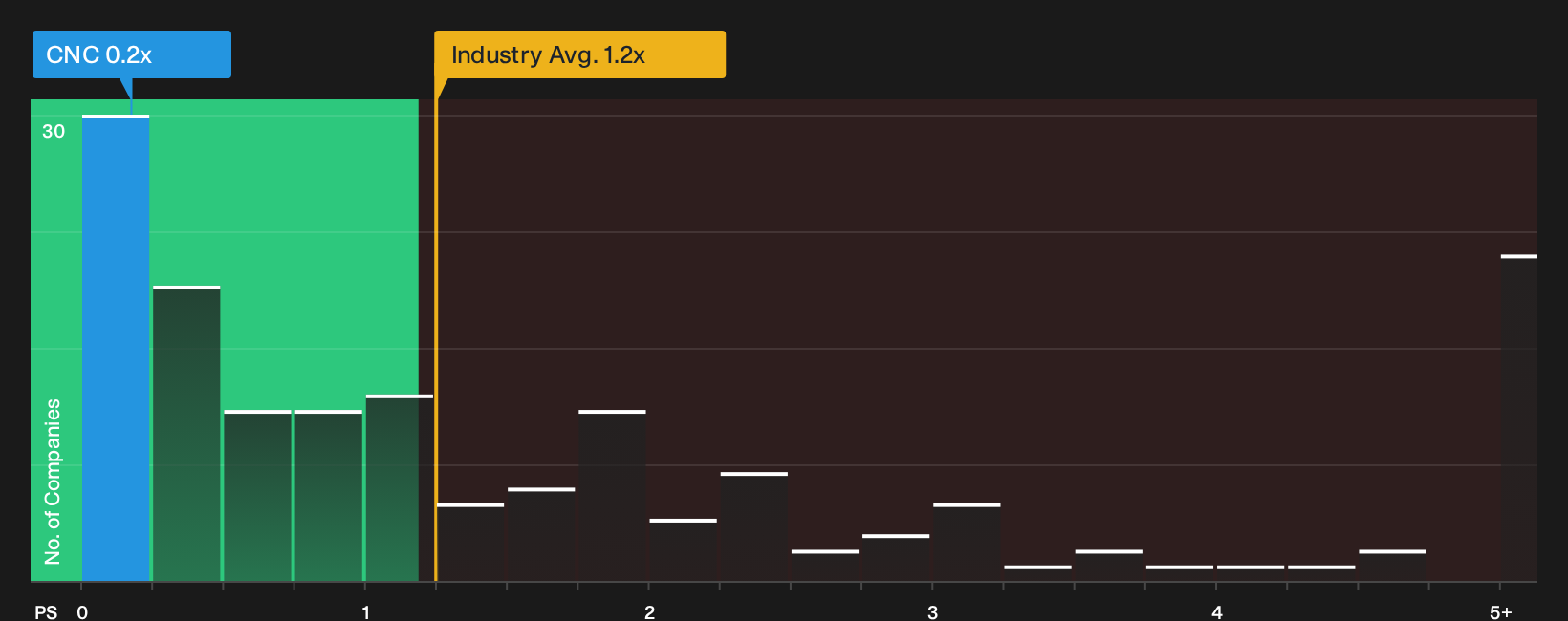
P/S suits Centene because investors often focus on how much they are paying for each dollar of revenue in health insurance, where margins can be thin but premium volumes are large. At a P/S ratio of 0.2x, the stock changes hands at a far lower multiple of turnover than the wider Healthcare group, which is around 1.2x, and also below the 1.6x average for closer peers.
Because the Fair Ratio framework blends Centene's growth profile, profitability, scale and risk, it points to a higher P/S than the level currently implied by the market, which screens the shares as undervalued on this measure. Despite Centene's recent inclusion in CertifyOS's National Shared Credentialing Program, which may influence views on future revenue efficiency and quality, the current P/S still reflects a clear discount to those sector and peer benchmarks. Explore the numbers behind Centene's P/S valuation.
The Centene Narrative: What Would Justify Today's Price?
Simply Wall St Narratives for Centene pick up where the valuation puzzle leaves off by spelling out which paths for future growth, margins and earnings would need to play out for the stock to look meaningfully higher or lower than today. Each scenario links a specific fair value estimate to a clear set of possible catalysts and pressure points, so you can track over time which version of Centene's story is actually unfolding.
Community views on Centene split cleanly between those who see a margin recovery story and those who think reimbursement and regulatory risks still bite hard.
Bull case: 14% undervalued
"Company wide cost structure work, including an adjusted SG&A ratio of 6.9% in Q2 2026 and a targeted US$480 million of SG&A savings, along with AI enabled fraud and legal cost controls, supports the case that lower overhead and medical cost leakage can feed directly into higher operating margins..."
Discover why this Narrative puts Centene at 14% undervalued.
Bear case: 10% overvalued
"Rising government scrutiny over managed care costs and ongoing legislative focus on pricing transparency are set to intensify regulatory pressure on Centene, increasing the risk of lower reimbursement rates and margin compression across Medicaid and Marketplace lines..."
Explore why this Narrative puts Centene at 10% overvalued.
One more Centene factor worth checking before you move on
Valuation only tells part of the Centene story, because internal checks have also raised specific concerns that could matter for risk, contract stability, or profitability over time. Take a closer look at 1 warning sign before settling on a valuation.
This article by Simply Wall St is general in nature. We provide commentary based on historical data and analyst forecasts only using an unbiased methodology and our articles are not intended to be financial advice. It does not constitute a recommendation to buy or sell any stock, and does not take account of your objectives, or your financial situation. We aim to bring you long-term focused analysis driven by fundamental data. Note that our analysis may not factor in the latest price-sensitive company announcements or qualitative material. Simply Wall St has no position in any stocks mentioned.
Have feedback on this article? Concerned about the content? Get in touch with us directly. Alternatively, email editorial-team@simplywallst.com