
3 Insurance Stocks That Could Gain From Higher Bond Yields
Bond yields are jumping, economic data looks hot, and Fed expectations keep shifting, which turns the spotlight onto insurers that live and breathe long-term investments. This mix can punish some assets while creating fresh entry points elsewhere, and sitting on the sidelines risks missing that reset. This article walks through three U.S. insurers from our screener that appear closely exposed to these rate and inflation signals, and explains how their stories differ.
The insurers below are just a sample from this rate sensitive corner of the market, and the full screen surfaced 24 more U.S. life and property-casualty players with equally detailed stories that are not covered here. To identify and analyze the highest conviction ideas across this broader group, head straight to the U.S. Life and Property-Casualty Insurers with Large Investment Portfolios screener.
United Fire Group (UFCS)
United Fire Group plugs directly into this screener’s theme as a property and casualty writer whose business model leans heavily on its investment book, with the real interest rate story sitting behind how investors think about its future earnings power.
United Fire Group writes a wide range of commercial property and casualty policies and surety bonds in the U.S., generating about US$1.5b from this insurance segment, and carries a market value of roughly US$1.4b.
"The ongoing increase in the frequency and severity of climate-related events raises the likelihood of higher future catastrophe losses for UFG, especially given their geographic and product exposure to regions prone to severe convective storms and wildfires."
What really matters next is how a single pressure on its underwriting economics collides with the payout from that larger bond portfolio.
When those forces collide for United Fire Group, the full picture sits inside the full narrative for United Fire Group, where climate risk, pricing power and investment returns stop pulling in one direction.

Everest Group (EG)
Everest Group plugs straight into the rising yield story. Its global reinsurance and insurance franchise is built on a large fixed income portfolio that can reset at higher bond rates as policies renew and cash flows are reinvested.
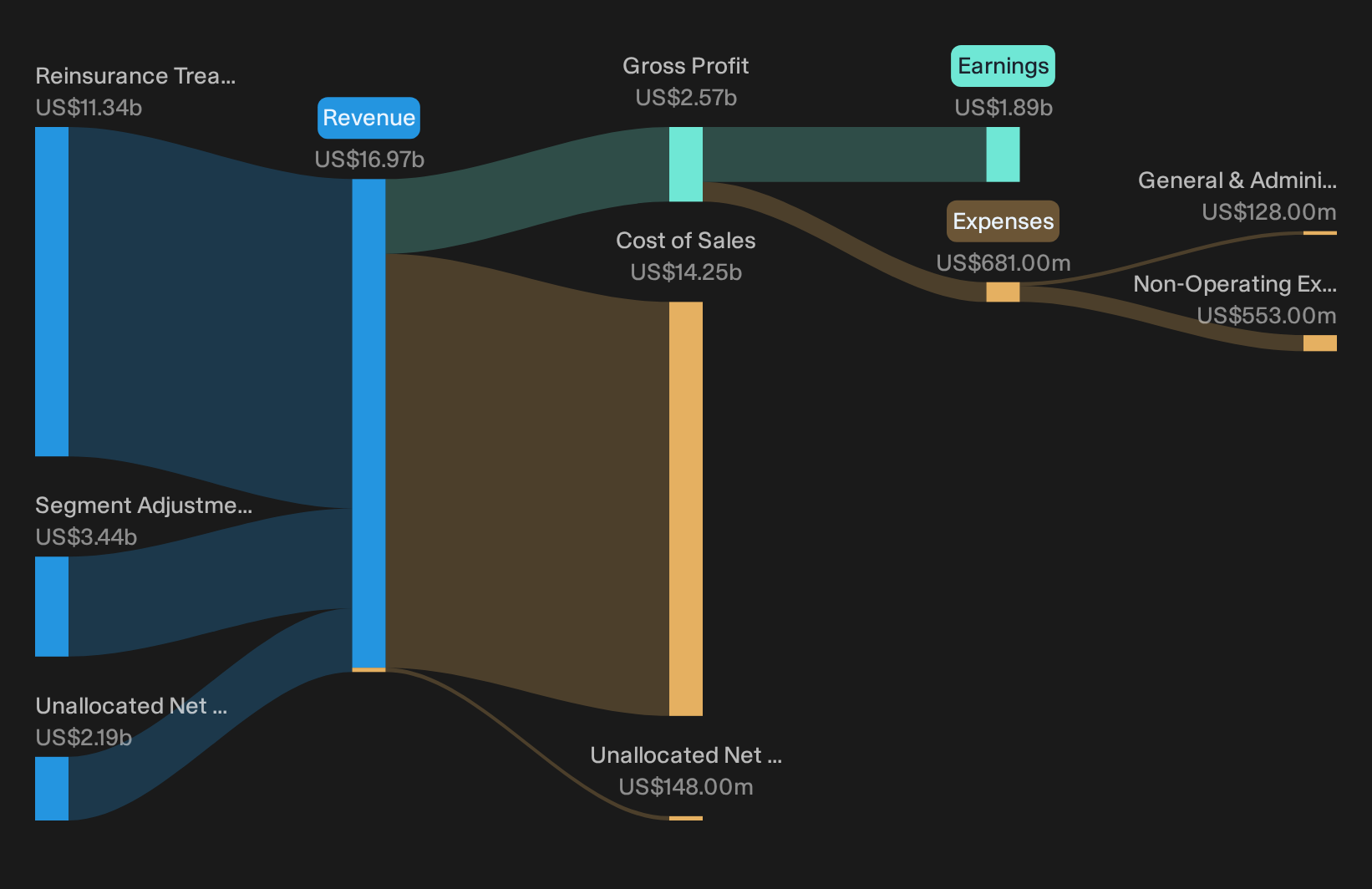
Everest Group, a global reinsurer and commercial insurer founded in 1973 and now worth about US$14.2b, earns most of its US$16.8b business revenue from reinsurance treaty business at roughly US$11.3b, with investment related items and adjustments filling the rest of the mix.
"Everest Group is reshaping its portfolio toward short tail property, specialty lines and selected international business while reducing U.S. casualty writings by over US$1.2b since 2024. This shifts earned premium toward areas that have recently supported a 90% combined ratio across core operations and can influence future net margins and earnings quality."
What really moves the needle from here is how one evolving pressure on Everest Group’s balance sheet filters through into those profitability targets.
Those balance sheet pressures are exactly where the story starts to shift, and the full narrative for Everest Group shows how Everest Group’s underwriting and investment engines could be quietly decoupling.
Reinsurance Group of America (RGA)
Reinsurance Group of America is the purest expression of this screener’s theme. It is a life and health reinsurer whose asset intensive deals lean on long dated bonds that can benefit when long term rates reset higher across the curve.
RGA reinsures life and health risks worldwide and runs sizeable asset intensive and longevity deals, with around US$9.2b from U.S. and Latin America Traditional, US$3.8b from Asia Pacific Traditional and US$4.6b from U.S. and Latin America Financial Solutions operations supporting a roughly US$16.1b market value.
"RGA is capitalizing on growing insurance demand in Asia and other international markets, as evidenced by robust new business in Hong Kong, Taiwan, Korea, and a record number of asset-intensive transactions across five countries and three continents; this global expansion drives sustained premium growth and strengthens revenue diversification."
The real test for Reinsurance Group of America now is how one quiet pressure on its long duration investment book shapes future margins and book value.
That quiet pressure on Reinsurance Group of America’s long duration book could be masking a very different earnings trajectory, and the full narrative for Reinsurance Group of America explains how that tension may reshape returns.

Seeking Fresh Alternatives Before They Fly
Markets move fast and the best breakout ideas rarely stay under the radar for long. Spot fresh momentum pockets before the crowd, while it matters, and get in early.
- Consider cash generative growth stories that still trade like underdogs by scanning the 30 high quality undervalued stocks before these opportunities get fully priced in.
- Monitor income engines built on sturdy balance sheets and robust payouts with the curated 7 dividend fortresses before yields change and prices move away.
- Explore under the radar compounders with resilient financials using the hand picked 16 high quality undiscovered gems while they remain overlooked and expectations stay low.
This article by Simply Wall St is general in nature. We provide commentary based on historical data and analyst forecasts only using an unbiased methodology and our articles are not intended to be financial advice. It does not constitute a recommendation to buy or sell any stock, and does not take account of your objectives, or your financial situation. We aim to bring you long-term focused analysis driven by fundamental data. Note that our analysis may not factor in the latest price-sensitive company announcements or qualitative material. Simply Wall St has no position in any stocks mentioned.
Have feedback on this article? Concerned about the content? Get in touch with us directly. Alternatively, email editorial-team@simplywallst.com