
Walmart (WMT) Expands Neighborhood Markets And AI Tools, Is It Still 28% Undervalued?
Walmart (WMT) just cut the ribbon on a new 45,000 square foot Neighborhood Market in Mesquite, tying a very local grocery and pharmacy opening to a much broader expansion and efficiency story for the stock.
Recent moves such as rolling out Apple Pay and Google Pay in U.S. stores, piloting Health Ambassador programs in rural locations, and integrating with Meta’s Muse AI agent frame how investors read Walmart’s price action. The share price is at US$110.53 after a 7 day share price return of 2.82% and a 30 day share price return of 3.79%. Over longer periods, the 90 day share price return has fallen 4.53% and the year to date share price return is down 1.98%, set against a 1 year total shareholder return of 8.5% and a 3 year total shareholder return of about 11x that indicates how the market has been re-rating the stock over time.
Spot opportunities beyond Walmart by scanning a curated list of retailers geared toward value conscious shoppers and resilient balance sheets with the list of solid balance sheet and fundamentals (23 results).For Walmart, that mix of fresh store openings, new payment options and early AI experiments raises a simple fork in the road. Is the recent pullback already enough of a reset, or does patience on entry price still matter here?
Most Popular Narrative: 28.5% Undervalued
The most followed narrative on Walmart puts fair value at $154.58, well above the last close of $110.53. This frames the current pullback very differently from the recent share price drift.
Walmart’s SBU “Other” has emerged as a dynamic growth engine, capturing new opportunities beyond traditional retail. The week of June 13-19, 2026, offers a compelling snapshot of this segment’s momentum and sets the stage for future projections.
See why 58 investors see Walmart as 28% undervalued.
According to prakhar_ef9px, that segment sits alongside a much larger group wide story. Walmart generated about $735.84b in revenue and $22.08b in net income, with earnings growing 17.5% per year over the past 5 years even though profit growth over the most recent year, at 3.4%, lagged both its own 5 year pace and the 7.3% earnings growth seen in the wider US Consumer Retailing industry.
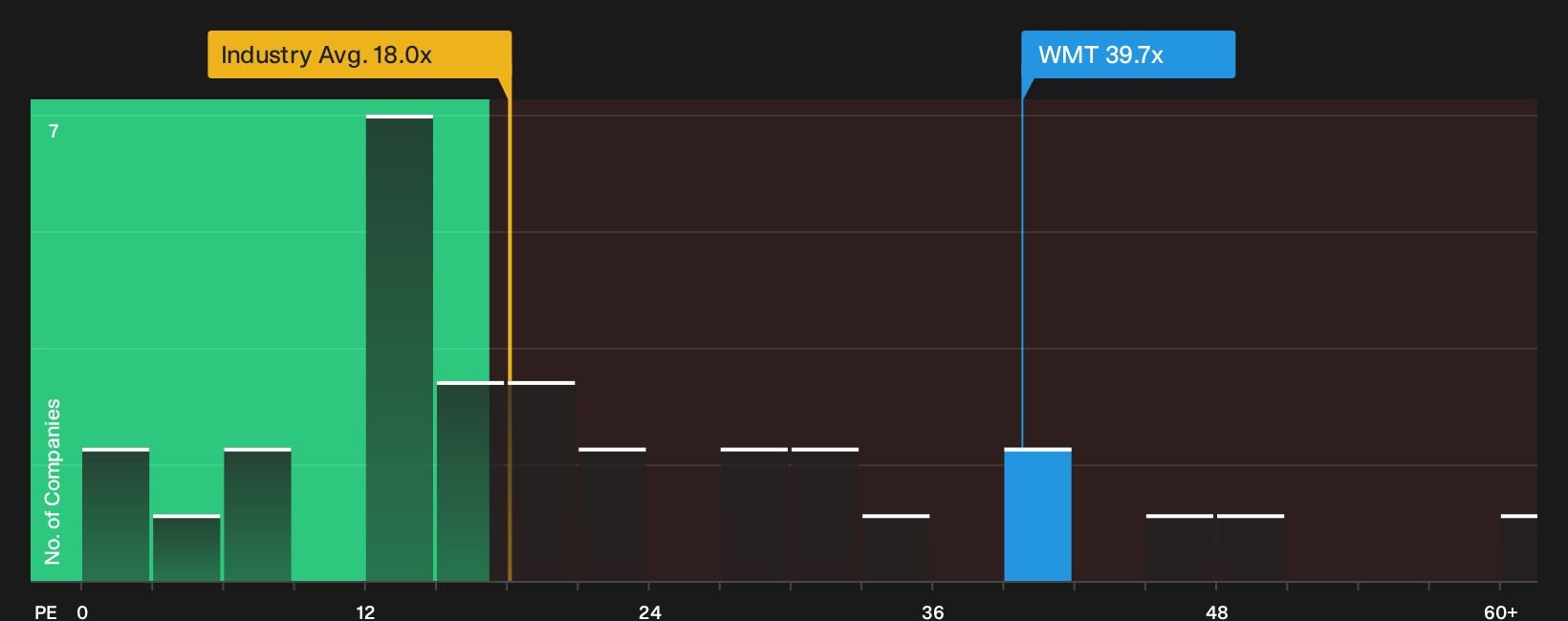
The same narrative uses a 7.108% discount rate to bring future cash flows back to today, then compares that implied value per share with the live quote. On that view, the current share price around $110.53 sits materially below the $154.58 fair value marker, even as other checks like a 39.7x P/E relative to a 37.1x fair ratio and a 22.6x peer average suggest the market is already paying up for high quality earnings and a forecast 21% Return on Equity in three years.
Result: Fair Value of $154.58 (UNDERVALUED)
Still, the narrative depends on Walmart maintaining strong execution in newer businesses while also avoiding a sharper slowdown in earnings compared with broader US consumer retail peers.
Find out about the key risks to this Walmart narrative.
Another View on Walmart’s Valuation
A second lens on Walmart leans on the P/E ratio rather than cash flow forecasts. At 39.7x earnings versus a 37.1x fair ratio and a 22.6x peer average, the stock carries a clear premium. Is that pricing a durable edge, or is it simply stretching the margin for error?
See what the numbers say about this price — find out in our valuation breakdown.
Next Steps
Sentiment around Walmart is mixed, which is exactly when fresh data can help you move fast and think independently. To see what the current optimism is built on, take a closer look at the 2 key rewards.
Looking for more investment ideas beyond Walmart?
If you stop at Walmart, you only see part of the opportunity set. Give yourself options and let the data point you toward your next potential winner.
- Target steady cash generators by reviewing the 7 dividend fortresses that focus on companies aiming to support income with substantial yields.
- Hunt for quality at a discount through the 30 high quality undervalued stocks that highlights businesses combining strong fundamentals with prices below their estimated worth.
- Prioritize peace of mind with the 31 resilient stocks with low risk scores that filters for resilient balance sheets and lower historical risk scores.
This article by Simply Wall St is general in nature. We provide commentary based on historical data and analyst forecasts only using an unbiased methodology and our articles are not intended to be financial advice. It does not constitute a recommendation to buy or sell any stock, and does not take account of your objectives, or your financial situation. We aim to bring you long-term focused analysis driven by fundamental data. Note that our analysis may not factor in the latest price-sensitive company announcements or qualitative material. Simply Wall St has no position in any stocks mentioned.
Have feedback on this article? Concerned about the content? Get in touch with us directly. Alternatively, email editorial-team@simplywallst.com