
Palantir vs. Salesforce: One Trades at 144x Earnings. Only One Pays You to Own It.
Enterprise AI is quickly becoming one of technology's biggest battlegrounds. Businesses are no longer experimenting with artificial intelligence just to see what it can do. They are already convinced of its potential and are now looking at how to apply it across their operations. That shift is creating opportunities for software companies that can turn AI into something businesses actually use, rather than another expensive experiment.
Two companies stand out for very different reasons: Palantir Technologies (PLTR) and Salesforce. (CRM) Both are chasing the same enterprise AI opportunity, but their growth, valuations, and approaches to rewarding shareholders look very different.
For dividend investors, that adds another layer to the comparison, especially since AI growth and shareholder returns don't always go hand in hand.
So which enterprise AI stock offers the better proposition today?
Palantir Powers Data and Defense at a $444 Billion Valuation
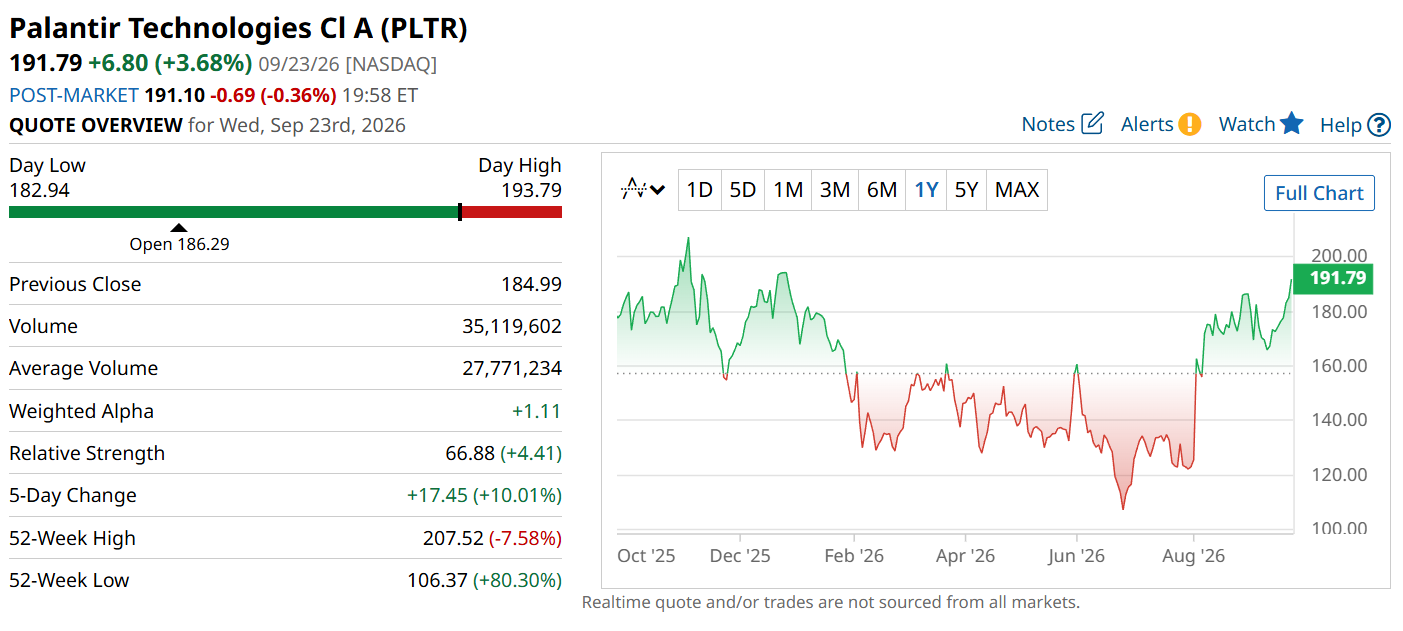
Palantir Technologies is an enterprise software company known for its data analysis solutions and its use of artificial intelligence in real-world operations. Many industries use its software, including the U.S. government and defense agencies. The company is the larger of the two, with a market cap of $460 billion.
Salesforce Builds AI Into a $192 Billion CRM Empire
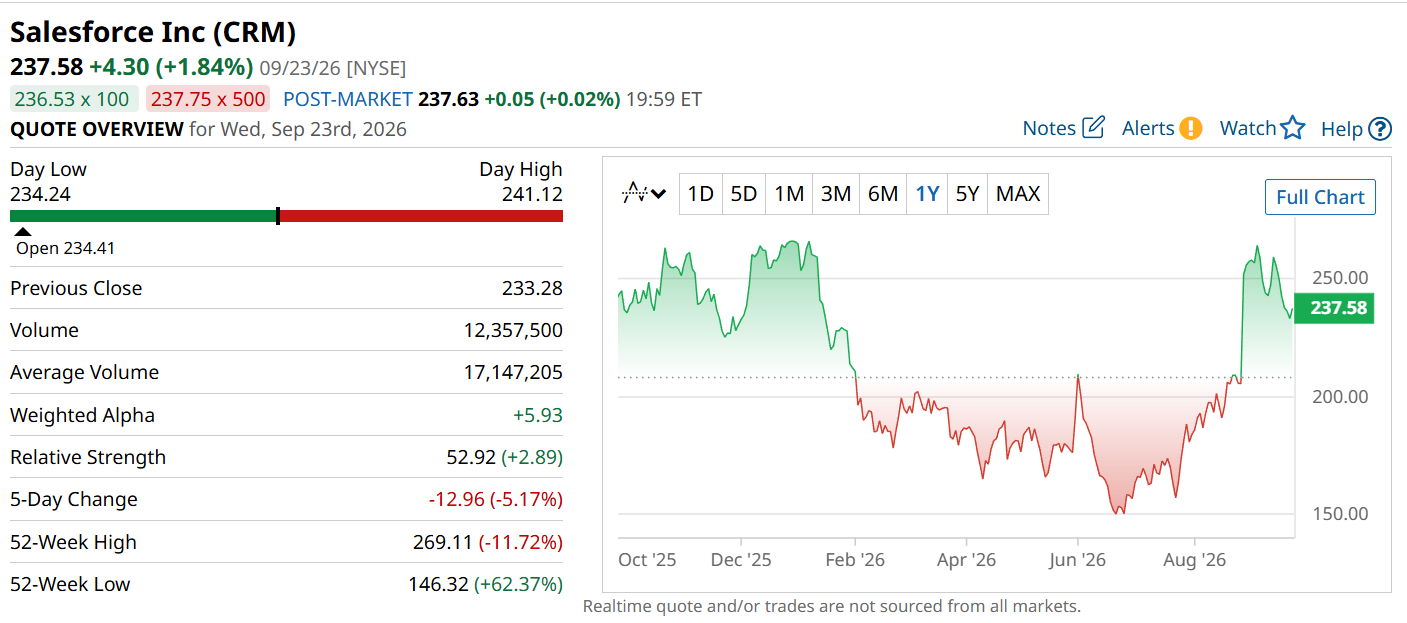
Salesforce is another enterprise software company built around a customer relationship management platform. It helps businesses manage customer relationships and is leaning further into AI through Agentforce, which I’ll cover later. Its market cap is $195 billion.
The two companies compete in the same enterprise software market, but Palantir is already worth more than twice as much as Salesforce. But does its business justify that gap?
Palantir vs. Salesforce in the Battle for Enterprise AI
Both companies are betting heavily on enterprise AI, but the drivers behind it are entirely different.
Palantir's Artificial Intelligence Platform, or AIP, connects AI with a company's existing data and day-to-day operations. Think of it as an advanced chatbot that actually helps with your day-to-day operations. It lets businesses analyze information and make decisions, even automating much of their work.
Meanwhile, Salesforce Agentforce is different. It lets companies build AI agents that can perform tasks across different parts of the business, including sales. It can also use company data and workflows to answer questions and take actions for both employees and customers.
Think of it this way: Palantir wants AI deeply involved in how a company makes decisions and runs its operations, while Salesforce wants AI agents working alongside employees throughout the customer relationship. Palantir is building around data and operations, while Salesforce is building from its massive CRM ecosystem.
The next question is how well those strategies are delivering in terms of numbers.
Revenue, Margins and Growth by the Numbers
I compared these companies’ latest quarterly financials and other metrics using Barchart’s Stock Comparison Tool.
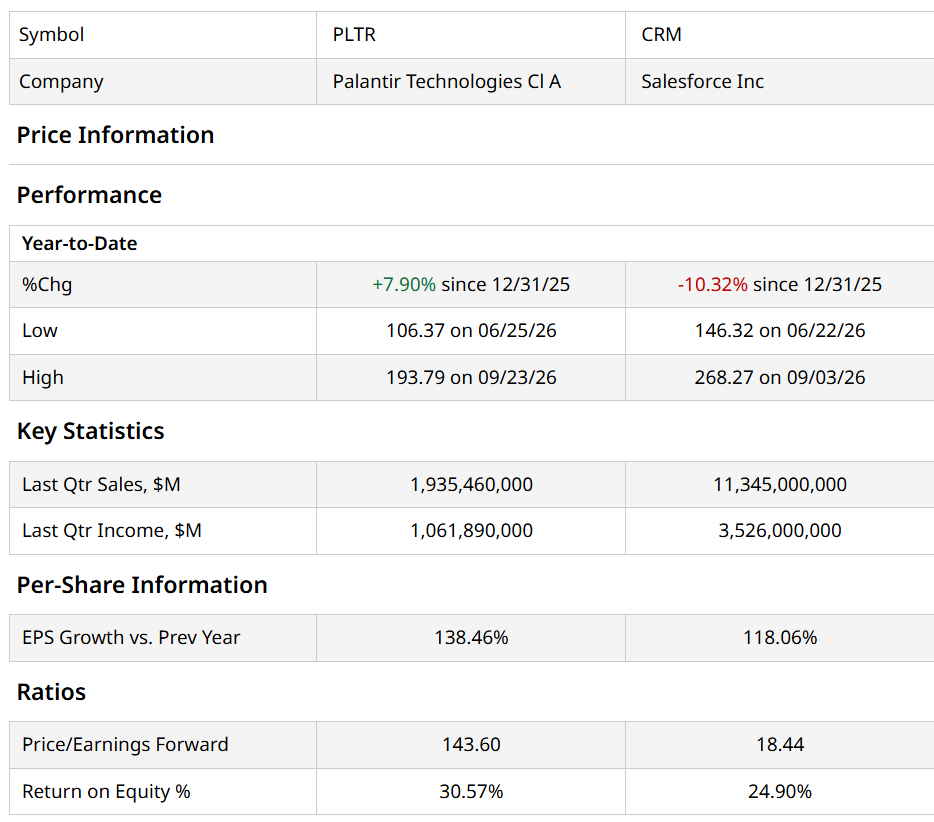
Now, you’ll immediately notice something surprising.
Despite Palantir's higher market cap and bigger market profile, Salesforce is beating it in absolute dollar terms.
In the last quarter, Palantir reported $1.94 billion in revenue, a mere 17% of Salesforce’s $11.3 billion. To be clear, though, the growth beneath those numbers is vastly different. Palantir’s latest quarterly revenue grew 93%, while Salesforce’s grew only 11%.
That gap becomes even more evident at the bottom line. Palantir reported a $1.06 billion net income, translating to an impressive 54.9% profit margin. Again, Salesforce has the bigger number here at $3.5 billion, but at a lower 31.1% net margin.
That’s not a knock on the smaller company, but it does help explain why Palantir has the higher market cap. And it’s probably also why Palantir is up 8% year-to-date, while Salesforce is down 10%.
But here, we see a valuation difference. Salesforce is trading around 18x forward earnings, while Palantir is at an eye-watering 144x. That means Palantir trades at nearly eight times Salesforce’s earnings multiple, even with a nearly 24-percentage-point margin lead.
For context, the S&P 500 Information Technology sector has a current P/E ratio of 34x. So Salesforce looks much cheaper on earnings, while Palantir’s premium reflects expectations for much faster growth.
But for dividend investors, there’s another part of this comparison that may matter even more.
Which Stock Actually Pays You a Dividend?
This is where the case for owning one of the two companies changes. While both compete for enterprise AI spending, they reward investors very differently.
Palantir does not currently pay a dividend, and its recent financials gave no indication that one is coming anytime soon. For now, investors are relying entirely on share-price appreciation for their returns.
Meanwhile, Salesforce pays a forward annual dividend of $1.76, which translates to a yield of approximately 0.74%. It might be small, but that cheaper valuation could be enough to convince a dividend investor to buy Salesforce.
Now, let’s see what Wall Street makes of the two.
Wall Street Price Targets for PLTR and CRM
Wall Street sees plenty of potential in both.
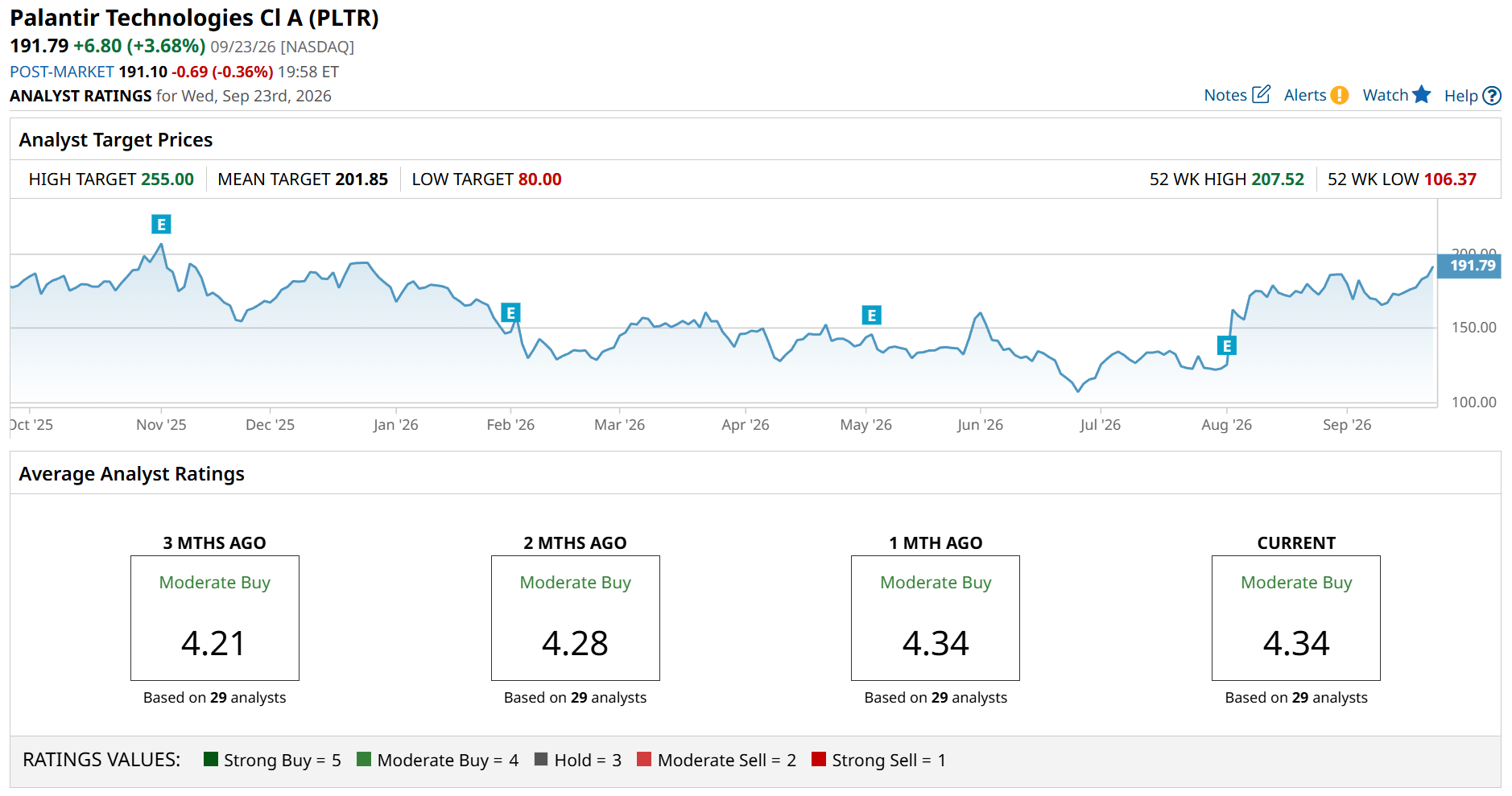
A consensus among 29 analysts rates PLTR stock a “Moderate Buy,” with as much as 33% potential upside based on its high target price.
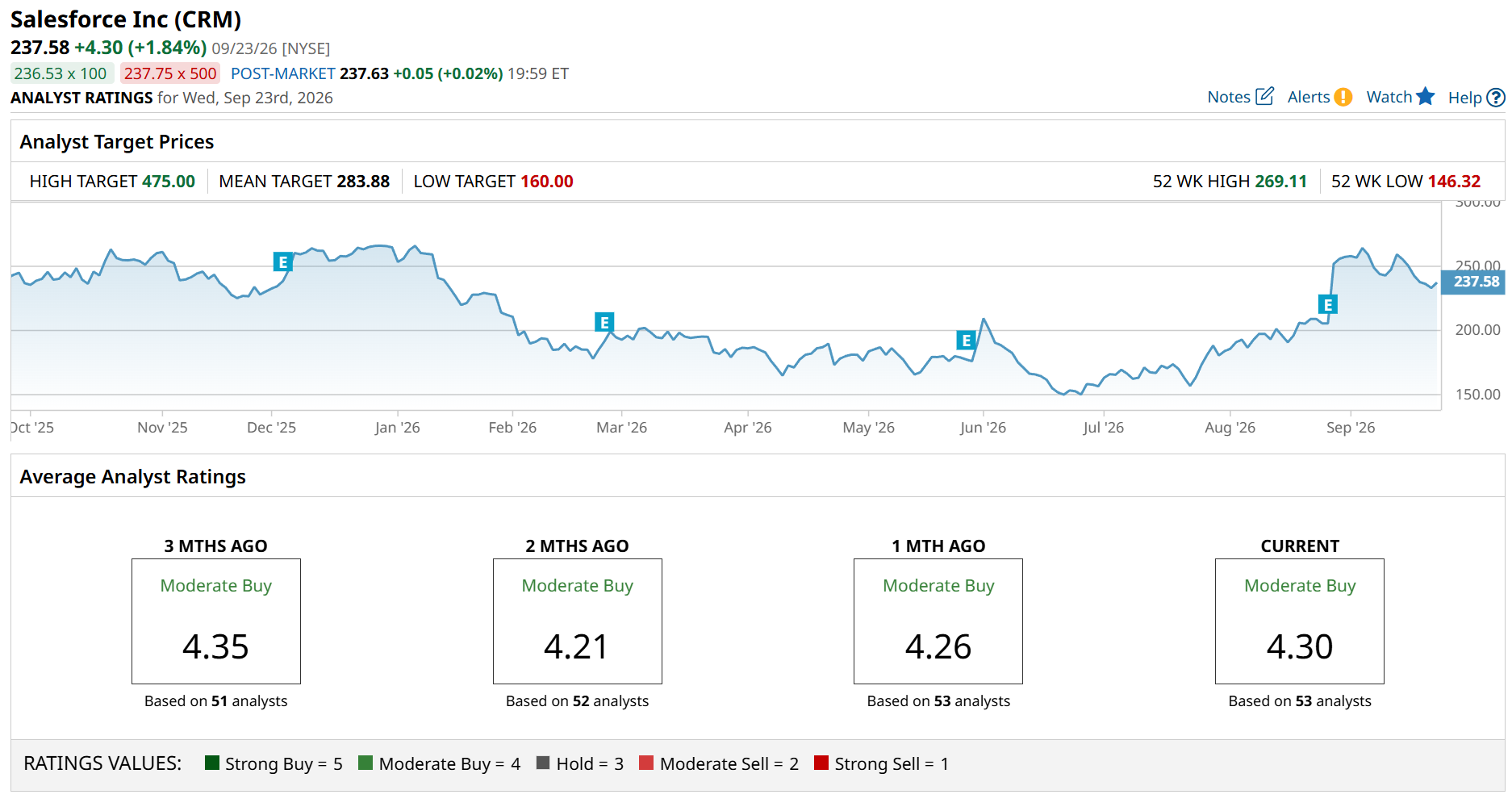
Similarly, CRM has a consensus “Moderate Buy” rating based on 53 analysts. However, its potential upside based on its high target price is almost double.
Verdict
Right now, Salesforce looks like the much better deal. Despite trading at roughly half of Palantir’s market cap, Salesforce has relatively decent revenue streams, profitability, a cheaper valuation, and offers something Palantir currently does not: a dividend.
On the date of publication, Rick Orford did not have (either directly or indirectly) positions in any of the securities mentioned in this article. All information and data in this article is solely for informational purposes. For more information please view the Barchart Disclosure Policy here.