
There are concerns about the midterm elections or the rise of US stocks! Wall Street report: If the Democratic Party controls at least one house of Congress, the AI sector will bear the brunt
The Zhitong Finance App learned that the US midterm elections are becoming a major concern in the US stock market where the AI market is currently high.
In the past few weeks, the results of polls and market predictions have been heavily biased in favor of the Democratic Party, and now the Democratic Party is increasingly hopeful that it will control at least one house in the National Assembly. In response, Wall Street strategists believe that once this situation occurs, stocks in the market that benefit from the AI boom, generally have high valuations, and have very little room for fault tolerance may come under pressure — as subsequent congress may launch investigations, hold hearings, and even introduce stricter regulatory rules.
Brian Mulberry, chief market strategist at Zacks Investment Management, said that if the Democratic Party shows a strong performance in the November election, hearings on AI security issues “will not only increase in number, but the smell of gunpowder will also be stronger.” Mulberry believes that as headlines from Washington make traders worry that Congress will introduce relevant measures, this will plunge AI trading into turmoil.
According to information, senior Democratic Party officials have been preparing to investigate companies linked to the Trump administration and his family. Furthermore, according to reports, a group of Democratic senators on Wednesday urged Trump to reach an agreement with China to mutually slow down or suspend AI research and development.
Tobin Marcus of Wolfe Research wrote in a report to clients last week that concerns about the potential risks of AI systems have surfaced recently, making the security issue “a more realistic topic for Congress in 2027.” The policy-focused strategist predicts that the Democratic Party will set up an “AI Special Committee” to summon industry executives for questioning, and possibly even issue a subpoena.
Market watchers have long warned of the risk. Last month, Bank of America's Michael Hartnett warned that if the Democratic Party sweeps the House and Senate — plus winning Texas — it could trigger a 10% drop in the US stock market on the grounds that AI-related sectors could face policy shocks. Barclays strategists led by Jenny Yang and Alex Altmann said that AI infrastructure and data center construction may face stricter scrutiny, which is a major risk “partially ignored” by the market.
As the possibility of a congressional investigation rises, the Evercore ISI strategist led by Sarah Bianchi wrote in a report released on Tuesday that “the broadest range of market risk comes from investigations and hearings on industry-related issues, particularly in the large tech/AI sector.” These strategists are particularly concerned about whether the investigation will reveal new information about AI agents getting out of control, or whether internal corporate communication documents acknowledge that AI has security risks.
However, in the long list of surveys expected by Wall Street, AI is only one part. Evercore ISI believes that the number of follow-up investigations may be so high that it is difficult for investors to follow them all.
The agency also anticipates that Congress will investigate sectors related to people's costs that voters are highly concerned about, including energy, healthcare, food, and agriculture. Strategists have also previously warned that companies receiving equity investment from the US government (such as Intel (INTC.US)) may also face risks.
Of course, even if the Democratic Party wins both houses, Trump can still exercise his veto power, making the relevant bill almost impossible to implement without his support. Trump is now a supporter of the AI industry, and has repeatedly rejected calls to restrict data center construction or slow down the development of advanced models.
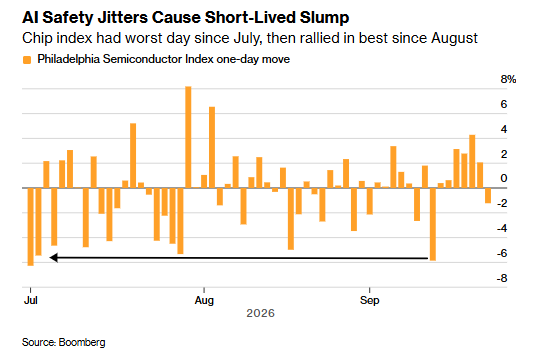
Investors have so far been mostly unconvinced by concerns raised by various regulatory calls. After a period of turbulence, the Philadelphia Semiconductor Index has risen 5.1% so far this week. The Nasdaq 100 index, which is dominated by technology stocks, hit its first record high since June on Tuesday.
However, the market is far from being at ease. In addition to holding hearings, the Commission can also propose legislation. If there is a so-called “blue wave” in November — as the forecast market shows — US stocks could be impacted as investors begin to take into account the greater policy risks that may arise after the 2028 election, particularly those associated with rising corporate taxes and AI regulations.
Scott Chronert, head of US stock strategy at Citigroup, wrote in a report to clients this week that if the Democratic Party sweeps both houses of Congress, all key committees will fall into the hands of the Democratic Party. “We believe this poses a slight disadvantage for AI transactions and for sectors that previously enjoyed the dividends of deregulation. In the next two years, a batch of laws that are unfavorable to the market will be sent to Trump's table to be vetoed; once this happens, a large backlog of policy proposals will be rapidly implemented after 2028.”