
As Muse fuels AI infrastructure, investors focus on Micron's (MU.US) performance! Will the 100 billion dollar contract add fuel to the AI computing power craze?
The Zhitong Finance App learned that as Meta Muse and OpenAI Astra promote the expansion of global AI applications into intelligent workflows with continuous execution and multi-step collaboration, global AI computing power demand is expected to usher in a new blowout expansion frenzy. This is also an important logic that has recently accelerated the popularity of AI smart applications in the global stock market beyond expectations, transforming it into the growth expectations of many AI computing power industry chain leaders and computing power core vendors such as SK Hynix, Samsung, Micron, Nvidia, AMD, TSMC, etc.
Currently, the market is re-evaluating the CPU, memory, and storage requirements to support these applications. As a result, the financial report that Micron (MU.US), one of the three major memory chip manufacturers, will release next week has become an important window for testing the specific progress of the storage supercycle and the unprecedented AI infrastructure frenzy.
AI agents and cutting-edge AI models are rapidly penetrating into various industries around the world, bringing continued strong expansion of AI infrastructure core hardware requirements such as AI GPUs/TPUs, data center CPUs, optical interconnect systems, and data center memory chips, and are being rapidly transformed into continuous record performance data and future prospects that continue to exceed market expectations from the three original memory chip manufacturers of SK Hynix, Samsung, and Micron Technology. Whether the next phase of valuation can continue to rise will depend more on the sustainability of profit growth and expansion of performance prospects.
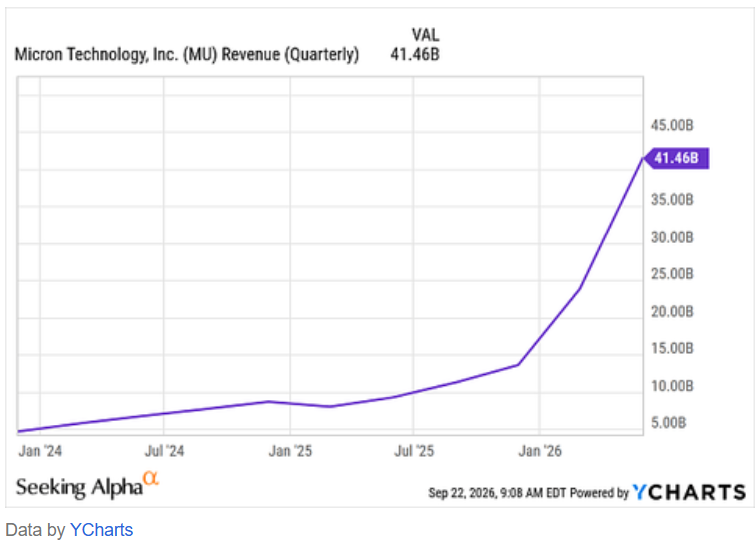
As shown in the chart above, Micron's revenue data is growing at an accelerated pace, highlighting the accelerated shift in memory chip demand to deliver results. Micron will announce its results for the fourth fiscal quarter of fiscal year 2026 on September 30; revenue for the previous quarter reached $41,456 billion, up about 346% year over year, and adjusted earnings per share of $25.11. The company's previous fiscal quarter guidance was revenue of 50 billion US dollars, fluctuating up and down 1 billion US dollars, gross margin of about 86%, adjusted earnings per share of 31 US dollars, and fluctuating 1 dollar up and down. More importantly, Micron previously revealed that of the 16 strategic customer agreements it has signed, 14 are calculated at the lowest price of the contract, corresponding to cumulative revenue of about 100 billion US dollars during the remaining contract period, which will help enhance the visibility of future revenue and profits.
However, it should be noted that the recent strong and stringent performance benchmarks are in line with Wall Street analysts' expectations, which means that the market is not only concerned about whether the current season can exceed expectations, but also whether prices, shipments, and long-term orders for the 2027 fiscal year can continue to support the increase in profit forecasts.
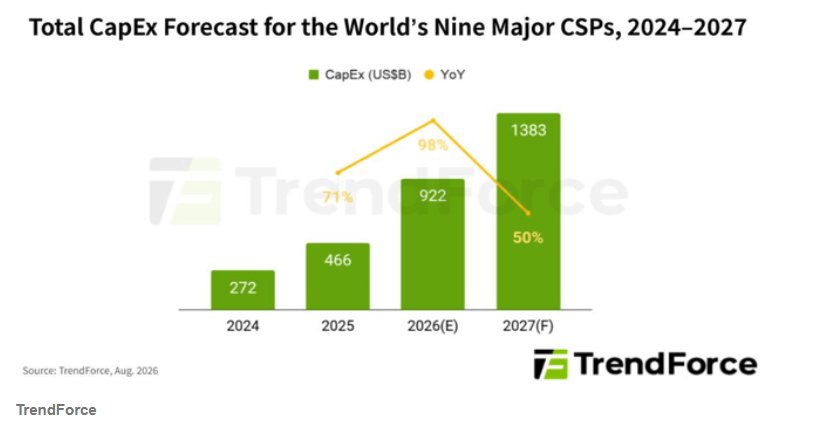
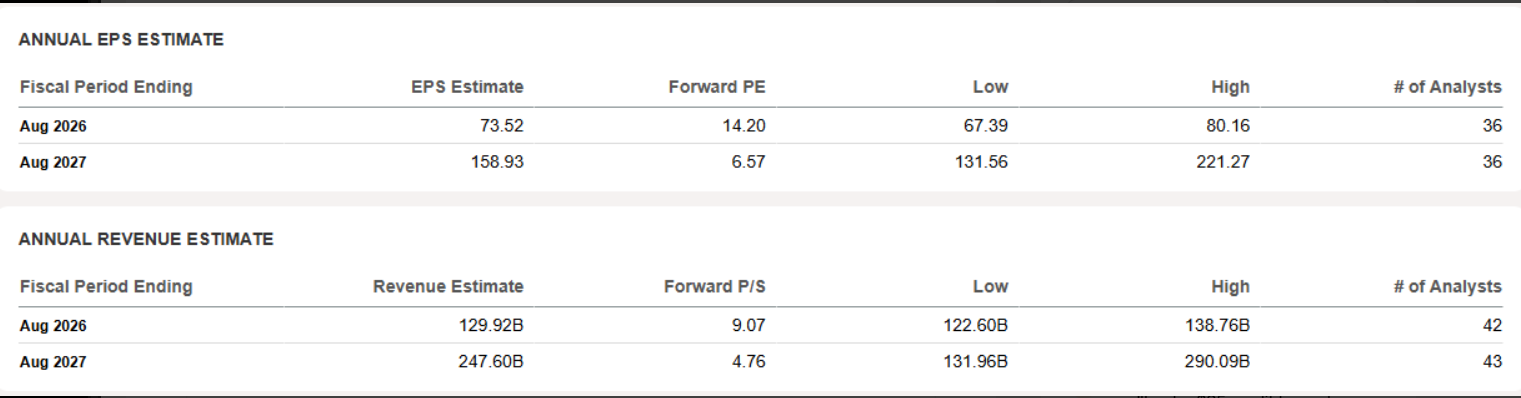
The key to supporting the bullish judgment is that AI infrastructure procurement is covering more complete computing systems. Wall Street analysts' estimates compiled in S&P Global's September 22 research report show that the total capital expenditure of the four tech giants Meta, Alphabet, Amazon, and Microsoft from 2026-2028 is about 2.8 trillion US dollars; under their Visible Alpha estimates, Wall Street analysts' earnings expectations for Micron's 2027 fiscal year have risen sharply from about $90 to about $156 in March.
Meta's Muse and OpenAI's Astra have strengthened extremely professional computer operation, programming, and multi-step work capabilities. What can be deduced from this is that the accelerated expansion of AI applications is simultaneously increasing the infrastructure investment required for “model thinking” and “actual execution of work.” This is why, with the significant improvement of the AI commercialization process, UBS Group's senior analyst team drastically raised the 2027 operating cash flow forecast of global hyperscale cloud computing vendors and new cloud-type enterprises by 30%, and Wall Street financial giant Morgan Stanley expects the data center comprehensive capital expenses of the four largest North American supercloud computing and AI application vendors such as Oracle to rise from US$917 billion in 2026 to US$1.64 trillion in 2027 and US$1.64 trillion in 2028. The deployment capacity is expected to expand from 35 gigawatts in 2025 to 35 gigawatts during the same period An amazing 145 gigawatts in 2028.
As AI “does the job”, why are CPUs and memory chips more indispensable?
The most profound change in the computing power requirements of intelligent entities is that a user command can start a continuous work chain. Research, programming, or corporate office tasks often require planning, searching, browsing the web, reading files, executing code, checking results, and fixing errors. Many of these steps call the model again and continuously generate new context. Meta officially revealed that Muse runs in a cloud-based secure virtual machine with a separate browser, and users can continue to advance tasks even after closing the application; OpenAI emphasizes Astra's ability to operate computers, use browsers, and cross-software professional workflows. From an engineering perspective, when such tasks expand from a small number of high-frequency users to the daily processes of an enterprise, infrastructure requirements are simultaneously driven by user size, task frequency, task duration, and peak value.
This also explains why the market is beginning to pay more attention to AMD, Intel, and Arm-based data center CPUs. GPUs and ASICs are responsible for large-scale neural network computation, while CPUs are responsible for virtual machines, browsers, code sandboxes, task scheduling, data preprocessing, and tool execution. Whether an intelligent body can complete tasks efficiently depends on whether model inference and actual execution can be smoothly connected; waiting for the CPU, database, or input/output process may also reduce the utilization rate of expensive accelerators. AMD's PACE technology solution has clearly adopted the collaborative method of CPU orchestration and GPU execution of heavy inference, and Arm also lists intelligent sandboxes and tool execution as important workloads for cloud CPUs. This provides a specific engineering basis for CPU demand expansion, and makes server DRAM, storage, and networking key links in the same demand transmission chain.
From the perspective of large model inference, the pre-filling stage requires processing the input context, and the decoding phase continuously generates output; model weight and key value caches, or KV Cache, take up memory capacity and bandwidth. When the model and cache strategy are similar, longer contexts, higher concurrency, and more parallel tasks will increase the scale of states that the system needs to maintain at the same time. Thus, a clear division of storage is formed: HBM supports high bandwidth access to accelerators, server DRAM undertakes CPU work sets and part of the cache, enterprise SSDs store files and application states, and take on part of the inference context in systems using hierarchical caching. Nvidia's CMX solution has added an Ethernet-connected flash memory layer between GPU memory and shared storage to enable context storage, migration, and reuse across nodes; storage capacity, access speed, and network bandwidth all influence inference service throughput.
Large-scale production systems are already being used as a reference for this expansion of demand. OpenAI revealed on September 11 that its Habitat online storage platform processes more than 70 million requests per second, serves more than 500 PB of data, and undertakes tasks such as routing, compression, encryption, and verification. This is overall platform data covering multiple OpenAI products, reflecting the huge application and storage load behind AI services. As more agents enter the production environment, additional execution nodes, database access, and cross-node data exchange will further increase the requirements for servers, memory, enterprise-grade SSDs, and high-speed interconnections; as cluster size and rack power increase, procurement requirements will also be transmitted to optical interconnection, power supply and distribution, and cooling systems. However, the actual increase in each step still depends on the deployment method and utilization rate.
The efficiency improvements brought about by a stronger model may also expand the range of tasks that can be commercialized. Meta revealed that in its engineer comparison test, Muse Spark 1.3 reduced tool calls by about 20% and token usage decreased by about 25% compared to 1.2. This means that the cost of resources to complete similar tasks is expected to drop, and it is also easier for companies to hand over processes that are otherwise too costly and slow to respond to AI. The core of the market's bullish demand for computing power is the expansion of the number of new users and tasks after the cost falls, which can exceed the decrease in resource consumption per task. For example, just a simplified calculation of the number of tokens. After a 25% reduction in the usage of a single task, the number of tasks increased by more than 33.3%, and the total usage will still rise; this shows that efficiency improvements and infrastructure expansion can occur at the same time, and it also shows that demand elasticity is the key to judging whether the “Jevans effect” can be realized.
The 100 billion dollar contract strengthens the chassis. How can the market reprice the storage supercycle?
For the US-based memory chip giant Micron, in addition to simultaneously covering HBM, server DRAM, and NAND storage, and being able to participate in upgrades at different levels of smart infrastructure, the biggest advantage over SK Hynix and Samsung Electronics is undoubtedly that there is no need to worry about the operating pressure that may be caused by the huge political pressure imposed by the US government at the “return of chip manufacturing to the US” level and the uncertainty of the tariff policy that the Trump administration may change its face at any time.
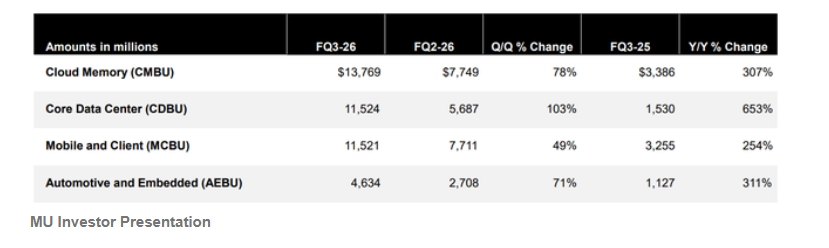
Cloud memory business revenue reached US$13.769 billion in the previous quarter, up about 78% month-on-month; core data center business revenue reached US$11.524 billion, up about 103% month-on-month. The company also revealed that data center SSD revenue exceeded 5 billion US dollars, a month-on-month increase of more than double. The core business of NAND supergiant, SNDK.US (SNDK.US), which has received much attention in the market, focuses on NAND flash memory and SSD. Therefore, the reference significance of Micron's financial report on SanDisk's fundamentals and performance is mainly on enterprise-grade storage requirements, NAND prices, and supply and demand prospects. The two companies participated in the same round of AI construction, but the product structure determined their different profit elasticity.
The speed of supply-side adjustment is an important support for this round of storage profit expansion. Building a new fab requires construction, equipment installation, process climbing, and customer certification; HBM also involves multi-layer stacking, advanced packaging and system verification, and it takes time for additional wafer input to be converted into deliverable products. Micron management previously determined that the tight supply and demand for DRAM and NAND may continue until after 2027, and industry supply will gradually improve in 2028, but it is not yet certain when it will fully catch up with demand. Samsung's expansion of HBM4 supply is therefore worth tracking, but the increase in its 4nm logic substrate production capacity requires joint evaluation with DRAM chips, package yield, and customer certification to determine the final deliverable HBM supply. A more valuable observation in terms of investment is the difference in growth between new effective supply and AI procurement demand, rather than a single production expansion figure.
The long-term agreement provides another layer of support for Micron's profit sustainability. The company announced at the time of disclosure of results in June that it has signed 16 strategic customer agreements, covering about 20% of DRAM sales and one-third of NAND sales during the contract period; 14 of these agreements are calculated at the lowest price of the contract and correspond to cumulative revenue of about 100 billion US dollars during the remaining period. These agreements have “pay-as-you-go” arrangements that agree on the purchase volume, and some large-scale agreements have price ranges.
The significance of long-term agreements between these major memory chip manufacturers on the AI computing power theme is that customers exchange long-term procurement commitments for supply guarantees, while Micron obtains clearer production capacity plans and revenue visibility, which helps reduce the sensitivity of some businesses to short-term market prices. It is worth noting that Micron's official statement that “about half or more of the revenue is covered by the agreement” is an expectation after the completion of all planned agreements, and cannot be interpreted as having been realized at present.
Micron management also recently anticipated that these agreements will bring about $22 billion in cash guarantees and related financial commitments, of which approximately $18 billion is a cash guarantee. They reflect the customer's desire to lock in long-term supply and also help support production expansion arrangements; in accounting, this portion of the cash deposit is included in financing activities and will be gradually refunded during the latter half of the agreement. Therefore, what is more noteworthy in the financial report is the progress of new contracts, coverage, product structure and actual delivery, and how these changes can improve the predictability of future operating cash flow.
Furthermore, Micron's “extra week” of the fourth fiscal quarter will directly affect the market's interpretation of the growth rate. Micron's fiscal season has 14 weeks, and the previous quarter was 13 weeks: based on the median revenue guide of 50 billion US dollars, the nominal increase was about 20.6% month-on-month, and the average weekly revenue increase was about 12.0%. According to further mechanical estimates, after 13 weeks of recovery in the next quarter, even if the average weekly revenue remains completely flat, the quarterly revenue will be about 46.43 billion US dollars. This calculation shows that when judging the guidelines for the new fiscal year, it is necessary to simultaneously examine the number of weeks, price, sales volume, and product mix; changes in total quarterly volume cannot alone represent an inflection point in demand. The price increase that management previously said is slowing down, and it also needs to be analyzed in conjunction with the absolute level of prices and the increase in shipments.
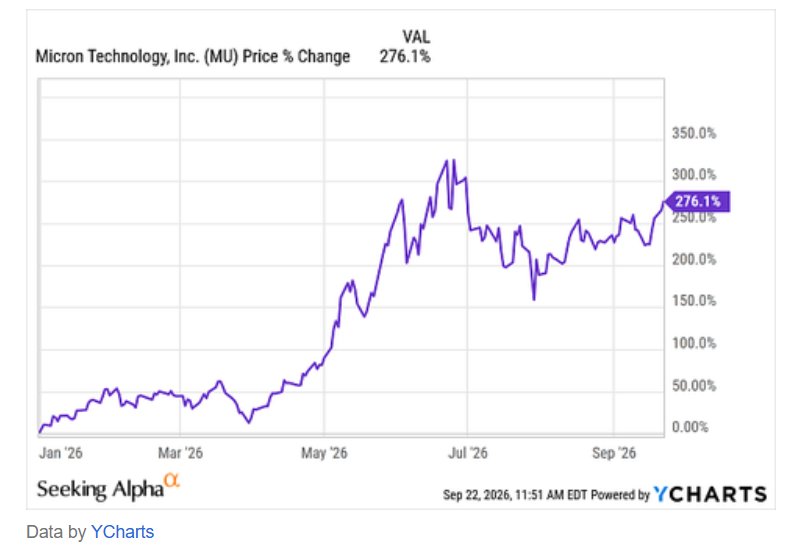
The most valuable investment information from the Micron earnings report and performance conference call on September 30, local time in the US, will focus on the continuity of HBM and enterprise-grade storage orders, DRAM and NAND price trends, effective capacity growth in FY2027, and whether long-term agreements can continue to expand coverage. Wall Street analysts compiled by TIPRANKS have an average bullish preview. Micron's agreed target price for the next 12 months or so was set at around 1,550 US dollars, based on the closing price of 1071.88 US dollars on September 23, which corresponds to a potential increase of more than 40%.