
UBS Says This Bargain Stock Is the "Best AI Enabler in the Market" and Sees Shares Surging 30%+
Key Points
Following Palantir's latest AIPCon event, UBS analyst Karl Keirstead highlights how the company is enabling AI-driven growth for its customers.
Palantir is finally generating faster growth from its commercial segment compared to its legacy government business.
While Palantir stock looks expensive at first glance, thorough valuation analysis suggests shares might actually be undervalued relative to the company's peers.
When most people hear the name Palantir Technologies (NASDAQ: PLTR) they picture an elusive government contractor that sells data analytics dashboards. What the company actually builds is an operating system for messy, mission-critical organizations. At the heart of that system is Palantir's ontology. An ontology is a living digital map of how an organization really functions -- the projects it tracks, the relationships between them, security permissions, and the operational processes that turn data into actionable intelligence in real time.
Palantir stitches this map together across three suites that sit under its Artificial Intelligence Platform (AIP). Gotham is the workhorse for intelligence agencies and defense customers, while Foundry does the equivalent job for large enterprises that need to connect workflows from their factories, supply chains, and finance systems. Apollo handles the essential work of pushing updates across classified networks and public clouds without disrupting anything.
Missed AI’s "Act 1"? Act 2 Could Be 15x Bigger. Most investors think they missed the AI boat because they didn't buy Nvidia in 2005. But according to our analysts, we’re only at the end of "Act 1"—the R&D phase. "Act 2" is the global rollout. Continue »
AIP lets customers drop frontier AI models onto their own ontology to get real work accomplished instead of demoing another software pilot. This combination is now in production at both the Pentagon and within the Fortune 500. The result for Palantir is accelerating revenue and compounding profits that no longer look like a one-off win.
Image source: The Motley Fool.
Palantir is penetrating the public and private sectors
Palantir's growth is no longer tied to a government-only narrative. During the second quarter, the company generated $1.94 billion in total revenue, up 93% from a year earlier. U.S. commercial customers accounted for $764 million of quarterly revenue, a 149% jump year over year. Meanwhile, government customers generated $809 million in sales, still a respectable 90% increase compared to last year. Palantir's commercial segment is now growing faster than its legacy public sector business, a mix Wall Street has wanted to see for years.

Image source: Palantir Investor Relations.
Palantir ended Q2 with $6.24 billion in remaining deal value (RDV) within the U.S. commercial division. This represents an increase of 124% year over year and 27% sequentially. When paired with the company's net dollar retention rate of 157%, it becomes more clear that existing customers are spending a lot more each year rather than just renewing their contract on the original terms.
Why UBS calls Palantir the best AI enabler
After attending Palantir's latest customer event, AIPCon, UBS analyst Karl Keirstead came away calling the company the "best AI enabler in the market." The word "enabler" is deliberate. Palantir does not train generative models. Instead, AIP makes these models useful inside large, regulated organizations that aren't going to hand proprietary data and decision rights to an outside lab.
This value-add is important for investors to understand, as large language models (LLMs) still struggle to handle enterprise data workloads in the same way Palantir's stack can. That distinction matters. Many of Palantir's competitors in the enterprise software arena are simply wrapping a chatbot around an existing database. By contrast, Palantir's ontology allows AI to trigger real-time workflows and simulations that produce actionable insights, all while respecting security permissions.
Is Palantir stock really a bargain?
Following AIPCon, UBS raised its price target on Palantir to $250 -- implying roughly 32% upside from current levels. The loudest argument from Palantir skeptics is that the stock is overvalued. If you view Palantir purely through traditional metrics such as price-to-sales (P/S) or price-to-earnings (P/E) ratios, then you will absolutely consider the stock expensive.
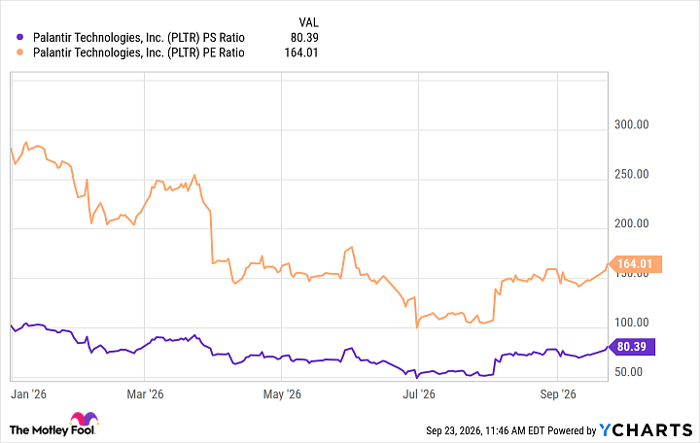
PLTR PS Ratio data by YCharts
I would argue that assessing Palantir solely through traditional valuation metrics is a trap. The multiples illustrated in the chart above suggest Palantir is priced to perfection. I think they actually overlook the fact that Palantir is generating an operating margin in excess of 60%, which flows directly to the company's cash flow. UBS astutely pointed out that Palantir actually trades at a lower 2027 free-cash-flow multiple than both Snowflake and CrowdStrike, despite the company's revenue growth and profitability profile being far stronger.
Against this backdrop, high current valuation multiples embed an assumption that Palantir's growth story could end soon. But if its commercial and government markets continue compounding the way they have, the multiples above will normalize the old-fashioned way -- as earnings catch up. That is the subtle idea behind UBS calling Palantir stock a bargain.
In my eyes, the company's long-term trajectory is compelling as enterprises and public agencies continue spending on AI infrastructure. For this reason, I see Palantir as a no-brainer stock to buy and hold for the long run.
Adam Spatacco has positions in Palantir Technologies. The Motley Fool has positions in and recommends CrowdStrike, Palantir Technologies, and Snowflake. The Motley Fool has a disclosure policy.