
What Moog (MOG.A)'s Earnings Beat Means For Shareholders
- Moog recently reported a strong Q2, with revenue up 15.2% year on year, earnings per share ahead of expectations, and full year EPS guidance set above prior analyst forecasts.
- The company now trades on a 30.9x P/E, which is above its direct peer group but below the broader Aerospace & Defense sector. This puts sharper focus on how durable this earnings profile really is.
- We will now explore how Moog's higher than expected Q2 earnings and raised full year guidance could influence its broader investment narrative.
Moog Investment Narrative Recap
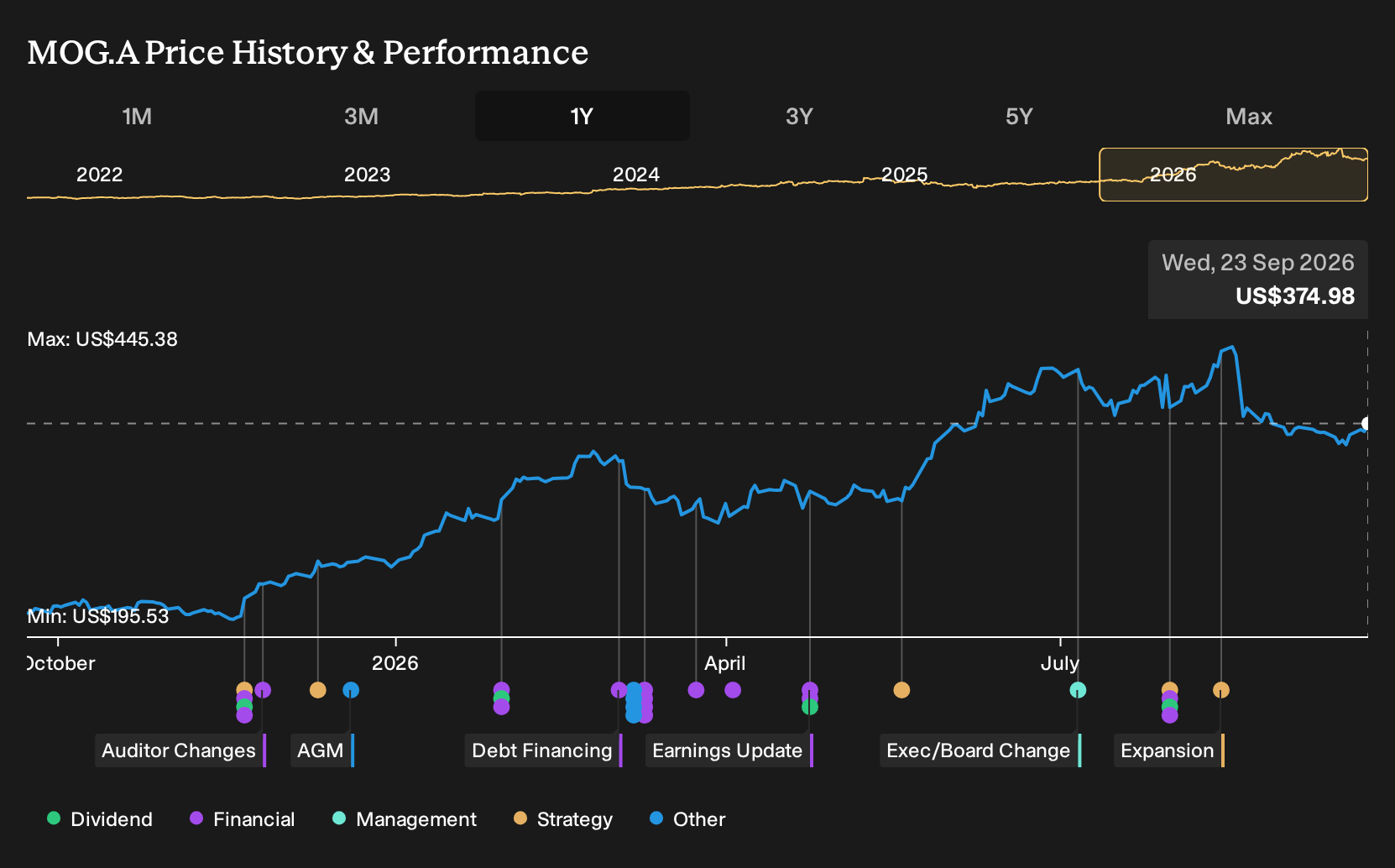
To own Moog, you need to believe its mix of defense, aerospace, and industrial controls can keep converting contract demand into resilient earnings without relying on one off asset sales. The latest quarter supports that view on operations, with revenue up 15.2% and earnings ahead of expectations, even if the share price reaction cooled enthusiasm.
In the near term, the key swing factor is how consistently Moog can turn this growth into stronger free cash flow while managing working capital and tariff pressures. The biggest risk is that defense budgets or aerospace platform volumes soften just as inventory and cost commitments remain elevated, which would pressure margins.
The most relevant recent development is Moog lifting full year EPS guidance after beating Q2 expectations. That single move sharpens attention on execution. Management has effectively told investors that current contract visibility and cost control support a higher earnings run rate than the market assumed before this update.
For you, this guidance raise ties directly into the main catalysts. Defense and automation demand, aftermarket services, and efficiency programs now need to consistently show up in reported profit and cash conversion to justify a 30.9x P/E. If free cash flow again lags earnings, concerns around working capital intensity and margin durability will stay front of mind.
What The Moog Forecasts Are Asking You To Believe
Moog's narrative projects US$5.3b revenue and US$389.4m earnings by 2029. That profile rests on 7.1% yearly revenue growth and an earnings increase of about US$12.3m from US$377.1m today.
Uncover why Moog's fair value indicates a 19% potential upside to its current price that could narrow quickly.
Exploring Other Perspectives
One alternate view fixates on execution risk. The most pessimistic analysts worry that Moog’s missile and space capacity build out could run ahead of demand. Before this Q2 beat, they were penciling in about US$5.3b of revenue and US$397.4m of earnings by 2029, and treating that as an optimistic ceiling. These pre news estimates reflect a belief that higher fixed costs and tariff exposure might cap the benefit from long term defense programs. The latest results may push some of those expectations higher, although this remains uncertain. You can use this gap between consensus and the bearish scenario to pressure test your own thesis.
Explore 3 other Moog fair value estimates, including one that suggests as much as 51% downside from the current price!
Decide For Yourself
Don't just follow the ticker. Dig into the data and build a conviction that's truly your own.
- A great starting point for your Moog research is our analysis highlighting 2 key rewards that could impact your investment decision.
- See our latest analysis for Moog. The report includes a comprehensive fundamental analysis summarized in a single visual, the Snowflake, making it easy to evaluate Moog's overall financial health at a glance.
Looking For More Investment Ideas Beyond Moog?
If Moog has sharpened your thinking about contracts, earnings quality, and valuation, it can be useful to line that up against other businesses with similar or contrasting profiles. The Simply Wall St Screener helps you do that side by side, using the same data framework you have just seen applied here.
- For investors who care most about quality at a sensible entry point, start with a curated set of 30 high quality undervalued stocks that combine stronger fundamentals with more modest pricing.
- If capital preservation and steadier profiles matter more to you right now, focus on a 31 resilient stocks with low risk scores that aims to filter out companies with weaker balance sheets or fragile earnings.
- When you want durability in both financial strength and day to day operations, scan the list of solid balance sheet and fundamentals (23 results) to see which businesses currently screen well on debt, liquidity, and core fundamentals.
This article by Simply Wall St is general in nature. We provide commentary based on historical data and analyst forecasts only using an unbiased methodology and our articles are not intended to be financial advice. It does not constitute a recommendation to buy or sell any stock, and does not take account of your objectives, or your financial situation. We aim to bring you long-term focused analysis driven by fundamental data. Note that our analysis may not factor in the latest price-sensitive company announcements or qualitative material. Simply Wall St has no position in any stocks mentioned.
Have feedback on this article? Concerned about the content? Get in touch with us directly. Alternatively, email editorial-team@simplywallst.com